
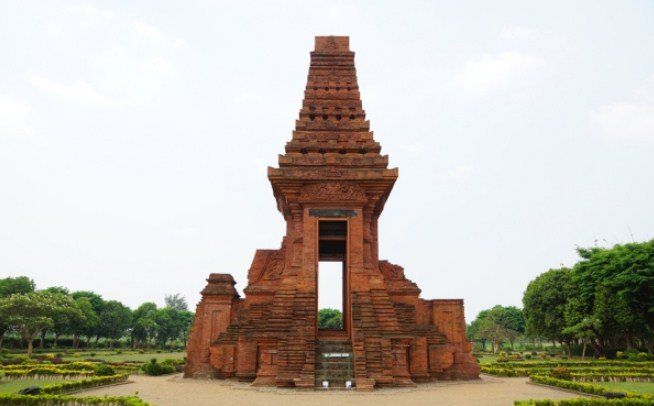

RADAR TULUNGAGUNG – The story of the Majapahit Empire history continues to captivate historians and the public alike, as the ancient kingdom once stood as a dominant maritime force shaping what is now modern Indonesia. Long before Indonesia emerged as the world’s fourth most populous nation, the Majapahit Empire had already laid the foundation for political unity, economic networks, and cultural identity across the archipelago.
The Majapahit Empire history began in East Java, with its capital in Trowulan. Known as a thalassocracy, or sea-based empire, Majapahit controlled vital maritime routes and thrived on trade, making it one of the most influential powers in Southeast Asia at the time.
Its rise was closely linked to the region’s fertile volcanic land and strategic position near the Malacca Strait, a key hub of global commerce connecting China, India, and the Middle East, which enabled Majapahit to dominate regional and international trade networks.
The Rise of a Maritime Power
The foundation of Majapahit cannot be separated from the political turmoil following the fall of Singhasari. Raden Wijaya emerged as a strategic leader, exploiting the arrival of Mongol forces sent by Kublai Khan. After using them to defeat his rival, Wijaya turned against the Mongols and successfully expelled them from Java. This bold maneuver marked the birth of Majapahit, with Wijaya crowned as its first king.
However, the early years of the kingdom were far from stable. Internal conflicts, rebellions, and political intrigue plagued the reign of his successor, Jayanegara. Stability only began to return under the leadership of Tribhuwana Wijayatunggadewi, who strengthened the kingdom’s administration and restored public trust.
Gajah Mada and the Oath That Changed History
A turning point in Majapahit Empire history came with the rise of Gajah Mada, one of the most legendary figures in Indonesian history. Upon becoming Mahapatih (prime minister), he declared the famous Sumpah Palapa, vowing not to enjoy worldly pleasures until he had unified the Nusantara.
Under his leadership and the reign of Hayam Wuruk, Majapahit reached its golden age. The empire expanded across Southeast Asia, with territories spanning Sumatra, the Malay Peninsula, Borneo, Sulawesi, and beyond. This era marked the peak of Majapahit’s political power and cultural influence.
Economic and Cultural Golden Age
Majapahit’s success was not only built on military conquest but also on economic strength. The kingdom became a major trading hub, exporting commodities such as rice, spices, sandalwood, and precious metals. Its maritime dominance was supported by a powerful navy, including massive ships known as “jong.”
Culturally, Majapahit flourished as a center of art, literature, and philosophy. The concept of unity in diversity, later adopted by Indonesia as “Bhinneka Tunggal Ika,” originated from this era. Religious tolerance between Hinduism and Buddhism also contributed to social stability.
The capital city of Trowulan became a cosmopolitan center, attracting traders and scholars from across Asia and even Europe. This openness to external influences strengthened Majapahit’s global connections and reinforced its position as a regional superpower.
The Beginning of Decline
Despite its grandeur, the Majapahit Empire history also reveals the dangers of internal conflict. After the death of Hayam Wuruk, succession disputes weakened the kingdom. The Paregreg civil war drained resources and divided the ruling elite.
At the same time, external pressures grew. The rise of the Malacca Sultanate shifted regional trade dynamics, while Islamic influence spread rapidly across the archipelago. Coastal regions began to break away, reducing Majapahit’s control over key trade routes.
The emergence of the Demak Sultanate further accelerated Majapahit’s decline. By the late 15th century, political fragmentation and economic challenges led to the eventual collapse of the once-mighty empire.
Legacy That Lives On
Although the Majapahit Empire eventually fell, its legacy remains deeply embedded in Indonesia’s national identity. The concept of unity across diverse cultures, the importance of maritime trade, and the need for political stability are lessons drawn from its history.
Today, the Majapahit Empire history is not just a tale of rise and fall, but a reminder of how leadership, diplomacy, and cultural inclusivity can shape a nation’s destiny. As Indonesia continues to grow as a global player, the echoes of Majapahit’s past still resonate in its journey forward.