
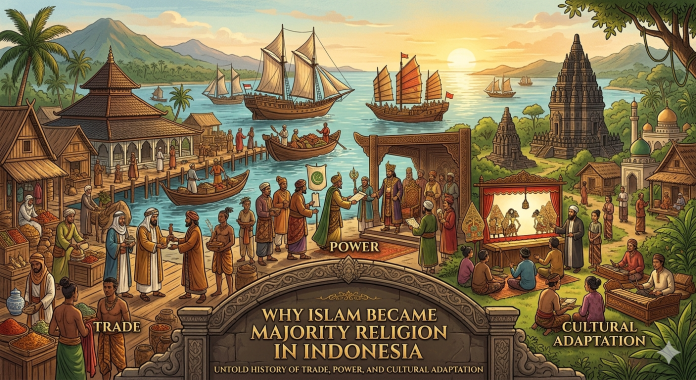

RADAR TULUNGAGUNG – The question of why Islam became majority religion in Indonesia continues to spark curiosity, especially considering the country’s distance from the Middle East, where Islam was first born. Unlike regions geographically close to its origin, Indonesia’s transformation into the world’s largest Muslim-majority nation did not happen through conquest, but through a long and complex historical process.
To understand why Islam became majority religion in Indonesia, it is important to look at how the religion first entered the archipelago. Historians widely agree that Islam arrived through international trade routes, brought by merchants from Arabia, Persia, India, and even China. Over time, these interactions were not only economic but also social, as traders built relationships with local communities and gradually introduced Islamic values.
The spread of Islam accelerated as local rulers began to see both political and economic advantages in adopting the religion. This marked a crucial phase in why Islam became majority religion in Indonesia, as the rise of Islamic kingdoms and the integration of Islamic teachings with local culture made the religion more widely accepted across different layers of society.
Early Arrival Through Trade Networks
To understand why Islam became majority religion in Indonesia, one must trace back to its earliest arrival in the archipelago. Historians suggest Islam entered Nusantara as early as the 7th century through Arab traders, though concrete archaeological evidence, such as the tomb of Fatimah binti Maimun dated 1082 CE, places its presence firmly in the 11th century.
Multiple theories explain its origins, including the Gujarat, Persian, and Mecca theories. However, all agree on one key point: trade played a central role. Muslim merchants from the Middle East and South Asia established commercial ties with coastal kingdoms, particularly in Sumatra. Over time, intermarriage between traders and local populations helped form early Muslim communities.
Another influential factor was China. Muslim communities in southern China, formed through Silk Road interactions, later migrated to Southeast Asia. These communities contributed significantly to the spread of Islam, particularly in Java and Sumatra.
Rise of Islamic Kingdoms
The turning point in why Islam became majority religion in Indonesia came around the 13th century, when Islamic kingdoms began to rise. The Sultanate of Samudra Pasai in Aceh is widely regarded as the first Islamic kingdom in the archipelago. Its strategic location along trade routes allowed it to flourish and influence neighboring regions.
The Malacca Sultanate also played a pivotal role. Founded by Parameswara, later known as Sultan Iskandar Shah after converting to Islam, Malacca became a powerful trading hub and a center for Islamic dissemination. Its close diplomatic ties with China, particularly during the Ming Dynasty expeditions led by Admiral Zheng He, strengthened its position.
Zheng He’s voyages not only boosted trade but also facilitated the establishment of multi-ethnic Muslim communities along Java’s northern coast. These communities later contributed to the rise of the Demak Sultanate, the first Islamic kingdom in Java.
Economic and Political Incentives
Another key reason why Islam became majority religion in Indonesia lies in economic and political benefits. Between the 14th and 17th centuries, Islamic civilizations dominated global trade networks, including the Silk Road and spice routes. For local rulers, converting to Islam meant gaining access to vast international markets and forming alliances with powerful Muslim traders.
This strategic conversion was especially appealing to elites. By adopting Islam, rulers could strengthen their political legitimacy and economic influence. However, this alone did not guarantee widespread acceptance among the general population.
Cultural Adaptation and Spiritual Appeal
Islam’s success in Indonesia cannot be separated from its ability to adapt culturally. Rather than replacing local traditions, Islamic teachings blended with existing beliefs, a process known as acculturation. This approach made Islam more accessible and less disruptive to local societies.
Spiritual storytelling became an effective tool. Islamic values were often introduced through folklore featuring mystical figures, foreign traders with supernatural abilities who married local royalty. These narratives helped shift the concept of divine kingship from Hindu-Buddhist traditions to Islamic frameworks.
Additionally, Islamic preachers incorporated local customs into their teachings. This cultural flexibility resonated with the deeply spiritual nature of Nusantara societies, making Islam more relatable and acceptable.
Limited Religious Push by European Colonizers
When European powers arrived, they did not significantly alter the religious landscape. Unlike the Spanish and Portuguese, who actively spread Catholicism, the Dutch focused primarily on trade and resource exploitation. Their lack of missionary zeal meant Islam continued to grow without major resistance.
A Lasting Legacy
By the time colonialism took hold, Islam was already deeply rooted across the archipelago. Its integration into political systems, economic networks, and cultural practices ensured its continuity. Today, the legacy of these historical processes explains clearly why Islam became majority religion iIndonesia.