
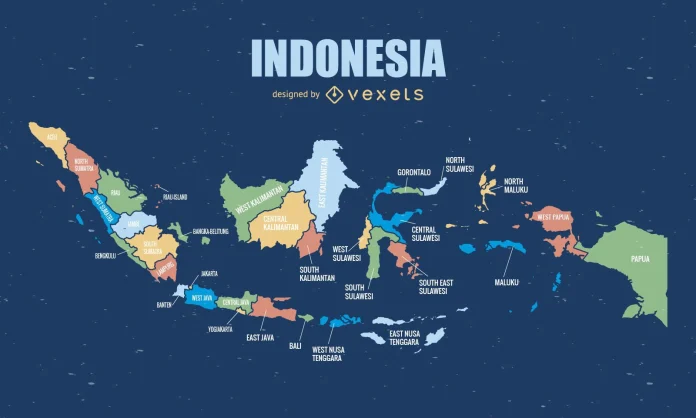

RADAR TULUNGAGUNG – The history of Indonesia is far more complex than most people realize. Long before the rise of kingdoms or the arrival of colonial powers, the Indonesian archipelago was formed through massive geological processes that began millions of years ago. This makes the history of Indonesia not only a story of human civilization, but also of the Earth’s dynamic transformation.
In the early stages of the history of Indonesia, the region was part of a vast supercontinent. Over time, tectonic movements split these landmasses into smaller islands, creating what we now know as Indonesia. These natural processes shaped the geography of the archipelago and continue to influence it today through earthquakes and volcanic activity.
The history of Indonesia also reflects a long journey of human migration and cultural blending. From ancient humans like Pithecanthropus erectus to waves of modern human settlers, the archipelago became home to diverse ethnic groups. This diversity later played a crucial role in forming Indonesia’s identity as a unified nation.
The Birth of the Indonesian Archipelago
Around 65 million years ago, during the Mesozoic era, the Earth’s geography was vastly different. Large landmasses were still connected, forming supercontinents. The region now known as Indonesia was once part of these massive land structures, linked to Eurasia and even distant parts of the globe.
Tectonic activity played a crucial role in shaping the history of Indonesia. Movements of major plates, Indo-Australian, Eurasian, and Pacific, caused land to fracture, fold, and shift. Over time, these processes split the supercontinents into smaller landmasses, eventually forming the islands we recognize today, including Sumatra, Java, Kalimantan, and Sulawesi.
Even today, these tectonic movements continue subtly, evidenced by frequent earthquakes and volcanic activity across the archipelago.
Early Human Presence in Indonesia
Long before recorded civilization, the Indonesian archipelago was inhabited by early humans. One of the earliest known inhabitants was Pithecanthropus erectus, an ancient human species that lived approximately 1.5 to 1.7 million years ago.
These early humans had distinct physical characteristics, such as flat skulls, large jaws, and no chin, yet they walked upright like modern humans. Their presence marks a significant chapter in the early history of Indonesia, showing that the region has been inhabited for millions of years.
Migration of Modern Humans
Around 100,000 years ago, modern humans, or Homo sapiens, began migrating into the archipelago. These groups came in waves, bringing diverse cultures and physical traits.
The Melanesian people were among the earliest arrivals, settling in areas like Papua. They were followed by Austronesian groups, who are believed to have brought advanced seafaring skills and agricultural practices. Later migrations included Malay ethnic groups, adding further diversity to the population.
This continuous influx of different ethnic groups highlights how the history of Indonesia is deeply rooted in cultural diversity, long before the concept of a unified nation emerged.
Influence of Foreign Civilizations
As time progressed, the archipelago became a hub for interaction between various civilizations. Indian influences arrived around the first century, introducing elements of Hinduism and Buddhism. Later, Chinese traders and Arab merchants brought new cultural and economic dynamics.
These interactions laid the foundation for early kingdoms, such as Kutai in the 4th century. The formation of these kingdoms marked a shift from prehistoric societies to organized political structures.
Arrival of Europeans
The next major turning point in the history of Indonesia came with the arrival of European powers. The Portuguese were the first to reach the archipelago in the early 16th century, seeking control over the lucrative spice trade.
They were later followed by the Dutch, who established a long period of colonial rule. This era of colonization significantly shaped Indonesia’s political, economic, and social landscape, leaving lasting impacts that are still felt today.
The Origin of the Name “Indonesia”
Interestingly, the name “Indonesia” itself did not originate locally. It was first introduced by foreign scholars in the 19th century. British and Scottish researchers used the term in academic writings to describe the archipelago.
The name gained wider recognition through scholarly publications and was later adopted by Indonesian nationalists. One of the earliest figures to use it as a political identity was Ki Hajar Dewantara.
The term became even more significant when nationalist leaders like Mohammad Hatta embraced it, transforming “Indonesia” from a geographical label into a symbol of unity and independence.
From Identity to Independence
By the early 20th century, “Indonesia” had evolved into a powerful political identity. The name was used in organizations and movements advocating for independence from colonial rule.
This growing sense of unity culminated in the historic Youth Pledge of 1928, where Indonesians declared one nation, one people, and one language: Indonesia.
Finally, on August 17, 1945, the long journey of the history of Indonesia reached a defining moment when independence was proclaimed, marking the birth of the Republic of Indonesia.