
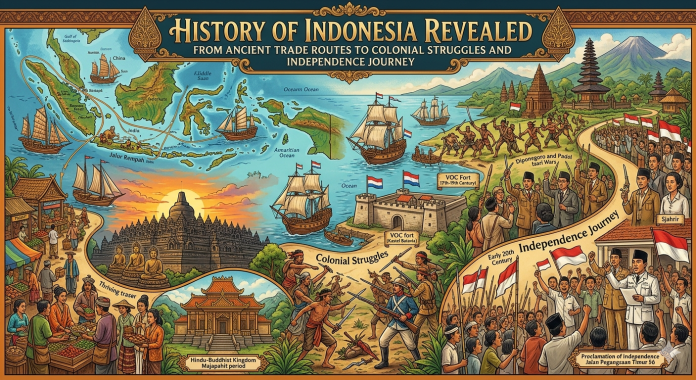

RADAR TULUNGAGUNG – The history of Indonesia is often overshadowed by the global popularity of Bali, a destination widely recognized for its natural beauty and tourism appeal. For many international audiences, Bali has become the face of Indonesia, representing the nation as a whole. However, beyond this single island lies a vast archipelago with thousands of islands, each contributing to a rich and complex historical narrative.
Understanding the history of Indonesia means exploring how diverse regions, cultures, and societies gradually formed a unified nation. From ancient civilizations and early trade networks to powerful kingdoms and foreign influences, Indonesia’s past is shaped by centuries of interaction with the wider world. These dynamics not only influenced culture and religion but also laid the foundation for political and economic systems.
The history of Indonesia also tells a story of resilience and transformation. The archipelago experienced periods of glory under great empires, followed by centuries of colonial domination and struggle. Yet, through resistance, adaptation, and national awakening, Indonesia eventually emerged as an independent nation, marking a significant milestone in its long historical journey.
Early Civilization and Ancient Trade
The history of Indonesia can be traced back tens of thousands of years. Archaeological findings suggest that early human ancestors may have inhabited the region as far back as 1.9 million years ago. Meanwhile, evidence of more modern civilization emerged around 400 BC, marked by trade relations with India and China.
Artifacts discovered in Sumatra, along with inscriptions found in West Java and South Kalimantan, indicate that early Indonesian societies were already engaged in international trade networks. These exchanges did not only involve goods but also ideas, including the spread of Hinduism and Buddhism, which significantly shaped local culture and governance.
The Rise of Powerful Kingdoms
Entering the 7th century, the Sriwijaya Kingdom rose as a dominant maritime power based in Sumatra. Known for its strategic control over trade routes, Sriwijaya expanded its influence across the Malay Peninsula and parts of Java. However, its dominance declined after an invasion by the Chola Kingdom from India in 1025.
Following Sriwijaya’s fall, the Majapahit Kingdom emerged in 1292 as a powerful Hindu empire. It reached its peak during the 13th and 14th centuries, continuing the legacy of trade and regional influence. Majapahit’s decline began after the deaths of key figures such as Gajah Mada in 1364 and King Hayam Wuruk in 1389.
The Spread of Islam and New Powers
As Majapahit weakened, Islamic influence began to grow across the archipelago. Islamic sultanates gradually replaced earlier Hindu-Buddhist kingdoms, becoming new centers of political and economic power. These kingdoms continued thriving through trade, attracting foreign merchants and expanding their reach.
European Arrival and Colonial Era
The history of Indonesia took a dramatic turn with the arrival of European powers in the 16th century. Portuguese and Spanish explorers were the first to reach the region, drawn by the lucrative spice trade in Maluku.
Soon after, the Dutch and British entered the competition. The Dutch, through the Dutch East India Company (VOC), established dominance in the 17th century. Initially focused on trade, the VOC gradually transformed into a colonial power, controlling large parts of the archipelago, especially Java.
After the VOC collapsed due to corruption and financial troubles in 1799, the Dutch government took direct control, forming the Dutch East Indies. During the 19th century, colonial rule intensified, marked by policies such as the forced cultivation system, which required farmers to allocate a portion of their land for export crops like coffee, sugar, and tea.
Resistance and National Awakening
Colonial exploitation sparked resistance among Indonesians. One notable conflict was the Java War (1825–1830), led by Prince Diponegoro. Although the Dutch emerged victorious, resistance movements continued to grow.
In the early 20th century, the Dutch introduced the Ethical Policy, aimed at improving welfare through education and limited political reform. While this policy opened opportunities for some Indonesians, it also fueled a sense of nationalism among the educated class.
Japanese Occupation and Independence
During World War II, Japan occupied Indonesia, ending Dutch rule temporarily. Unlike previous colonizers, Japan involved Indonesians in administrative roles and supported nationalist movements, albeit for strategic purposes.
As Japan faced defeat, it promised independence to Indonesia. On August 17, 1945, Sukarno and Mohammad Hatta proclaimed independence, marking a crucial moment in the history of Indonesia.
However, independence did not come easily. The Dutch attempted to reassert control, leading to years of conflict. International pressure, particularly from the United States, eventually forced the Netherlands to recognize Indonesia’s sovereignty in 1949.
Modern Indonesia
After independence, Indonesia experienced political shifts, from parliamentary democracy to Sukarno’s guided democracy, and later the New Order era under Suharto. Since 1999, Indonesia has transitioned into a democratic nation.
Today, with a population of over 270 million people, Indonesia continues to grow as a diverse and dynamic country. Its long and complex history remains a testament to resilience, unity, and transformation.