

RADAR TULUNGAGUNG -The story of the Majapahit Empire origins begins with chaos and collapse in the late 13th century, when one of the most powerful kingdoms in the Nusantara suddenly fell. Singasari, once a dominant force controlling trade routes and regional influence, collapsed rapidly due to internal weakness and external rebellion. This dramatic turning point opened the door for a new power to rise.
In the midst of this turmoil, the Majapahit Empire origins took shape through the actions of a young noble, Raden Wijaya. As the rightful heir of Singasari, he did not choose direct confrontation after the fall of his kingdom. Instead, he developed a calculated strategy that would later reshape the political landscape of Java and surrounding regions.
What makes the Majapahit Empire origins truly remarkable is not just the fall of an old kingdom, but the rise of a new empire built on intelligence, patience, and tactical brilliance. From fleeing into exile to manipulating foreign forces like the Mongol army, Raden Wijaya turned impossible odds into a historic victory that would shape the future of the Nusantara.
The Fall of Singasari Kingdom
In the 13th century, Singasari stood as a major power in the Nusantara, expanding its influence through a mandala system and controlling key trade routes. Under King Kertanegara, the kingdom aimed to unify the archipelago. However, this ambition led to a dangerous oversight—neglecting internal stability.
This weakness was exploited by Jayakatwang of Kediri, who launched a rebellion driven by historical revenge. At the time, Singasari’s main military forces were deployed outside Java, leaving the capital vulnerable.
Jayakatwang executed a calculated two-sided attack. A smaller force advanced from the north as a diversion, while the main army struck from the south, targeting the royal palace. The strategy succeeded. The palace fell quickly, and Kertanegara was killed, marking the end of Singasari’s rule.
Raden Wijaya’s Escape and Strategic Retreat
Amid the chaos, Raden Wijaya managed to escape. As Kertanegara’s son-in-law and heir, his survival became a crucial turning point in the Majapahit Empire origins.
He fled to Madura and sought help from Arya Wiraraja, who advised him to temporarily submit to Jayakatwang. Following this advice, Raden Wijaya gained the trust of the new ruler and was granted land in a forest area called Tarik.
Rather than seeing it as exile, he used the opportunity to build a new settlement. The area was rich with bitter maja fruit, which inspired the name Majapahit. This marked the beginning of a quiet but strategic rise.
Building Strength in Majapahit
While outwardly living a peaceful life, Raden Wijaya quietly consolidated power. Former Singasari soldiers, who had gone into hiding or served under Kediri, gradually joined him. This growing force laid the foundation for a future uprising.
The timing of his next move proved crucial. In 1293, a massive Mongol fleet arrived in Java. The invasion was ordered by Kublai Khan in response to Kertanegara’s earlier insult toward Mongol envoys. However, by the time they arrived, Kertanegara was already dead.
Recognizing the opportunity, Raden Wijaya approached the Mongols with a proposal: assist him in defeating Jayakatwang. The Mongols agreed, unaware of his long-term intentions.
The Fall of Kediri
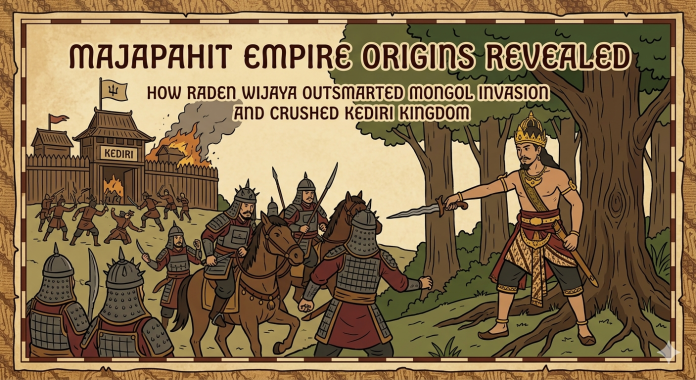
The combined forces launched a coordinated attack on Kediri. The Mongol army attacked from multiple directions, while Raden Wijaya led his troops through forest routes to strike the palace from behind.
This three-sided assault overwhelmed Kediri’s defenses. Jayakatwang was captured and executed, bringing an end to his rule. The Mongols believed their mission was complete and that Java was now under their influence.
Outsmarting the Mongols
However, Raden Wijaya had no intention of submitting to Mongol control. He returned to Majapahit under the pretext of preparing tribute, but instead organized a counterattack.
Using guerrilla tactics, his forces launched surprise attacks and lured Mongol troops into dense forests. The unfamiliar terrain disrupted Mongol formations, which were designed for open-field combat.
Unable to adapt to the environment, the Mongol forces suffered heavy losses and eventually withdrew from Java. This marked a decisive victory for Raden Wijaya.
The Birth of Majapahit Empire
With Kediri defeated and the Mongols expelled, Raden Wijaya secured full control. In 1293, he officially established the Majapahit Kingdom and became its first ruler.
The Majapahit Empire origins reflect a combination of intelligence, patience, and strategic execution. From a small forest settlement, Majapahit would grow into one of the greatest empires in Southeast Asian history, shaping the future of the Nusantara for generations.