
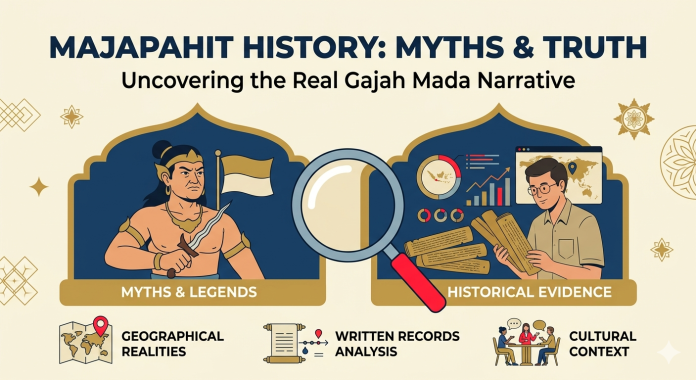

RADAR TULUNGAGUNG – The discussion surrounding Majapahit history hoax continues to attract public attention, especially as misleading narratives about the kingdom resurface in digital spaces. From claims that Gajah Mada had a different identity to suggestions that Majapahit was actually a sultanate, such stories have spread widely. However, historians warn that these claims often stem from weak or misinterpreted sources.
Understanding the Majapahit history hoax requires a closer look at how historical truth is constructed. Experts emphasize that history is not merely a collection of stories but a discipline grounded in verified sources. Without proper source criticism, misinformation can easily be mistaken for fact.
In recent years, viral content has fueled confusion about Majapahit. Some narratives even trace back to older texts like the Babad Tanah Jawi (Chronicle of Java), which contains stories such as Gajah Mada living in the same era as Raden Patah or the fall of Majapahit caused by a family conflict. These accounts, while popular, are not always historically reliable.
Understanding Historical Sources
To separate fact from fiction, historians rely on source classification. Historical sources are broadly divided into primary and secondary categories. Primary sources are considered the most reliable because they are created by eyewitnesses or individuals directly involved in events.
In the context of Majapahit, inscriptions serve as key primary sources. These stone-carved records were issued by rulers or officials during their lifetime, making them highly credible. One example is the Sukamerta Inscription from 1296, which documents administrative decisions during the reign of the kingdom’s first ruler.
Another crucial primary source is the Negarakertagama, written by Mpu Prapanca in 1365. As a court insider, Prapanca documented the golden age of Majapahit under King Hayam Wuruk. His work includes detailed accounts of royal life, territorial administration, and religious practices, offering a firsthand perspective on the empire.
Secondary Sources and Their Limitations
Secondary sources, on the other hand, are written after the events and often rely on earlier materials. While useful, they are less reliable and should not be treated as definitive evidence.
One example is the Pararaton, written more than a century after Majapahit’s peak. Although it provides genealogical information about kings, historians consider it supplementary rather than authoritative.
The Chronicle of Java presents an even greater challenge. Written approximately 250 years after Majapahit’s collapse, it reflects a different cultural and religious context. Its narratives often blend mythology, legend, and political motives, making it a weak source for reconstructing Majapahit history.
Why Historical Hoaxes Spread
The persistence of the Majapahit history hoax is closely linked to how sources are used without critical evaluation. Many readers accept stories at face value without questioning their origin, purpose, or reliability.
Historians recommend applying the 5W+1H method—What, Who, When, Where, Why, and How, to assess any historical claim. By examining who wrote a source, when it was created, and for what purpose, it becomes easier to identify potential bias or inaccuracies.
For instance, inscriptions often include sapatha or curses against those who violate their contents. This cultural context made forgery highly unlikely. Meanwhile, the Negarakertagama was written as a spiritual text, not a political tool, reducing the likelihood of deliberate distortion.
In contrast, the Chronicle of Java appears to carry political intentions. It attempts to both diminish Majapahit’s legacy and link later kingdoms to its lineage. This contradiction highlights the importance of understanding the motives behind historical writing.
Becoming a Critical Reader of History
The debate over Majapahit is a reminder that history must be approached critically. Not all widely circulated stories are true, and not all written sources hold equal value.
By prioritizing primary sources and carefully evaluating secondary ones, readers can avoid falling into the trap of historical hoaxes. The goal is not only to preserve accurate knowledge but also to build a deeper understanding of Indonesia’s past.
As misinformation continues to spread online, the responsibility to verify historical claims lies not only with scholars but also with the public. Recognizing a Majapahit history hoax is the first step toward preserving the integrity of history itself.