
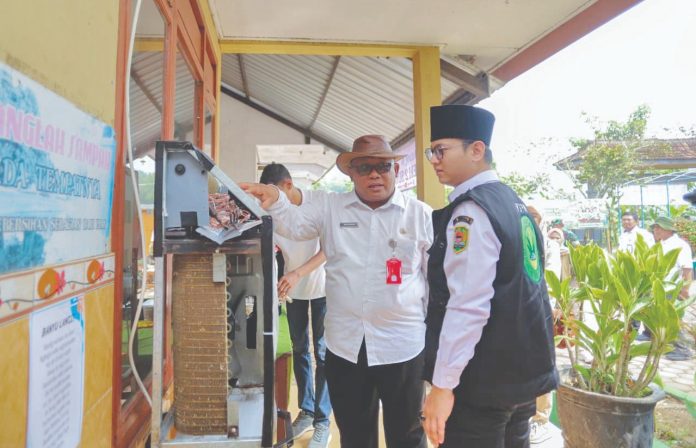

TRENGGALEK – Trenggalek government has introduced condensation technology to help drought-prone villages produce clean water from air.
The innovation aims to reduce dependence on emergency water aid during the dry season. Officials hope residents can create their own water supply for daily needs.
The system captures cold vapor in the air and turns it into usable water. Regent Mochamad Nur Arifin, known as Mas Ipin, introduced the technology during a visit to SDN 2 Sukorejo in Gandusari District on Wednesday, April 22.
Mas Ipin said water availability is one of the main factors in protecting food security. This is especially important in rural areas where farming depends on stable water supplies.
“If we talk about food security, one of the biggest factors is water availability. Meanwhile, the natural water cycle continues to decline,” he said.
He explained that forest loss and damaged underground water storage have weakened the natural water cycle. As a result, drought risks become more serious each year.
To answer this problem, the Trenggalek administration started developing condensation technology. The system collects moisture from cold air and converts it into water for public use.
“This innovation is expected to help people produce their own water. They should not depend only on aid distribution,” he added.
Data from Indonesia’s Meteorology, Climatology, and Geophysics Agency (BMKG) shows high drought potential this year.
Every dry season, around 92 to 100 villages in Trenggalek face clean water shortages. This problem affects thousands of residents across the regency.
The condition forces the Regional Disaster Management Agency (BPBD) to deliver clean water every day. In many cases, delays happen because demand is too high.
“For years, BPBD has had to go back and forth delivering water. With this technology, we want people to have an independent solution,” Mas Ipin said.
The local government has also changed its spending priorities. It now focuses more on long-term investment in sustainable technology.
Officials believe this approach is more effective than relying only on emergency response. It can also reduce costs in the future.
At present, the condensation system still uses electricity as its main power source. However, the government plans to switch to solar energy later.
This change will lower operational costs and improve environmental sustainability. It will also make the technology more suitable for remote villages.
The administration hopes more drought-prone villages can use this system in the future. Officials want wider implementation across Trenggalek.
Mas Ipin said the program shows the government’s real effort to face climate change. It also supports long-term water security for local communities.
“This is part of our real commitment to facing climate change and ensuring sustainable water access for residents,” he said.
If expanded successfully, the technology could become a new model for rural water security in East Java. It may help many villages with seasonal drought and limited clean water access.