
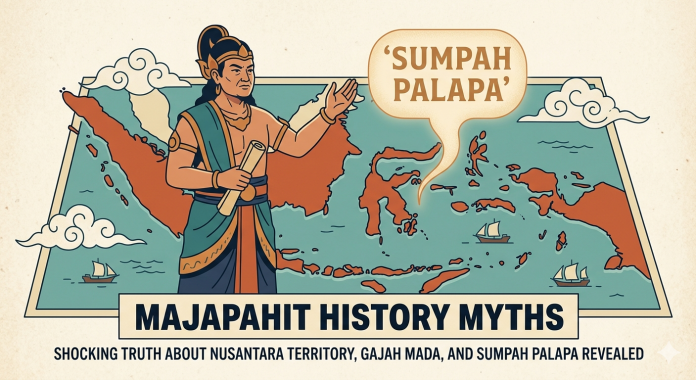

RADAR TULUNGAGUNG – The grandeur of the Majapahit Empire has long been celebrated as a symbol of Indonesia’s past glory. Known to have existed between 1293 and 1527, the empire is often portrayed as one of the most powerful kingdoms in Asia. However, recent discussions based on historical reinterpretation suggest that several widely believed narratives about Majapahit may not be entirely accurate.
These revelations challenge popular assumptions about the kingdom’s territorial reach, the figure of Gajah Mada, and the meaning of the famous Sumpah Palapa. The findings are gaining attention as historians attempt to separate myth from historical fact.
The Myth of Majapahit’s Vast Territory
One of the most enduring beliefs is that Majapahit controlled a vast territory stretching from Sabang to Merauke, including regions such as Malaysia, Singapore, Brunei, Thailand, Vietnam, and parts of the Philippines. This claim has often been linked to the concept of “Nusantara,” which is frequently interpreted as the empire’s political domain.
However, historians argue that this interpretation is misleading. The term “Nusantara” does not necessarily refer to territories under Majapahit’s direct rule. Instead, it describes regions outside the core kingdom that maintained trade relations or diplomatic ties.
Historical evidence supports this reinterpretation. Archaeological findings such as temples and inscriptions linked to Majapahit are predominantly located in Java, Madura, and Bali. This suggests that the empire’s actual political control was more limited than commonly believed.
Some experts even point out that the Srivijaya Kingdom may have had a broader sphere of influence, given that its artifacts have been discovered across multiple countries, including Thailand, India, and China.
The Controversial Face of Gajah Mada
Another widely accepted narrative involves the physical depiction of Gajah Mada, the influential military leader and prime minister of Majapahit. His image is commonly recognized in textbooks and public monuments across Indonesia.
Surprisingly, this familiar face is not based on historical evidence. It was created by Muhammad Yamin, a prominent historian and former minister during the era of Sukarno.
Yamin’s illustration of Gajah Mada was purely imaginative. Observers have noted that the depiction bears a striking resemblance to Yamin himself. Despite this, the image has been widely adopted and treated as an authentic representation.
Historians warn that this could lead to historical distortion. Without clear labeling, many people may assume the image is based on factual evidence. Scholars have suggested that such illustrations should be explicitly described as artistic interpretations rather than historical facts.
Rethinking the Meaning of Sumpah Palapa
The Sumpah Palapa is often interpreted as Gajah Mada’s vow to conquer the entire Nusantara region. This interpretation has shaped the narrative of Majapahit as an expansionist empire driven by military conquest.
However, a closer reading of historical texts suggests a different meaning. Instead of a pledge to conquer, the oath may have been intended as a commitment to unite the archipelago through alliances and cooperation.
The misunderstanding of this oath had significant consequences. It contributed to conflicts such as the Bubat War in 1357. The war, which involved the Sunda Kingdom, is often seen as a tragic result of misinterpretation and political tension.
The legacy of the Bubat War also gave rise to cultural myths, including the belief that Sundanese women should not marry Javanese men. While such ideas persist in some communities, they are widely regarded as myths rather than historical facts.
A Call for Historical Re-evaluation
These revelations highlight the importance of critical thinking in understanding history. The story of the Majapahit Empire remains a vital part of Indonesia’s identity, but it is equally important to distinguish between myth and evidence.
Historians and researchers continue to call for deeper archaeological studies and more accurate interpretations of historical sources. By doing so, they hope to provide a clearer picture of Majapahit’s true influence and legacy.
As new findings emerge, long-held beliefs may continue to be challenged. For now, the debate serves as a reminder that history is not static, it evolves with every new discovery.