
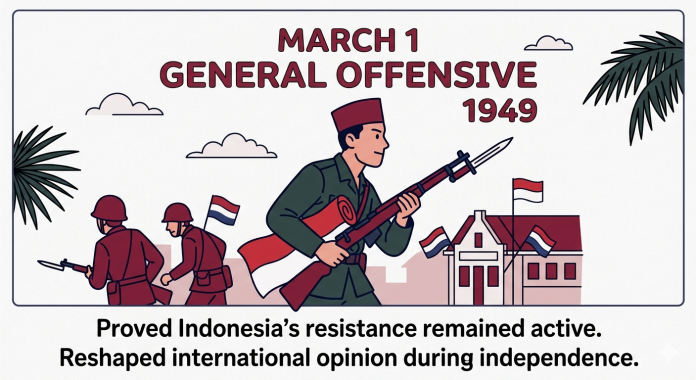

RADAR TULUNGAGUNG – The March 1 General Offensive 1949 remains one of the most significant military operations in Indonesia’s struggle for independence, helping prove to the international community that the Republic of Indonesia and the TNI were still active despite Dutch claims to the contrary. More than seven decades later, historians continue to debate who first initiated the operation that became a turning point in the diplomatic battle for sovereignty.
Following the Dutch military offensive of December 19, 1948, known in Indonesia as the Second Dutch Military Aggression, Dutch forces captured Yogyakarta, then the capital of the Republic. President Sukarno, Vice President Mohammad Hatta, and several senior leaders were arrested and exiled to Bangka Island.
The Dutch occupation triggered an international propaganda campaign portraying the Republic of Indonesia as effectively defeated. Dutch authorities argued that both the Indonesian government and the TNI had ceased to function, creating challenges for Indonesian diplomatic representatives who were seeking support at the United Nations.
Sultan’s Proposal and the Planning of the Offensive
According to accounts later provided by Sri Sultan Hamengkubuwono IX, the idea of launching a major offensive emerged after he learned that the United Nations Security Council would soon discuss the Indonesian situation in early 1949.
The Sultan believed a bold military action could demonstrate that Indonesian resistance remained alive while boosting public morale under Dutch occupation. Historical testimonies indicate that he communicated the proposal to General Sudirman, who reportedly supported the idea and instructed military commanders in the region to prepare an operation.
A meeting between Hamengkubuwono IX and Lieutenant Colonel Soeharto on February 14, 1949, helped advance planning for the attack. The operation was initially scheduled for February 28 but was postponed to March 1 after concerns that the plan had been compromised.
Competing Historical Narratives Over the Initiator
While Hamengkubuwono IX maintained that he proposed the offensive, other historical sources present different interpretations.
Several military testimonies and archival documents point to the involvement of Colonel Bambang Sugeng, then Military Governor of the region covering Surakarta and Yogyakarta. Historians have cited military orders signed by Bambang Sugeng instructing Soeharto to prepare a large-scale attack on the capital.
These records have fueled a long-running debate over who deserves credit for initiating the operation. Some scholars argue the offensive resulted from collective planning among military and civilian leaders, including Hamengkubuwono IX, General Sudirman, Bambang Sugeng, and regional commanders. Others highlight Soeharto’s role in developing and executing the operational plan.
The controversy intensified during the New Order era when official state narratives and educational materials increasingly portrayed Soeharto as both the initiator and commander of the offensive. The 1979 film Janur Kuning further reinforced that interpretation by emphasizing his leadership role.
Six Hours That Changed International Perceptions
The offensive began at approximately 6 a.m. on March 1, 1949. Indonesian forces launched coordinated attacks from multiple directions across Yogyakarta, targeting Dutch military positions throughout the city.
As commander of Brigade 10 and Wehrkreise III, Soeharto led operations in the western sector. Other officers commanded attacks in the northern, eastern, southern, and central sectors, while additional TNI units outside Yogyakarta engaged Dutch forces to slow reinforcements.
For around six hours, Indonesian troops successfully controlled large parts of the city before withdrawing shortly before noon as Dutch reinforcements approached.
One of the operation’s most significant achievements was its impact on international opinion. Journalists and foreign observers in Yogyakarta witnessed Indonesian forces operating openly in the city, directly contradicting Dutch claims that the Republic and the TNI no longer existed.
Reports of the offensive spread through radio broadcasts and international media coverage, helping strengthen Indonesia’s diplomatic position at the United Nations.
The growing international pressure that followed contributed to renewed negotiations between the Netherlands and the Republic of Indonesia. Those diplomatic efforts ultimately culminated in the Round Table Conference in The Hague in 1949, where the Dutch agreed to transfer sovereignty to Indonesia.
The March 1 General Offensive 1949 therefore stands not only as a military success but also as a crucial diplomatic victory. Although historians continue to debate who first conceived the operation, there is broad agreement that the offensive helped convince the world that Indonesia’s independence movement remained active and determined to achieve full sovereignty.