
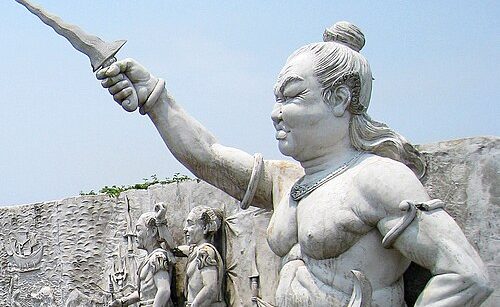

RADAR TULUNGAGUNG – The story of Gajah Mada and the Sumpah Palapa stands as one of the most compelling chapters in Indonesian history. As the key architect behind the rise of the Majapahit Empire, Gajah Mada boldly pursued his vision to unite Nusantara under one rule. Behind that legendary oath lies a story filled with mystery, political strategy, and a tragic ending.
Gajah Mada made history when he declared the Sumpah Palapa after Queen Tribhuwana Tunggadewi appointed him as Mahapatih. Through this oath, he vowed to refrain from worldly pleasures until he conquered regions across Nusantara. This declaration did not only reflect ambition, it signaled the start of Majapahit’s transformation into a dominant regional power.
Historians still debate Gajah Mada’s origins. No primary sources clearly explain his birth, which leaves room for multiple interpretations. Some stories describe him as a divine figure, while others portray him as a man from humble beginnings. These conflicting accounts continue to shape the mystery surrounding his early life.
The Rise of Gajah Mada in Majapahit
Gajah Mada built his reputation during the reign of King Jayanegara. He proved his loyalty by defeating the Ra Kuti rebellion and securing the king’s safety. Because of this achievement, the king appointed him as Patih of Kahuripan.
He did not stop there. Gajah Mada strengthened his influence through discipline, intelligence, and strategic thinking. He later took on the role of Patih of Daha before rising to the position of Mahapatih. During his inauguration, he confidently delivered the Sumpah Palapa and declared his mission to unite Nusantara.
Many court elites initially doubted him. However, Gajah Mada quickly silenced critics through real action. He led military campaigns across Sumatra, Bali, and other strategic regions. By combining naval and land forces, he expanded Majapahit’s control over key trade routes and political territories.
Expansion and the Golden Age of Majapahit
Gajah Mada pushed Majapahit to its peak. He launched a major campaign in Sumatra and later led a successful invasion of Bali in 1343. Over the next two decades, he continued expanding Majapahit’s influence across Nusantara, including parts of Kalimantan, Sulawesi, and even Tumasik.
His leadership turned Majapahit into a powerful maritime empire. Trade flourished, political influence grew stronger, and the kingdom gained recognition across the region. Through consistent strategy and bold decisions, Gajah Mada fulfilled much of his Sumpah Palapa.
Yet, his relentless ambition also set the stage for his downfall.
The Bubat Tragedy That Changed Everything
The turning point came in 1357 during the Bubat tragedy. King Hayam Wuruk planned to strengthen alliances by marrying Princess Dyah Pitaloka from the Sunda Kingdom. He intended to build unity through diplomacy.
Gajah Mada interpreted the situation differently. He saw the arrival of the Sunda royal entourage as a sign of submission. Acting on that assumption, he ordered his troops to confront them and demanded their surrender.
This decision triggered a deadly conflict. The Sunda forces resisted, but Majapahit troops overwhelmed them. King Lingga Buana and many members of the Sunda royal family died in the battle. Princess Dyah Pitaloka chose to end her life rather than accept humiliation.
The tragedy shocked the kingdom. It damaged diplomatic relations and created long-lasting tension between regions. More importantly, it shattered trust within Majapahit’s leadership.
The Fall of Gajah Mada
King Hayam Wuruk reacted with deep disappointment. He removed Gajah Mada from his position as Mahapatih, effectively ending his political career. Although the king still appreciated his past contributions and granted him land, Gajah Mada lost his influence in the court.
After his dismissal, Gajah Mada withdrew from public life. Historical records offer no clear account of his final days. Some sources claim he died in seclusion, while others suggest he achieved moksha according to Hindu belief.
Despite the uncertainty, his legacy remains powerful. Gajah Mada’s Sumpah Palapa continues to inspire the idea of unity across Indonesia. At the same time, his story reminds us that ambition without restraint can lead to irreversible consequences.