
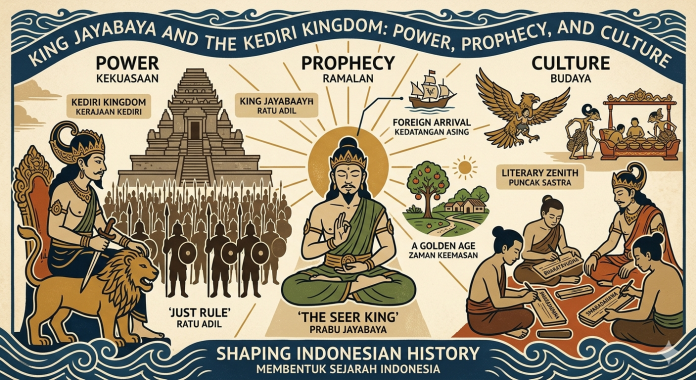

RADAR TULUNGAGUNG – The history of the Kediri Kingdom remains one of the most fascinating chapters in Indonesian civilization. Known for its powerful kings, vast territory, and legendary prophecies, the Kediri Kingdom once controlled most of Java and parts of Sumatra. Among its rulers, King Jayabaya became the most famous figure because of his leadership and predictions that many people still discuss today.
The origins of the Kediri Kingdom began after the reign of King Airlangga, the ruler of the Medang Kamulan Kingdom. To prevent conflict between his two sons, Airlangga divided his kingdom into two regions in 1041. The western territory became Panjalu or Kediri, while the eastern territory became Jenggala. This division later triggered decades of war between the two kingdoms.
The Kediri Kingdom eventually emerged as the strongest power in Java. Historical records from inscriptions, temples, and ancient literature describe how Kediri expanded its influence and became a major political and cultural center in the archipelago. The kingdom stood from 1045 until its collapse in 1222 after the rise of Tumapel or Singhasari.
The Beginning of Kediri Kingdom
Sri Samarawijaya became the first king of Kediri after the division of Airlangga’s kingdom. He ruled the western region with the capital located in Daha. However, his reign remains mysterious because historians found very few inscriptions from that period.
Conflict between Kediri and Jenggala continued for around 60 years. Although Jenggala initially gained several victories, Kediri eventually unified Airlangga’s former territories under its control. This success transformed Kediri into one of the most dominant kingdoms in Nusantara.
Ancient literary works also played an important role during this era. The famous Kakawin Bharatayudha, written by Mpu Sedah and Mpu Panuluh, celebrated Kediri’s victory over Jenggala. The work later became one of the greatest literary achievements in Javanese history.
The Golden Age Under King Jayabaya
The most glorious period of the Kediri Kingdom happened during the reign of King Jayabaya between 1135 and 1157. Historians describe Jayabaya as a wise ruler who successfully united the kingdom and expanded its political influence.
During his leadership, agriculture and trade developed rapidly. Economic stability improved the welfare of the people, while Kediri’s power extended across Java and parts of Sumatra. Several inscriptions from Jayabaya’s era, including the Hantang Inscription and Jepun Inscription, confirmed the kingdom’s prosperity.
Jayabaya also became legendary because of his prophecies, widely known as Jangka Jayabaya. Many Indonesians believe several of his predictions match modern events and technological developments. This belief strengthened Jayabaya’s image as one of the most mystical rulers in Javanese history.
According to ancient stories, Jayabaya disappeared mysteriously through moksa, a spiritual process where a person vanishes without leaving a physical body behind. Before disappearing, he reportedly removed his royal clothes and crown near Menang Village in Kediri.
The Kings Who Continued Kediri’s Legacy
After Jayabaya, several rulers continued governing the Kediri Kingdom. Sri Sarweswara became known as a religious and cultural king who strongly upheld spiritual teachings. His philosophy emphasized harmony and unity among humans.
Sri Aryeswara later ruled the kingdom, although historical records about his reign remain limited. The next ruler, Sri Gandra, appeared in inscriptions that described his efforts to fulfill the wishes of local communities and improve royal administration.
Sri Kameswara then led Kediri during another important cultural period. Literature flourished under his rule, including the famous Kakawin Smaradahana written by Mpu Dharmaja. The story inspired many later Javanese legends, including the Panji tales that spread throughout Southeast Asia.
The Fall of Kediri Kingdom
The final ruler of Kediri was King Kertajaya, who reigned from 1194 until 1222. During his reign, tensions grew between the royal court and the Brahmins. Historical sources explained that Kertajaya attempted to reduce the influence of the Brahmins and demanded worship similar to a god.
The Brahmins rejected his policies and sought protection from Ken Arok, the leader of Tumapel. This alliance triggered a major war between Kediri and Tumapel in 1222.
The decisive battle took place near Ganter. Ken Arok’s forces defeated Kediri’s army, marking the end of the Kediri Kingdom and the rise of the Singhasari Kingdom. Kertajaya reportedly escaped from the battlefield, but his fate remains unknown.
Even after its collapse, the Kediri Kingdom left an extraordinary legacy through inscriptions, temples, literature, and cultural traditions that still influence Indonesian history today.