
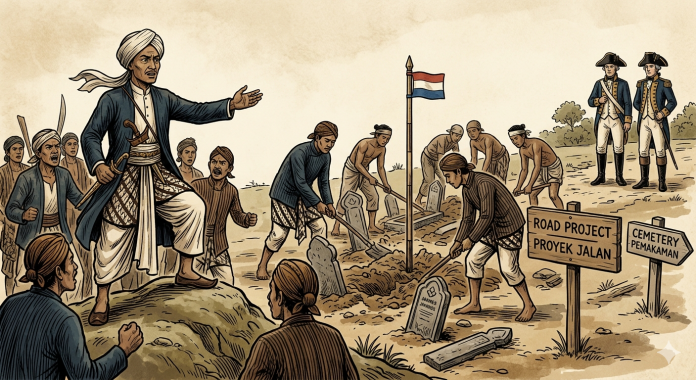

RADAR TULUNGAGUNG – Diponegoro War remains one of the most devastating and defining conflicts in Indonesian history, triggered by what seemed like a simple infrastructure project but quickly escalated into a full-scale rebellion against Dutch colonial rule.
Born in Yogyakarta on November 11, 1785, Prince Diponegoro, originally named Bendoro Raden Mas Mustahar, grew up during a period of increasing Dutch interference in Javanese royal affairs. Despite being of royal blood, he chose a modest life in Tegalrejo, where he was deeply influenced by Islamic teachings and close interaction with common people. This background would later shape his resistance against colonial injustice.
The roots of the Diponegoro War can be traced to long-standing tensions between the Dutch colonial government and the Javanese aristocracy. The Dutch not only imposed heavy taxes and forced labor on the people but also interfered in palace traditions, undermining the dignity of the Yogyakarta Sultanate. Their policies created widespread resentment among both elites and ordinary citizens.
A Symbolic Act That Ignited War
The breaking point came in July 1825. Dutch authorities initiated a road construction project that crossed Diponegoro’s land in Tegalrejo. Worse, the project placed boundary markers over the graves of his ancestors, an act seen as deeply disrespectful in Javanese culture.
In response, Diponegoro removed the markers and replaced them with spears, a powerful symbolic declaration of war. This act marked the beginning of the Diponegoro War, also known as the Java War.
When summoned by the Dutch to explain his actions, Diponegoro refused. On July 21, 1825, Dutch troops attacked Tegalrejo, forcing him to retreat and begin organizing resistance from Selarong, Bantul. From there, he mobilized a diverse coalition of supporters, including nobles, ulama, peasants, and santri.
Guerrilla Warfare Against a Modern Army
Despite being armed mostly with traditional weapons such as spears and kris, Diponegoro’s forces demonstrated remarkable strategic skill. They launched coordinated attacks across key routes in Yogyakarta, aiming to isolate Dutch positions and disrupt supply lines.
On August 7, 1825, a large-scale assault shocked Dutch forces, who were unprepared for such organized resistance. Although Diponegoro failed to capture the Yogyakarta Palace, the attack proved that the rebellion was far from ordinary.
Facing a technologically superior enemy equipped with firearms and artillery, Diponegoro adopted guerrilla warfare tactics. His troops would strike quickly, seize supplies, and disappear into forests, making it difficult for the Dutch to track them.
The Dutch responded by implementing a “benteng stelsel” strategy, building hundreds of small forts across Central and East Java to limit Diponegoro’s movements. By 1830, at least 258 forts had been constructed, gradually tightening the noose around his forces.
Massive Losses on Both Sides
The Diponegoro War lasted five years and resulted in staggering casualties. Historical estimates suggest that around 200,000 to 500,000 Javanese people died, while Dutch forces lost approximately 13,000 soldiers. Financially, the war drained the Dutch treasury, costing millions of guilders.
Unable to secure victory through military means alone, the Dutch resorted to diplomacy. They invited Diponegoro to negotiate peace, offering what appeared to be a genuine attempt at resolution.
Betrayal and Capture
On March 28, 1830, Diponegoro attended a meeting with Dutch General Hendrik Merkus de Kock in Magelang. Believing it to be a diplomatic discussion following the end of Ramadan, he arrived with peaceful intentions.
However, the meeting turned into a trap. Dutch forces arrested Diponegoro on the spot, disarmed him, and exiled him far from Java. He was eventually sent to Makassar, where he spent the remainder of his life in captivity.
Diponegoro died on January 8, 1855, at the age of 69. During his exile, he wrote his memoirs, later known as Babad Diponegoro, which remain a crucial historical source.
Legacy of Resistance
The Diponegoro War is widely regarded as the largest and deadliest conflict in Java during the colonial era. More than just a military struggle, it symbolized resistance against injustice, cultural humiliation, and foreign domination.
Prince Diponegoro’s decision to reject royal privilege and fight alongside the people cemented his status as a national hero. His legacy continues to inspire generations in Indonesia’s ongoing journey toward justice and sovereignty.