
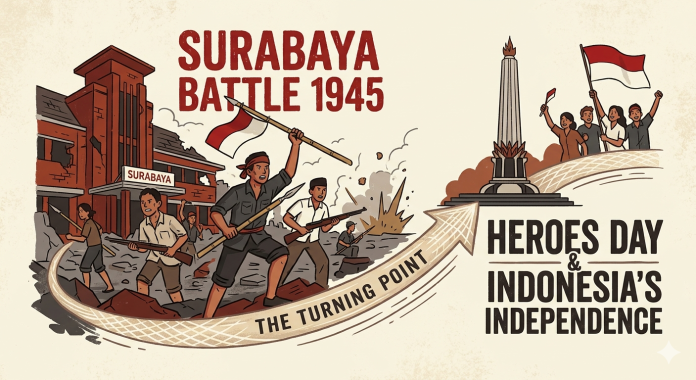

RADAR TULUNGAGUNG – Surabaya Battle 1945 stands as one of the most defining moments in Indonesia’s struggle to defend its independence. Commemorated every November 10 as Heroes Day, this historic event reflects extraordinary courage and sacrifice. However, the full story behind the Surabaya Battle 1945 reveals a complex chain of events that ignited one of the fiercest urban battles in Southeast Asian history.
The Surabaya Battle 1945 was not just a military confrontation but also a turning point that shaped Indonesia’s national identity. The bravery of Surabaya’s people, especially the youth, demonstrated a powerful spirit of resistance that continues to inspire generations today.
In the early days following independence, Indonesia faced serious threats from foreign powers attempting to reclaim control. The Surabaya Battle 1945 became the clearest example of how far Indonesians were willing to go to protect their sovereignty, even when facing a far more advanced military force.
Hotel Yamato Incident Ignites Resistance
The first major spark of the Surabaya Battle 1945 came from the Hotel Yamato incident on September 18, 1945. Dutch forces raised their flag on top of the hotel, provoking anger among Indonesians who saw it as a direct insult to their independence.
Crowds gathered and demanded the flag be removed. When negotiations failed, violence erupted. In a dramatic act of defiance, Indonesian fighters climbed the building, tore off the blue section of the Dutch flag, and raised the red-and-white Indonesian flag. This moment became a powerful symbol of resistance and marked the beginning of widespread conflict in Surabaya
Allied Arrival and Escalating Conflict
The situation intensified when Allied troops under British command arrived in Surabaya on October 25, 1945. Officially, their mission was to disarm Japanese soldiers and free prisoners of war. However, their cooperation with Dutch forces raised suspicion among Indonesians.
The Surabaya Battle 1945 escalated as local fighters, many armed with weapons seized from Japanese forces, began confronting the Allies. Surprisingly, Indonesian forces managed to win early clashes, boosting their confidence and strengthening their determination to resist.
Ultimatum and Rising Tension
The conflict reached a critical point when the Allies issued an ultimatum demanding Indonesians surrender their weapons within 48 hours. Instead of complying, the people of Surabaya rejected the demand, showing their unwavering resolve in the Surabaya Battle 1945.
President Soekarno attempted to mediate the situation by negotiating with British commander Brigadier General A.W.S. Mallaby. Although a ceasefire agreement was reached, it quickly collapsed due to ongoing mistrust and tensions on both sides.
The death of General Mallaby on October 30, 1945, became a turning point. His killing triggered anger among Allied forces and led to preparations for a large-scale military retaliation.
November 10: The Peak of Battle
The climax of the Surabaya Battle 1945 occurred on November 10. Thousands of Indonesian fighters, dominated by young volunteers, gathered to defend their city. Their spirit was fueled by powerful speeches that encouraged resistance regardless of the consequences.
At dawn, Allied forces launched a massive attack using tanks, warships, and aircraft. The city of Surabaya was bombarded from all directions, land, sea, and air. Despite limited resources, Indonesian fighters resisted fiercely, engaging in intense street battles.
The Surabaya Battle 1945 lasted for nearly three weeks. Although Indonesian forces were eventually overwhelmed, their resistance demonstrated extraordinary bravery. The human cost was immense, with approximately 20,000 people killed, including many civilians.
Legacy of the Surabaya Battle 1945
Despite ending in defeat, the Surabaya Battle 1945 became a symbol of national pride and resilience. The courage displayed by the people of Surabaya proved that independence was worth defending at any cost.
In 1959, President Soekarno officially declared November 10 as Heroes Day to honor those who sacrificed their lives. The Surabaya Battle 1945 continues to inspire generations, reminding Indonesians of the importance of unity, courage, and determination.
Today, the legacy of the Surabaya Battle 1945 lives on as a powerful reminder that freedom is never given, it is earned through sacrifice and unwavering spirit.