
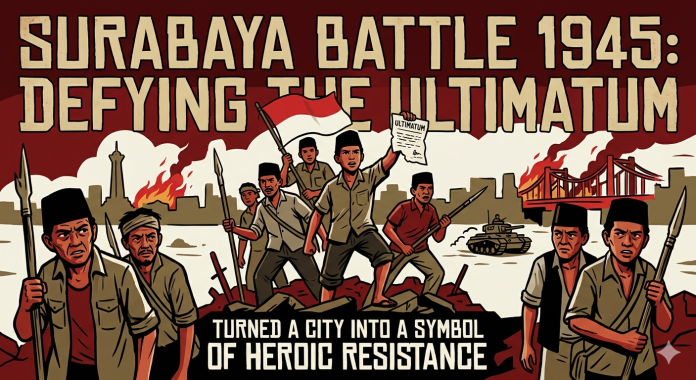

RADAR TULUNGAGUNG – Surabaya Battle 1945 was not just a military confrontation, but a defining moment that proved Indonesia’s determination to defend its independence. Taking place shortly after the proclamation of freedom, the battle turned Surabaya into a fierce war zone where thousands of Indonesians stood against a powerful Allied force.
The conflict began when tensions escalated between Indonesian fighters and returning foreign troops who refused to recognize the country’s sovereignty. What started as symbolic resistance soon evolved into open warfare, especially after the controversial flag incident at Hotel Yamato, which ignited public anger and unified the people.
As the situation worsened, the British forces issued an ultimatum demanding total surrender. Instead of backing down, Indonesians chose to fight. The Surabaya Battle 1945 quickly became one of the bloodiest and most heroic battles in the nation’s history, laying the foundation for what is now remembered as Heroes Day
Rising Tensions After Independence
After Soekarno proclaimed independence on August 17, 1945, celebrations spread across the nation. However, the reality was far from peaceful. The Dutch, backed by Allied forces, sought to regain control of Indonesia.
Tensions escalated on September 19, 1945, at Hotel Yamato in Surabaya. A Dutch flag was raised, provoking outrage among Indonesians. In a bold move, local youths climbed the building, tore off the blue section, and turned it into the red-and-white Indonesian flag. This act of defiance ignited widespread resistance.
British Arrival and Broken Promises
On October 25, 1945, British troops arrived in Surabaya under the command of A.W.S. Mallaby. They claimed their mission was to restore order, disarm Japanese soldiers, and free prisoners of war.
Initially, agreements were made with Indonesian leaders to maintain peace. However, within days, British forces violated these commitments. They released Dutch prisoners and occupied key locations, including ports and strategic buildings.
These actions fueled anger among Indonesians, leading to armed clashes on October 27. What started as minor skirmishes quickly escalated into widespread fighting across the city.
The Death That Changed the Course
A temporary ceasefire was negotiated on October 30 after intervention by Soekarno, Mohammad Hatta, and Amir Sjarifuddin. However, peace proved fragile.
Later that day, General Mallaby was killed in an explosion near the Red Bridge area. The exact cause of his death remains unclear, but its impact was immediate. The British forces were enraged and prepared for a large-scale retaliation.
Ultimatum and Defiance
Under the leadership of Eric Carden Robert Mansergh, the British issued a harsh ultimatum on November 9, 1945. Indonesian fighters were ordered to surrender unconditionally by the following morning.
The ultimatum demanded that all fighters lay down their weapons and raise their hands in surrender. Instead of submission, the people of Surabaya chose resistance.
At this crucial moment, Bung Tomo emerged as a central figure. Through powerful radio broadcasts, he inspired thousands with his passionate speeches, urging them to fight for independence rather than surrender.
His message resonated deeply, transforming fear into courage and unity.
Full-Scale Battle Erupts
On November 10, 1945, the Surabaya Battle 1945 reached its peak. British forces launched a massive offensive from land, sea, and air. Warships bombarded the city, while aircraft carried out aerial attacks.
Despite limited weaponry, Indonesian fighters resisted fiercely. Armed mostly with rifles, bamboo spears, and improvised weapons, they stood against a far more advanced military force.
Approximately 20,000 Indonesian soldiers and 100,000 volunteers participated in the battle. The संघर्ष continued for three weeks, turning Surabaya into a devastated war zone.
Street battles occurred across neighborhoods, demonstrating extraordinary courage from ordinary citizens who refused to surrender.
Heavy Losses and Lasting Legacy
The battle resulted in significant casualties. Around 20,000 Indonesians were killed, most of them civilians. On the British side, approximately 1,500 soldiers lost their lives.
Although British forces eventually took control of the city, they failed to break the spirit of Indonesian resistance. Instead, the battle strengthened global awareness of Indonesia’s determination to remain independent.
Today, November 10 is commemorated as Heroes Day, honoring those who sacrificed their lives.
The legacy of the battle is preserved at landmarks such as the Tugu Pahlawan, which stands as a powerful reminder of bravery and sacrifice.
The Surabaya Battle 1945 was not just a military confrontation. It became a symbol of national identity, proving that independence was defended with courage, unity, and unwavering determination.