
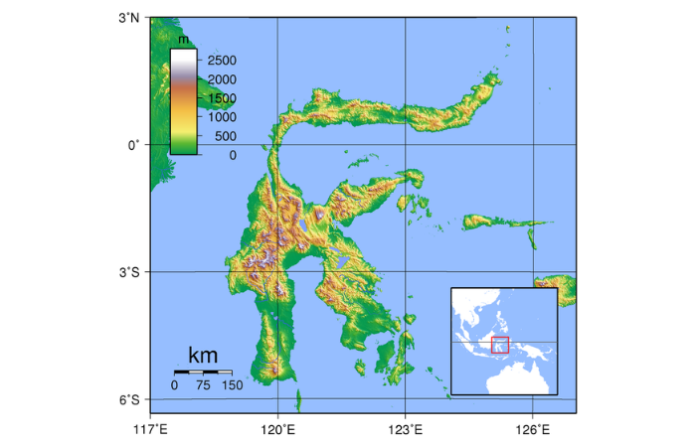

RADAR TULUNGAGUNG – The question of which island is the oldest in Indonesia continues to spark debate among historians, geologists, and biogeographers. Among the most widely discussed theories is the claim that Sulawesi is the oldest island in Indonesia, a hypothesis linked to its unique wildlife, ancient geological history, and evidence of some of the region’s earliest human settlements.
The theory gained prominence through the work of British naturalist Alfred Russel Wallace, who conducted extensive research across the Indonesian archipelago during the 19th century. Wallace observed that Sulawesi’s animal life differed significantly from that of both western Indonesia and Australia, suggesting the island followed a distinct evolutionary path for millions of years.
While modern geology does not definitively identify a single “oldest island” in Indonesia, Sulawesi’s complex geological formation and extraordinary biodiversity continue to make it one of the most important regions for understanding Southeast Asia’s natural history.
Sulawesi’s Unique Wildlife Sets It Apart
Wallace’s observations centered on the unusual distribution of animal species across the archipelago. Islands such as Java, Sumatra, and Kalimantan share many similarities in fauna because they were once connected to the Asian continental shelf during periods of lower sea levels.
In eastern Indonesia, Papua shares biological characteristics with Australia due to its historical connection to the Sahul landmass. Sulawesi, however, occupies a unique position between these two zones.
Species such as the babirusa, anoa, and tarsier are found almost exclusively on Sulawesi. Their evolutionary characteristics differ markedly from species found in either western Indonesia or Australia.
Wallace argued that this biological isolation reflected a long and separate geological history. His research later contributed to the concept of Wallacea, a biogeographical region encompassing Sulawesi, Maluku, and neighboring islands that were never fully connected to either Asia or Australia.
The island’s unusual biodiversity remains one of the strongest scientific reasons behind theories suggesting Sulawesi has ancient geological origins compared with many other Indonesian landmasses.
Geological History and Evidence of Ancient Human Settlement
Modern geological studies indicate that Sulawesi formed through a complex series of tectonic collisions involving fragments of the Asian and Australian continental plates. Researchers estimate that major stages of the island’s formation occurred between approximately 70 million and 50 million years ago, although different sections of the island have distinct geological histories.
Archaeological discoveries have added another layer to Sulawesi’s significance.
Evidence from caves in Maros, South Sulawesi, has revealed some of the oldest known traces of human activity in the region. Sites such as Leang Panninge and Leang Bulu Sipong have yielded important findings connected to the prehistoric Toalean culture, a hunter-gatherer society that inhabited parts of South Sulawesi during the Holocene period.
One of the most significant discoveries was the remains of a young woman nicknamed Bessé’, whose skeleton was uncovered in Leang Panninge. Genetic analysis published in recent years showed that she belonged to a previously undocumented human population and shared ancestry with early groups that migrated through Wallacea toward Papua and Australia.
Archaeologists estimate that Toalean communities survived until around 1,500 years ago and relied heavily on hunting wild animals and gathering shellfish along rivers and coastal areas.
Ancient Kingdoms Strengthened Sulawesi’s Historical Importance
Sulawesi’s historical significance extends beyond prehistory into the rise of early kingdoms.
Among the earliest known political entities in South Sulawesi was the Kingdom of Luwu, which many historians regard as one of the region’s oldest and most influential kingdoms. However, scholars continue to debate the exact timing of its emergence, with estimates ranging from the 10th century onward.
Luwu became known for its iron industry, particularly around the Lake Matano region, where rich iron ore and nickel deposits supported trade networks with other parts of the archipelago.
Historical records, including references in the 14th-century Javanese text Nagarakretagama, mention Luwu, although historians remain divided over the nature of its relationship with the Majapahit Empire.
Following Luwu’s prominence, the Kingdom of Siang emerged as another major power in South Sulawesi. European maps produced by Portuguese cartographers recorded the kingdom before the later dominance of the Gowa and Tallo kingdoms.
The combination of unique biodiversity, ancient geological origins, prehistoric human remains, and early state formation has kept Sulawesi at the center of discussions about Indonesia’s deep past. Although scientists have not conclusively declared it the country’s oldest island, evidence from multiple fields continues to support Sulawesi’s reputation as one of the archipelago’s most ancient and distinctive landscapes.