
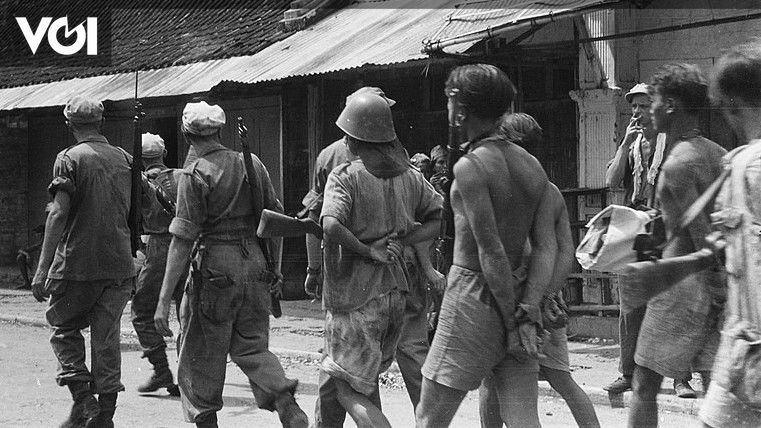

RADAR TULUNGAGUNG – The Rawagede Massacre stands among the deadliest atrocities during Indonesia’s fight to defend its independence after Dutch troops killed hundreds of civilians in West Java on December 9, 1947, while hunting Indonesian resistance fighters led by Captain Lukas Kustaryo.
The massacre unfolded during the First Dutch Military Aggression, when Dutch colonial forces launched a major offensive to reclaim Indonesia after the country declared independence in 1945. Residents of Rawagede, now called Balongsari in Karawang, became targets after Dutch intelligence suspected the village had sheltered guerrilla fighters.
For decades, the Rawagede Massacre remained a painful symbol of Indonesia’s anti-colonial struggle. The tragedy drew global attention after survivors and victims’ families sued the Dutch government, leading to a formal apology and compensation ruling from a Dutch court in 2011.
Rawagede Turned Into a Strategic Guerrilla Base
The violence in Rawagede grew out of the political chaos that followed World War II. After Japan surrendered in 1945, Indonesia proclaimed independence on August 17, 1945. However, the Netherlands tried to restore colonial control with support from NICA forces that arrived alongside Allied troops.
Tensions intensified despite diplomatic efforts such as the Linggadjati Agreement. Indonesian leaders viewed the agreement as recognition of national sovereignty, while Dutch officials argued that Indonesia still belonged within a Dutch-led federal structure.
When negotiations collapsed, Dutch Governor-General Hubertus van Mook announced on July 20, 1947, that the Netherlands no longer recognized the agreement. One day later, Dutch troops launched the First Dutch Military Aggression.
During the conflict, Rawagede became an important guerrilla center because of its strategic position near Karawang, Cikampek, and Rengasdengklok. Local residents strongly supported the independence movement, making the village a safe location for resistance fighters.
Fighters from TNI, Hizbullah, Pesindo, and several other groups established a combined command post known as MGP, or Markas Gabungan Pejuang. One of the movement’s key leaders, Captain Lukas Kustaryo, gained a reputation for launching fast guerrilla attacks against Dutch military camps.
Dutch troops reportedly called him the “Bandit of Karawang” because his raids repeatedly damaged Dutch operations and killed colonial soldiers.
Dutch Forces Stormed the Village Before Sunrise
After receiving reports about guerrilla activity in Rawagede, Dutch commanders prepared a large-scale assault for December 9, 1947. Before the attack began, many resistance fighters, including Captain Lukas, had already moved to another location.
At around 4 a.m., Dutch soldiers surrounded Rawagede from several directions. Many villagers continued their normal morning routines because they did not realize troops had sealed off the area. Soon afterward, soldiers ordered residents back into their homes while firing warning shots into the air.
Dutch troops then searched homes one by one while demanding information about Captain Lukas. When villagers refused to answer, soldiers began interrogating male residents in public.
Witnesses said villagers stayed silent despite repeated threats and intimidation.
The operation quickly turned into mass murder. Dutch troops forced men out of their homes, lined them up, and shot them at close range after they denied knowing Captain Lukas’ whereabouts.
Some villagers hid in rivers, muddy pools, and beneath thick water plants. Survivors later recalled that Dutch soldiers promised safety to anyone who came out of hiding. Instead, troops opened fire as soon as villagers revealed themselves.
One survivor named Surya escaped after bullets struck his hip during the chaos. He later changed his name to Surya Suhanda, a phrase locals interpreted as “Surya, enemy of the Dutch.”
Families Found Bodies Across Rivers and Fields
The killings continued from dawn until nightfall. Women, children, and elderly residents stayed inside their homes throughout the violence because they feared further attacks.
When survivors stepped outside the next morning, they discovered bodies scattered across roads, fields, bridges, and rivers. Residents also found piles of corpses stacked together in several parts of the village.
Historical testimony estimates that at least 431 people died in the Rawagede Massacre, most of them men between 16 and 60 years old. Local accounts suggest the true death toll may have reached even higher numbers because some victims disappeared without records.
The massacre devastated Rawagede’s economy and social structure. Hundreds of families lost their breadwinners, while farming activity collapsed after many agricultural workers died during the attack.
Residents buried victims quickly with limited resources because they feared Dutch troops might return. Women dug graves themselves and wrapped bodies with blankets, curtains, and bedsheets before burial.
Authorities later built the TMP Smpurnaraga memorial cemetery and a monument to honor the victims of the massacre.
In 2009, relatives of the victims filed a lawsuit against the Dutch government in The Hague. In 2011, a Dutch civil court ruled that the Netherlands bore responsibility for the Rawagede Massacre, forcing the government to issue compensation and an official apology.
Captain Lukas reportedly carried deep guilt throughout his life because villagers died while protecting him and refusing to betray the resistance movement to Dutch troops.