
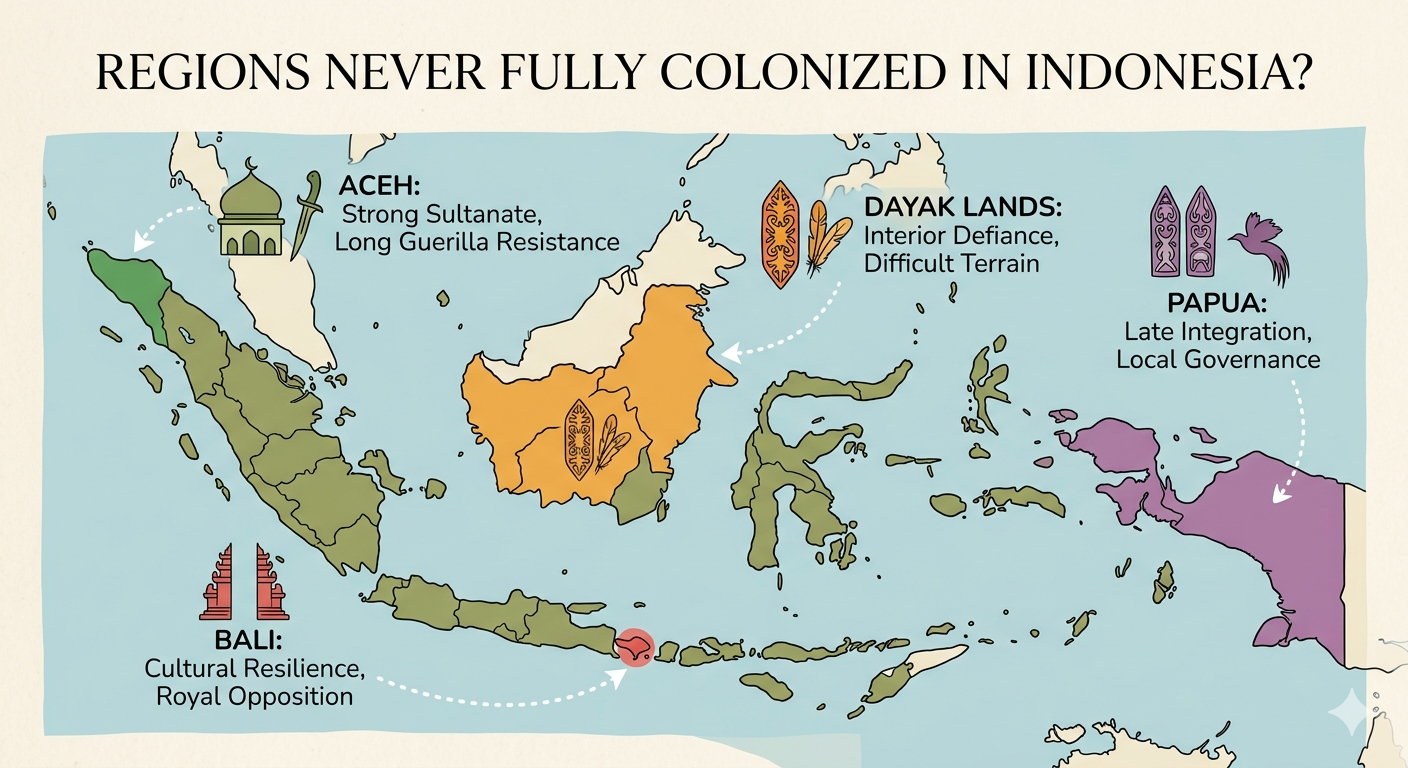

RADAR TULUNGAGUNG – The claim that several Indonesian regions were never fully colonized continues to spark debate among historians and the public. Across the archipelago, communities from Aceh to Papua developed reputations for fierce resistance, strong local governance, and cultural resilience that challenged the ambitions of European colonial powers for centuries.
Historical records show that Dutch, Portuguese, and Spanish colonial authorities often struggled to establish complete control over remote kingdoms, mountainous territories, and isolated island societies. In many cases, colonial administrations secured influence over trade routes, coastal settlements, or political elites while facing persistent resistance in inland regions and traditional strongholds.
Although historians caution against describing these areas as entirely untouched by colonial rule, many regions never surrendered their identities or local institutions completely. From the prolonged Aceh War and the diplomatic strategies of Ternate and Tidore to the cultural endurance of Bali, Dayak communities, and the Baduy people, these stories reveal how resistance took many forms beyond the battlefield.
Aceh War and Regional Resistance Shaped Indonesia’s Anti-Colonial Legacy
Among the strongest examples of resistance was Aceh in northern Sumatra. The Acehnese fought one of the longest and bloodiest colonial conflicts in Southeast Asian history during the Aceh War from 1873 to 1904. The powerful Aceh Sultanate had previously maintained diplomatic ties with foreign powers, including the Ottoman Empire, and built a reputation as a formidable maritime state.
Although Dutch forces eventually established control over major centers, resistance continued for decades. Historians generally agree that Dutch authority remained incomplete in many rural and mountainous areas, making Aceh a symbol of persistent anti-colonial struggle rather than a region entirely untouched by colonial rule.
A similar pattern appeared in South Sulawesi, where the Kingdom of Gowa under Sultan Hasanuddin challenged the Dutch East India Company (VOC) in the 17th century. Sultan Hasanuddin earned the nickname “The Rooster of the East” for his determined resistance. Following the Treaty of Bungaya in 1667, Dutch influence expanded, yet local opposition continued long after the agreement.
In the Maluku Islands, the Sultanates of Ternate and Tidore navigated colonial competition through diplomacy and shifting alliances involving Portugal, Spain, and the Netherlands. Rather than remaining fully independent, both kingdoms strategically balanced cooperation and resistance to preserve portions of their political authority.
Geography and Strong Local Institutions Limited Colonial Reach
Several regions became difficult for colonial administrations to govern because of challenging terrain and deeply rooted local traditions.
Papua, for example, presented enormous logistical obstacles due to its mountains, forests, and geographic isolation. Dutch colonial administration remained concentrated in coastal areas and selected settlements, while many inland communities maintained traditional ways of life well into the twentieth century.
In Kalimantan, numerous Dayak communities lived in remote interior regions that colonial authorities struggled to access. While the Dutch exercised influence over coastal territories and trade networks, direct control over many inland areas remained limited.
The same dynamic appeared in Toraja, Nias, Mentawai, Kerinci, and parts of Manggarai. Rugged landscapes, strong customary laws, and self-governing social systems often reduced the effectiveness of colonial administration. However, historians note that limited control should not be confused with complete independence from colonial influence.
Bali also became known for its fierce resistance. The Puputan tragedies in Badung in 1906 and Klungkung in 1908 demonstrated the determination of Balinese rulers and communities to resist Dutch conquest. Despite eventual military defeat, Bali retained a strong cultural identity that continues to shape the island today.
Cultural Survival Became a Lasting Form of Resistance
In many regions, resistance extended beyond military confrontation. Communities preserved local traditions, governance systems, and cultural identities despite colonial intervention.
The Minangkabau people of West Sumatra offer a notable example. Following the Padri War in the nineteenth century, Dutch authorities expanded their presence in the region. Yet Minangkabau intellectual, commercial, and religious networks continued to flourish, influencing developments far beyond Sumatra.
The Batak highlands around Lake Toba likewise maintained strong social structures rooted in clan traditions. Although colonial and missionary activities reached the area, local customs remained influential.
In Java, the Sultanates of Yogyakarta and Surakarta occupied unique positions under Dutch colonial arrangements. Neither kingdom remained fully sovereign, but both retained limited internal authority and preserved important cultural institutions that survive today.
Perhaps the strongest example of cultural autonomy can be found among the Baduy people in Banten. Through a deliberate policy of isolation and strict adherence to customary law, the Baduy community minimized outside influence and maintained many traditional practices across generations.
The historical record suggests that few Indonesian regions escaped colonial influence entirely. However, many communities successfully resisted full integration into colonial systems, preserved local identities, and maintained varying degrees of autonomy. Their experiences helped shape Indonesia’s broader struggle for independence and continue to serve as enduring symbols of resilience, cultural survival, and self-determination.