
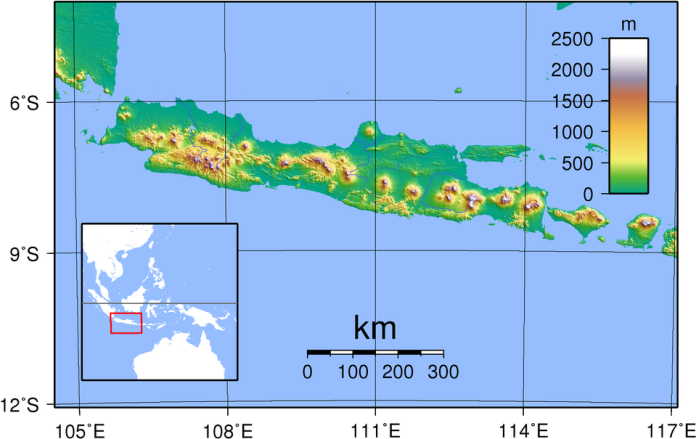

RADAR TULUNGAGUNG – The historical division of Java into western, central, and eastern regions emerged through centuries of geographic isolation, political conflict, religious transformation, and colonial intervention. Historians say the island’s cultural fragmentation shaped distinct identities that continue to influence modern Indonesia’s social, political, and economic landscape.
Although Java appears as a single island on modern maps, anthropologists have long viewed it as a cultural mosaic. West Java developed under strong Sundanese traditions, Central Java became the center of refined Javanese royal culture, while East Java evolved into a more open and maritime-oriented society driven by trade and military expansion.
The roots of Java divided into three regions can be traced back to ancient kingdoms, shifting centers of power, and major historical events such as the Bubat tragedy, the rise of Islamic sultanates, and Dutch colonial restructuring. Together, these forces transformed Java into three interconnected yet culturally distinct regions that still define the island today.
Geography and Ancient Kingdoms Shaped Java’s Early Division
The earliest separation on Java emerged naturally through geography. Mountain ranges and dense forests in the western region isolated communities and helped form a distinct Sundanese identity with its own language and customs. Historians trace one of the region’s earliest major powers to the Tarumanegara Kingdom in the fourth century under King Purnawarman, whose influence centered around present-day West Java.
Meanwhile, Central Java developed differently due to its broad fertile plains surrounded by volcanoes. By the eighth century, the Medang or Ancient Mataram Kingdom had risen as a highly organized agrarian civilization capable of constructing monumental religious sites such as Borobudur and Prambanan.
Historical texts, including the 15th-century Bujangga Manik manuscript, identified the Cipamali River, now known as the Pemali River in Brebes, as a symbolic cultural boundary between Sundanese territories in the west and Javanese regions in the east.
The divide deepened in 929 CE when King Empu Sindok moved the Mataram kingdom’s political center from Central Java to East Java following possible volcanic destruction linked to Mount Merapi and the growing importance of maritime trade routes.
The shift transformed East Java into a powerful commercial and military hub connected to international traders through ports near the Brantas River and Hujung Galuh, now Surabaya. Historians often describe the rise of “Brang Wetan,” or eastern Javanese culture, as more egalitarian and outspoken than the refined hierarchy associated with Central Java’s royal courts.
The Bubat Tragedy and Islamic Expansion Intensified Cultural Differences
One of the most defining moments in the emotional separation between Sundanese and Javanese societies came during the Bubat tragedy in 1357 under the Majapahit Empire.
The conflict erupted after diplomatic tensions surrounding a planned marriage between Majapahit ruler Hayam Wuruk and Sundanese princess Dyah Pitaloka Citraresmi. According to historical accounts, Majapahit military leader Gajah Mada demanded the princess be presented as tribute rather than an equal royal partner.
The insult triggered a violent confrontation at Bubat Square in Majapahit’s capital, where the Sundanese royal entourage led by King Prabu Linggabuana was killed. Dyah Pitaloka reportedly took her own life to preserve her kingdom’s honor.
The tragedy left a deep cultural scar that shaped oral traditions for centuries, including taboos surrounding marriages between Sundanese and Javanese families.
Java’s divisions evolved further during the 15th and 16th centuries with the spread of Islam and the rise of the Demak Sultanate, the first major Islamic kingdom on the island. Coastal communities from Cirebon and Semarang to Surabaya developed strong maritime identities influenced by trade networks and Islamic scholarship.
At the same time, inland Central Java preserved older agrarian traditions and court structures, while eastern regions such as Blambangan in Banyuwangi maintained strong Hindu-Buddhist influences due to their close ties with Bali.
The Wali Songo played a central role during this period by blending Islamic teachings with local culture through shadow puppetry, gamelan music, and traditional arts.
Colonial Policies Cemented the Three-Part Structure of Java
Dutch colonial rule eventually formalized Java’s divisions through political treaties, forced cultivation systems, and administrative restructuring.
Following internal conflicts within the Mataram Sultanate, the Dutch East India Company, or VOC, gained increasing influence across the island. The 1755 Treaty of Giyanti split Mataram into the Surakarta Sunanate and Yogyakarta Sultanate, permanently fragmenting Central Java’s political authority.
In West Java, the Dutch strengthened direct control through coffee plantations and the Priangan system, while East Java became a major economic frontier dominated by ports, agriculture, and military infrastructure.
The construction of the Great Post Road by Governor-General Herman Willem Daendels in the early 19th century connected the island from Anyer to Panarukan across nearly 1,000 kilometers. The road improved colonial control and accelerated economic integration but also caused massive suffering due to forced labor.
By the early 20th century, the Dutch East Indies administration officially divided Java into three provinces: West Java, Central Java, and East Java. Despite Indonesian independence in 1945 and later administrative changes such as the creation of Banten Province in 2000, the three-part cultural structure remained intact.
Today, West Java and Banten serve as Indonesia’s industrial and manufacturing centers, Central Java and Yogyakarta preserve traditional Javanese arts and spirituality, while East Java functions as a major trade and agricultural gateway to eastern Indonesia.
The long history of Java’s division demonstrates that unity on the island did not emerge through uniformity. Instead, historians argue the coexistence of Sundanese, Central Javanese, and East Javanese identities became one of Indonesia’s greatest cultural strengths.