
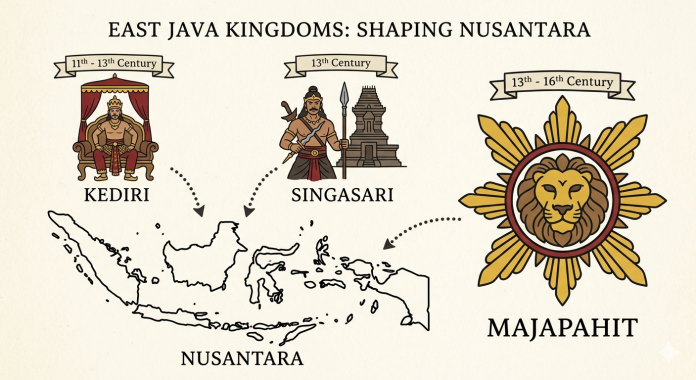

RADAR TULUNGAGUNG – East Java kingdoms played a crucial role in shaping the history of Indonesia long before the modern nation emerged. From the powerful Majapahit Empire to the ancient Kanjuruhan Kingdom, the region became the center of politics, culture, religion, and trade for centuries. These kingdoms not only controlled Java but also influenced vast parts of the archipelago during their golden eras.
The history of East Java kingdoms reflects the transition of Indonesian civilization from the Hindu-Buddhist period to the Islamic era and eventually the colonial age. Historical records, inscriptions, temples, and archaeological discoveries continue to reveal how influential these kingdoms once were across Nusantara.
Several famous kingdoms once stood proudly in East Java, including Kanjuruhan, Mataram Kuno, Kediri, Singasari, Majapahit, and Blambangan. Each kingdom left valuable cultural heritage sites that still attract historians and tourists today.
Kanjuruhan, the Oldest Hindu-Buddhist Kingdom in East Java
Kanjuruhan is believed to be the oldest Hindu-Buddhist kingdom in East Java. Historians estimate the kingdom existed between the late seventh century and the middle of the eighth century. Its capital was located in the area now known as Malang Regency.
Evidence of the kingdom appeared through the Dinoyo Inscription, dated 760 AD. The inscription used Old Javanese script and Sanskrit language. Researchers discovered the artifact in Merjosari Village, Malang.
The inscription explains several rulers of Kanjuruhan, including King Dewasimha and King Gajayana. During Gajayana’s reign, the kingdom experienced rapid growth in government, economy, arts, and social life. Historians consider Kanjuruhan an important foundation of early civilization in East Java.
Ancient Mataram and the Move to East Java
The Ancient Mataram Kingdom initially ruled Central Java before moving its center of power to East Java around 929 AD. Mpu Sindok led the relocation after major political and natural disasters struck the region.
Two main factors triggered the move. First, the Srivijaya Kingdom launched military pressure against Mataram. Second, Mount Merapi experienced a devastating eruption that damaged many settlements.
Historical evidence of Ancient Mataram survives through inscriptions and temple complexes. In East Java, researchers found artifacts such as the Linggasutan Inscription and Candi Lor. Meanwhile, Central Java still preserves iconic temples like Borobudur, Prambanan, and Sewu Temple.
Kediri Kingdom and Jayabaya’s Famous Prophecies
The Kediri Kingdom became one of the most respected powers in East Java. Historical records mention that the kingdom stood for around 177 years and produced several influential kings.
One of the most famous rulers was Sri Aji Jayabaya, who brought Kediri into its golden age. Jayabaya became widely known because of his legendary prophecies, which many Indonesians still discuss today.
The kingdom also left important historical sites, including Tondowongso archaeological remains, ancient Shiva statues, and inscriptions found in Tulungagung and Kertosono. These relics show the strong Hindu influence that shaped Kediri’s political and spiritual traditions.
Singasari and the Rise of Majapahit
The Singasari Kingdom emerged in 1222 under the leadership of Ken Arok. Located in present-day Malang, the kingdom expanded rapidly and became one of the strongest political powers in the region.
Singasari reached its peak during the reign of King Kertanegara, the last ruler of the kingdom. Under his leadership, Singasari controlled Java, Madura, Bali, parts of Kalimantan, and sections of Sumatra.
However, Kertanegara died in 1292, marking the fall of Singasari. One year later, his son-in-law Raden Wijaya established the Majapahit Kingdom, which later became the largest Hindu-Buddhist empire in Indonesian history.
Majapahit, the Empire That United Nusantara
Majapahit remains the most famous among all East Java kingdoms. Founded in 1293, the empire controlled large territories across Nusantara and became a symbol of Indonesian unity.
Majapahit achieved its greatest success during the reign of Hayam Wuruk between 1350 and 1389. At the same time, Gajah Mada served as the powerful prime minister who introduced the legendary Sumpah Palapa, a vow to unite the archipelago.
Many historical sites connected to Majapahit still stand today, including Bajang Ratu Temple, Tikus Temple, Penataran Temple, and the Kumitir Site in Mojokerto. These structures continue to demonstrate the architectural brilliance of the era.
Blambangan, the Last Hindu Kingdom in Java
Blambangan stood in the Banyuwangi area and survived until the eighteenth century. Historians often call it the last Hindu kingdom in Java because it maintained Hindu traditions long after other kingdoms collapsed.
Unlike many East Javanese kingdoms, Blambangan received strong cultural influence from Bali. Traditional dances and local arts in Banyuwangi still reflect Balinese heritage today.
Several historical remains from the kingdom survive, including ancient wells, royal sites, and structures near Pura Agung Blambangan. These relics preserve the memory of one of Java’s final Hindu strongholds.