
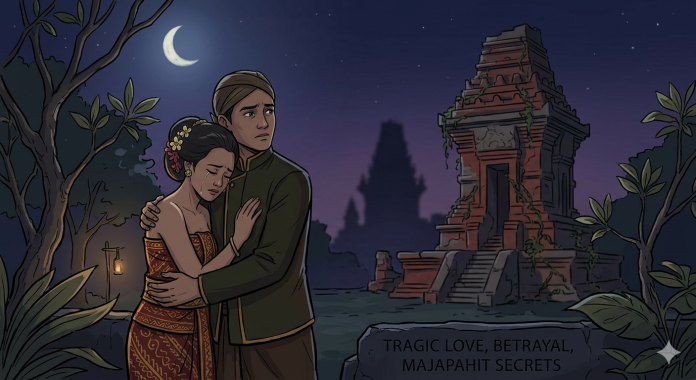

RADAR TULUNGAGUNG – The legend of Roro Kembang Sore remains one of the most emotional and mysterious stories in Tulungagung history. Ancient chronicles in Babad Tulungagung describe a tale filled with romance, betrayal, revenge, and political conflict during the Majapahit era.
Many people in East Java still consider the story an important part of Tulungagung’s cultural heritage. The legend also connects closely to the rise of Gajah Mada, one of the most influential figures in Majapahit history.
The story began during political unrest involving Perwira Mada, the warrior who later became Patih Gajah Mada. His success in defeating enemies of Majapahit strengthened his reputation and helped him gain power inside the kingdom.
The Hidden Identity of Roro Kembang Sore
Roro Kembang Sore was described as a beautiful noblewoman who later disguised herself as Resi Winandi, a female hermit living on Gunung Cilik. Behind her calm appearance, however, she carried deep emotional wounds caused by betrayal and tragedy.
At one point in the story, Roro Kembang Sore reunited with her mother, Roro Mursodo. The emotional meeting revealed the suffering experienced by their family after political conflict and violence destroyed their lives.
Despite the hardship, the biggest turning point in Roro Kembang Sore’s life came when she met a Majapahit prince named Pangeran Lembu Peteng.
Forbidden Romance in the Middle of Conflict
The meeting between Roro Kembang Sore and Pangeran Lembu Peteng quickly turned into romance. According to the legend, the two instantly fell in love while spending time together in the garden of the local regency.
The relationship, however, became dangerous because Lembu Peteng was actually on a mission connected to Kyai Besari and Adipati Kalang. Political tension and hidden agendas surrounded their growing love story.
Their romantic encounter was secretly witnessed by Pangeran Kalang, who later exposed the relationship to Roro Kembang Sore’s father, Pangeran Berdalem.
Furious over the scandal, Pangeran Berdalem confronted Lembu Peteng. A fierce battle erupted, forcing the young couple to flee together in hopes of escaping toward Majapahit territory.
The Tragic Death of Lembu Peteng
During their escape, Roro Kembang Sore reportedly sensed disaster approaching. Her instincts warned that something terrible would happen to them. The fear eventually became reality.
While resting near a river, the couple was suddenly attacked by Kyai Besari and Pangeran Berdalem. Lembu Peteng was killed on the spot, and his body was thrown into the river.
Witnessing the murder shattered Roro Kembang Sore emotionally. She refused to return with her father and instead ran away alone, carrying grief and anger that would later change the course of the story.
The Origin of Gunung Budeg Legend
After escaping, Roro Kembang Sore arrived at Dadapan Village, where she stayed at the house of Mbok Rondo Dadapan.
There she met Joko Bodo, the son of Mbok Rondo, who became fascinated by her beauty and repeatedly proposed marriage. Roro Kembang Sore rejected him many times before finally giving him an impossible condition.
She asked Joko Bodo to perform silent meditation on a mountain near the village.
According to the legend, when Mbok Rondo later found her son sitting silently and unresponsive, she angrily cursed him for behaving “like a stone.” At that moment, lightning struck and Joko Bodo transformed into stone.
The place later became known as Gunung Budeg, one of Tulungagung’s most famous mystical landmarks.
Revenge Against Adipati Kalang
The story reached its climax when Adipati Kalang discovered that Resi Winandi was actually Roro Kembang Sore in disguise.
Filled with shame and fear, Adipati Kalang attempted to flee. However, he was hunted by the forces of Perwira Mada, who later became the legendary Gajah Mada of Majapahit.
In the final confrontation, Adipati Kalang was brutally killed by the troops of Perwira Mada.
Even after revenge was completed, Roro Kembang Sore never fully recovered from the death of Lembu Peteng. The legend says she chose to spend the rest of her life meditating in isolation until her death.
Today, the story of Roro Kembang Sore continues to attract attention from history enthusiasts, cultural researchers, and lovers of Javanese mythology. The legend not only reflects the emotional complexity of ancient Java but also highlights Tulungagung’s deep connection to the history of the Majapahit Kingdom.