

RADAR TULUNGAGUNG – The history of the Majapahit Kingdom founding remains one of the most fascinating chapters in Indonesian history. Emerging from political chaos and foreign invasion, Majapahit rose to become the largest Hindu-Buddhist empire in the archipelago. The story begins with the fall of Singosari and the strategic brilliance of its successor, Raden Wijaya.
The Majapahit Kingdom founding cannot be separated from the collapse of the Singosari Kingdom in 1292. Singosari, established by Ken Arok, reached its peak under King Kertanegara. However, his rule ended abruptly after a rebellion led by Jayakatwang of Kediri. This political upheaval forced Raden Wijaya, a descendant of Singosari’s royal line, to flee and regroup.
The turning point in the Majapahit Kingdom founding came when Raden Wijaya sought refuge in Madura under the protection of Arya Wiraraja. With careful planning, he pretended to submit to Jayakatwang while secretly preparing a rebellion. He was granted permission to open the Tarik forest, a seemingly insignificant decision that would later shape history.
Strategic Beginnings in Tarik
In the Tarik forest, Raden Wijaya established a new settlement that would later be known as Majapahit. The name itself is believed to come from the bitter taste of the maja fruit found in the area. This settlement became the center of resistance against Kediri and the foundation of a future empire.
Wijaya’s leadership attracted loyal followers from former Singosari territories, including Tumapel and Daha. He also maintained strong ties with Arya Wiraraja, who played a crucial role in mobilizing support from Madura. Together, they began to build military strength while waiting for the right moment to strike.
Mongol Invasion Changes the Game
A major turning point in the Majapahit Kingdom founding occurred in 1293, when Mongol forces sent by Kublai Khan arrived in Java. The expedition aimed to punish Kertanegara for insulting the Mongol emperor. Unaware that Kertanegara had already been killed, the Mongols became an unexpected opportunity for Raden Wijaya.
Instead of confronting them directly, Wijaya formed a temporary alliance with the Mongol army. He promised submission in exchange for military assistance to defeat Jayakatwang. This strategic move proved decisive, as combined forces successfully overthrew Kediri.
Double Strategy Against the Mongols
After Jayakatwang was defeated, the Majapahit Kingdom founding entered its most critical phase. Raden Wijaya quickly turned against the Mongol forces, realizing that their presence posed a threat to his sovereignty. Using his knowledge of local terrain, he launched a surprise attack on the exhausted Mongol troops.
The unfamiliar geography of Java, combined with guerrilla tactics, put the Mongols at a disadvantage. Thousands of their soldiers were killed, forcing them to retreat. This marked one of the rare defeats of Mongol forces in Southeast Asia and highlighted the tactical brilliance of Raden Wijaya.
Birth of a Powerful Empire
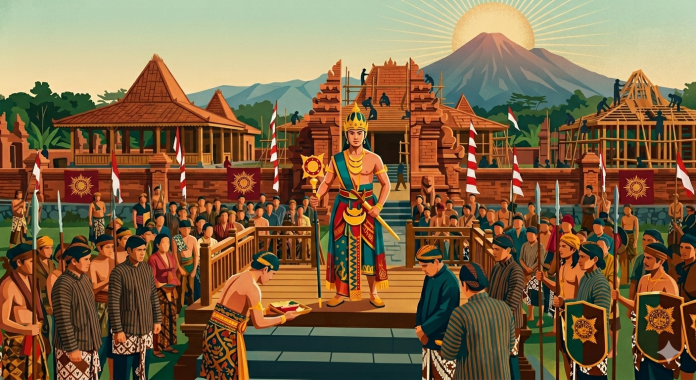
Following the withdrawal of Mongol forces, Raden Wijaya officially established the Majapahit Kingdom in 1293. This marked the successful completion of the Majapahit Kingdom founding, transforming a small forest settlement into the center of a powerful empire.
Majapahit would later grow into the largest Hindu-Buddhist kingdom in the archipelago, surpassing even Srivijaya in territorial reach. Its influence extended across much of Southeast Asia, shaping trade, culture, and politics for decades.
The founding of Majapahit was not merely the result of military strength, but also strategic diplomacy and adaptability. Raden Wijaya’s ability to navigate complex political situations and exploit opportunities set the foundation for one of the greatest empires in Indonesian history.