
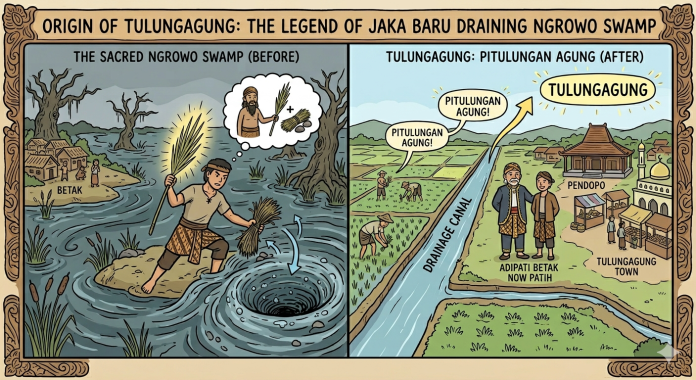

RADAR TULUNGAGUNG – The origin of Tulungagung is once again drawing public attention after a YouTube video retelling the legendary story of Jaka Baru and the sacred Ngrowo swamp went viral on social media. The tale, rooted in Javanese folklore, explains how the region that was once a vast swamp transformed into one of the most important areas in East Java.
The legend of Tulungagung begins in the era of Kadipaten Betak under the leadership of Adipati Betak. At that time, the region was facing a major population crisis. Waves of newcomers kept arriving to settle in the area, but there was almost no land left for housing and farming.
The only remaining territory was a massive swamp known as Ngrowo. Desperate to solve the problem, Adipati Betak decided to drain the swamp and turn it into habitable land. However, every effort failed because the swamp contained a mysterious spring that continuously produced water.
Adipati Betak Announces a Dangerous Contest
According to the story, Adipati Betak ordered his soldiers and workers to dry the swamp repeatedly, but the water always returned within a short time. Confused and frustrated, he finally listened to the advice of one of his trusted advisers.
The adviser suggested holding a grand contest. Whoever succeeded in drying the Ngrowo swamp would be rewarded with the prestigious position of patih, or royal chief minister, in Kadipaten Betak.
The announcement immediately spread across the kingdom and attracted many people. Warriors, mystics, and self-proclaimed powerful men came from various regions hoping to claim the reward.
Yet, despite their confidence, none of them succeeded.
Day after day, participants attempted to drain the swamp, but the endless spring kept refilling the area. The enormous wetland appeared impossible to conquer, causing despair among the people and disappointment for Adipati Betak.
The Arrival of Jaka Baru
When the contest was nearing its final day, a mysterious young man named Jaka Baru finally appeared before the ruler.
Jaka Baru introduced himself as a traveler from the slopes of Mount Wilis. Although Adipati Betak warned him that many powerful figures had already failed, the young man insisted on participating.
The ruler even threatened that failure could cost him his life. Still, Jaka Baru calmly accepted the risk. Before beginning the challenge, however, he requested permission to return home and seek blessings from his parents.
His father, Ki Ageng Mangir, was known as a wise spiritual figure. After hearing his son’s intentions, Ki Ageng Mangir gave his blessing and revealed the secret needed to stop the endless spring.
The Secret Behind the Ngrowo Swamp
Ki Ageng Mangir instructed Jaka Baru to find an aren tree and take a handful of ijuk fibers along with a single palm stick. He also reminded his son to pray to nature before entering the swamp.
Following the instructions carefully, Jaka Baru returned to Kadipaten Betak carrying the sacred items.
In front of Adipati Betak and the remaining participants, Jaka Baru entered the swamp and searched for the hidden water source deep beneath the marsh.
After discovering the spring, he inserted the aren fibers into the water source and planted the small stick beside it.
Miraculously, the water flow stopped instantly.
The Birth of Tulungagung
Soon after the spring was sealed, the swamp water gradually receded. The once-endless Ngrowo wetland eventually dried completely, astonishing everyone who witnessed the event.
Adipati Betak was overwhelmed with joy and repeatedly shouted the words “pitulungan agung,” which in Javanese means “great help” or “great divine assistance.”
As promised, Jaka Baru was officially appointed as the new patih of Kadipaten Betak.
Over time, the former swamp transformed into fertile land where people began building homes and settlements. More residents arrived, the area became increasingly crowded, and eventually the center of government moved there permanently.
According to local belief, the repeated phrase “pitulungan agung” gradually evolved into the name Tulungagung, the region known today in East Java.
A Cultural Heritage Still Remembered Today
The legend of Jaka Baru remains one of the most popular folklore stories in Tulungagung. Many residents continue to preserve the story through oral traditions, cultural performances, and digital content on social media platforms.
Beyond being a mythical tale, the story also symbolizes perseverance, wisdom, and harmony between humans and nature. For many people, the history of Tulungagung is not merely folklore but an important cultural identity passed down from generation to generation.
As interest in local history and Javanese legends continues to grow online, the story of Jaka Baru and the Ngrowo swamp is once again captivating audiences across Indonesia.