
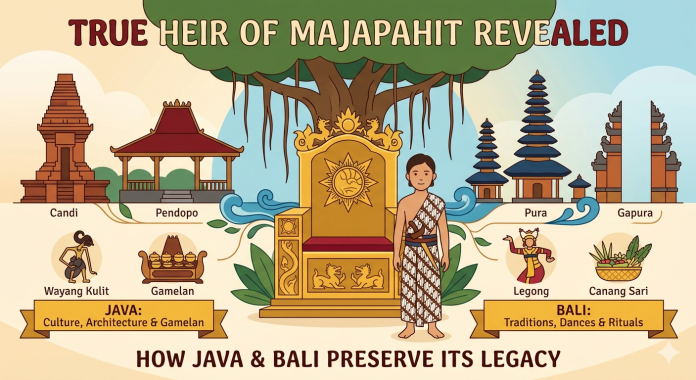

RADAR TULUNGAGUNG – The question of the true heir of Majapahit continues to spark debate among historians and cultural observers. As one of the greatest empires in Southeast Asia during the classical period, Majapahit’s decline in the late 15th century marked a turning point in Indonesian history. However, rather than disappearing completely, many of its cultural elements survived, especially within the Islamic kingdoms that rose afterward.
The discussion about the true heir of Majapahit often centers on whether Java or Bali inherited its legacy. But historical evidence suggests the answer is far more complex. Cultural continuity can be found across architecture, traditions, language, and even culinary practices that persist today.
The transformation began alongside the spread of Islam in the archipelago. Several theories attempt to explain its arrival, including the Gujarat Theory, Arab Theory, and Persian Theory. Each presents different arguments based on historical records, trade routes, and cultural similarities. While scholars continue to debate these origins, what remains clear is that Islam gradually integrated into existing Javanese culture rather than replacing it entirely.
Ancient Mosques Reflect Majapahit Architecture
One of the most striking examples of Majapahit influence is found in early Islamic architecture. Ancient mosques in Java, such as the Great Mosque of Demak, exhibit design elements similar to Hindu-Buddhist temples. Decorative features like medallions, floral motifs, and layered roof structures reflect a direct continuation of classical aesthetics.
The iconic multi-tiered roof, often seen in these mosques, is believed to symbolize Mount Mahameru, a sacred concept in Hindu cosmology. This architectural adaptation shows how Islamic structures embraced local traditions rather than discarding them, reinforcing the idea that cultural transition was gradual and inclusive.
City Layout Preserves Classical Concepts
Majapahit’s legacy is also visible in urban planning. Historical texts describe a central square surrounded by the royal palace and religious buildings. This layout persisted into the Islamic sultanates of Java, where the palace, mosque, and public square formed a unified civic center.
Additionally, burial traditions reflect older beliefs. Many Islamic figures in Java, including prominent religious leaders, were buried in elevated areas such as hills or mountains. These locations were considered sacred, continuing a worldview inherited from the Majapahit era.
The Concept of the Universal King
Another enduring legacy lies in political ideology. The concept of a “universal ruler,” known in classical texts as Chakravartin, was adopted and adapted by Islamic kingdoms. Javanese rulers incorporated similar ideas into their titles and governance systems.
This continuity highlights how leadership concepts evolved without losing their philosophical roots. The idea of a king as the center of harmony and order remained influential long after Majapahit’s decline.
Language and Everyday Traditions
Majapahit’s influence extends deeply into language. Common terms related to religious practices, such as fasting, heaven, and hell, originate from Sanskrit rather than Arabic. Words like “poso” (fasting) and “suwargo” (heaven) demonstrate how pre-Islamic vocabulary was absorbed into later traditions.
These linguistic traces show that cultural blending occurred at a fundamental level, shaping how people communicate and understand spiritual concepts today.
Culinary Heritage That Lives On
Even popular Eid dishes in Java reveal connections to the Majapahit era. Foods like ketupat and lepet were already known centuries before the rise of Islamic kingdoms. Historical texts from earlier periods mention these dishes as part of ritual offerings.
Over time, their meanings evolved. Ketupat, for example, is now associated with forgiveness during Eid celebrations. Despite new interpretations, its roots trace back to ancient Javanese traditions, proving the enduring nature of cultural heritage.
Nyadran and the Spirit of Ancestral Respect
The tradition of Nyadran, widely practiced in Java today, is another continuation of Majapahit customs. Originally linked to ceremonial rituals honoring the deceased, it has transformed into a communal activity involving prayers, grave cleaning, and shared meals.
Held before Ramadan, Nyadran reflects a blend of old and new beliefs, maintaining respect for ancestors while aligning with Islamic practices.
Wayang as a Cultural Bridge
Wayang, or shadow puppetry, further illustrates this cultural continuity. Although often associated with Islamic preaching by Walisongo, historical records confirm that wayang existed long before that period. Ancient inscriptions and literary works describe performances similar to those seen today.
During the Islamic era, wayang was adapted as a medium for religious teaching. Characters and stories were reinterpreted, but the core art form remained unchanged. This adaptability allowed it to survive across centuries.
Beyond Java vs Bali
The debate over the true heir of Majapahit often contrasts Java and Bali. Bali is frequently seen as preserving Majapahit traditions due to its Hindu roots. Meanwhile, Javanese Islamic kingdoms also claim continuity through historical narratives and cultural practices.
In reality, Majapahit’s legacy is not confined to a single region or identity. Its influence lives on in values such as tolerance, cultural respect, and unity amid diversity.
Rather than asking who owns the legacy, it may be more meaningful to recognize how it continues to shape Indonesian identity as a whole. The true heir of Majapahit is not defined by geography or religion, but by the preservation and practice of its enduring cultural values.