
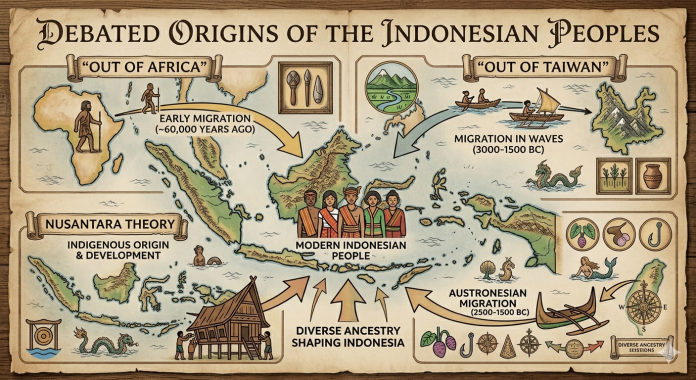

RADAR TULUNGAGUNG – The origins of Indonesian people have long been a fascinating topic that sparks debate among historians, archaeologists, and genetic researchers. Where did the ancestors of Indonesians come from? Were they native to the archipelago, or did they migrate from other regions? Several major theories attempt to answer these questions, each supported by different forms of evidence, from archaeology to linguistics and genetics.
Understanding the origins of Indonesian people is essential not only for historical knowledge but also for recognizing the diversity and identity of the nation today. At least four prominent theories explain how early humans arrived and developed in what is now Indonesia.
Yunnan Theory and Early Migration Waves
One of the most widely known explanations is the Yunnan Theory. This theory suggests that the ancestors of Indonesians came from the Yunnan region in southern China. Scholars such as Robert von Heine-Geldern and Mohammad Ali supported this idea based on archaeological findings.
Evidence for the Yunnan Theory includes the discovery of ancient stone tools, such as axes found in the Indonesian archipelago, which closely resemble tools discovered in Central Asia. This similarity indicates a possible migration route from mainland Asia to Southeast Asia.
According to this theory, migration occurred in two major waves. The first group, known as Proto-Malay, brought Neolithic culture, while the second group, Deutero-Malay, introduced metal culture. These groups are believed to have traveled through large rivers in mainland Asia, settled temporarily in regions like Vietnam, and eventually reached the Indonesian islands using outrigger boats.
Linguistic similarities also support this theory. Certain Malay words share features with the Champa language, suggesting a common origin or interaction between these populations.
Nusantara Theory Emphasizes Local Development
In contrast, the Nusantara Theory argues that the ancestors of Indonesians originated from within the archipelago itself. Prominent figures such as Mohammad Yamin and Sutan Takdir Alisjahbana supported this perspective.
This theory highlights the advanced civilization of early Malay communities, suggesting they developed independently over a long period. It proposes that local populations evolved culturally without significant external influence.
Fossil discoveries strengthen this argument. Remains of Homo soloensis and Homo wajakensis found in Indonesia are not present in regions like Indochina. This absence is used to challenge migration-based theories and support the idea of indigenous development.
Out of Taiwan Theory and Austronesian Expansion
Another influential explanation is the Out of Taiwan Theory. This theory states that the ancestors of Indonesians originated from Taiwan, specifically from Austronesian-speaking populations.
Supported by archaeologist Harry Truman Simanjuntak, this theory relies heavily on genetic and linguistic evidence. Research involving thousands of individuals from various ethnic groups in Indonesia shows strong genetic connections to Austronesian populations.
Migration is believed to have started between 4500 and 3000 BCE, when groups from Taiwan moved to the northern Philippines. Over time, they spread further into Indonesia, reaching islands such as Kalimantan, Sulawesi, and Java, and even extending to Madagascar.
Language plays a crucial role in this theory. Most languages spoken in Indonesia belong to the Austronesian family, which is believed to have originated in Taiwan. This linguistic pattern supports the idea of migration and cultural diffusion from the north.
Out of Africa Theory and Global Human Origins
The most comprehensive perspective comes from the Out of Africa Theory, which explains the origins of modern humans globally, including Indonesians. According to this theory, Homo sapiens first appeared in Africa and later migrated to other parts of the world.
Genetic studies, particularly those analyzing mitochondrial DNA, support this theory. These studies trace human ancestry back to Africa, where early humans began their journey tens of thousands of years ago.
Migration from Africa to Southeast Asia, including Indonesia, is estimated to have occurred around 72,000 years ago. Over time, humans adapted to different environments, resulting in the physical and cultural diversity seen today.
This theory does not contradict regional migration theories but instead provides a broader framework. It explains the ultimate origin of humans before they dispersed into various regions, including Asia and the Indonesian archipelago.
A Complex and Multilayered History
The origins of Indonesian people cannot be explained by a single theory alone. Each perspective offers valuable insights, supported by different types of evidence. While the Yunnan and Taiwan theories emphasize migration, the Nusantara Theory highlights local development, and the Out of Africa Theory provides a global context.
Together, these theories reveal that the history of Indonesian ancestry is complex and multilayered. Rather than a single origin, it is likely the result of multiple waves of migration, adaptation, and cultural evolution over thousands of years.