
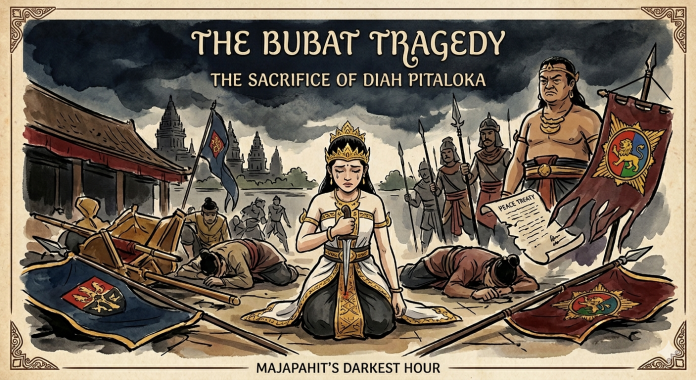

RADAR TULUNGAGUNG – Bubat Tragedy remains one of the most heartbreaking chapters in Indonesian history, marked by political ambition, betrayal, and ultimate sacrifice. At the center of this story stands Diah Pitaloka, a Sundanese princess whose fate became a symbol of honor and tragedy during the height of Majapahit power.
The story of the Bubat Tragedy began with what seemed like a promising union. King Hayam Wuruk of Majapahit, one of the most powerful rulers in the archipelago, proposed marriage to Diah Pitaloka, the daughter of King Linggabuana of Sunda. For many, this alliance represented hope for peace and prosperity between two great kingdoms.
However, beneath the surface, the Bubat Tragedy was already taking shape, driven by political ambition and conflicting interpretations of the marriage proposal.
A Royal Proposal with Hidden Tension
Diah Pitaloka was widely admired for her beauty, grace, and strong character. More than just a princess, she symbolized the dignity and future of the Sunda Kingdom. When news of the proposal spread, the royal court responded with mixed emotions. Some nobles saw an opportunity for unity, while others feared Majapahit’s growing ambition.
At the heart of this tension stood Gajah Mada, the powerful Mahapatih of Majapahit. Known for his famous oath to unite the archipelago, his vision often blurred the line between diplomacy and domination. This ambition would later play a crucial role in the unfolding of the Bubat Tragedy.
Journey to Majapahit
In 1357, the Sunda royal entourage began their journey to Majapahit. Led by King Linggabuana, the procession carried hopes of a peaceful union. Diah Pitaloka traveled in a grand royal carriage, symbolizing purity and unity between the two kingdoms.
The journey was majestic, passing through forests, rice fields, and villages where people cheered and prayed for peace. Yet, despite the grandeur, an uneasy feeling lingered. Reports and whispers suggested that Majapahit might have different intentions regarding the marriage.
As the group approached their destination, the atmosphere grew heavier. What was expected to be a joyous reception slowly turned into an unsettling silence.
Arrival at Bubat and Rising Suspicion
Upon arriving at Bubat, near the Majapahit capital, the Sunda delegation found no celebration. There were no welcoming ceremonies, no music, and no signs of festivity. Instead, Majapahit soldiers stood on guard with tense expressions.
This unusual reception raised suspicion among the Sunda nobles. King Linggabuana questioned the lack of respect, sensing something was wrong. The situation escalated when Gajah Mada appeared and delivered a shocking statement.
He declared that Diah Pitaloka was not to be treated as an equal bride, but as a symbol of Sunda’s submission to Majapahit. This statement transformed a marriage proposal into a political demand.
Clash of Honor
The declaration sparked outrage. King Linggabuana firmly rejected the notion of submission, emphasizing that Sunda came with dignity, not surrender. For the Sunda Kingdom, honor stood above all else.
Tensions quickly escalated into open conflict. The Bubat Tragedy reached its peak as war broke out between the vastly outnumbered Sunda forces and the powerful Majapahit army.
Despite their disadvantage, Sunda warriors fought bravely. They chose to defend their honor rather than accept humiliation. One by one, they fell on the battlefield, including King Linggabuana himself.
Diah Pitaloka’s Final Decision
As the battle raged, Diah Pitaloka witnessed the defeat of her kingdom’s forces and the death of her father. Faced with the reality of defeat and the threat of dishonor, she made a decision that would define her legacy.
Rather than become a symbol of submission, Diah Pitaloka chose to end her life. Using a hairpin, she took her own life as an act of ultimate sacrifice to preserve the dignity of Sunda.
Her decision cemented her place in history as a symbol of courage, purity, and unwavering honor. The Bubat Tragedy was no longer just a political conflict, it became a moral lesson passed down through generations.
Aftermath and Regret
The tragedy deeply affected King Hayam Wuruk. Reports suggest he never intended for the marriage to become a symbol of conquest. Upon learning the outcome, he was devastated by the loss of Diah Pitaloka.
Blame fell heavily on Gajah Mada, whose ambition had driven the conflict. As a result, he was removed from power and exiled. Despite Majapahit’s continued dominance, the emotional scars of the Bubat Tragedy lingered.
A Lesson from History
The Bubat Tragedy highlights the dangers of unchecked ambition and the importance of honor in leadership. It serves as a reminder that power without integrity can lead to destruction.
Diah Pitaloka’s sacrifice continues to inspire, representing the enduring value of dignity over life itself. Her story remains a powerful symbol in Indonesian history, reminding leaders to uphold justice and humanity above all.