
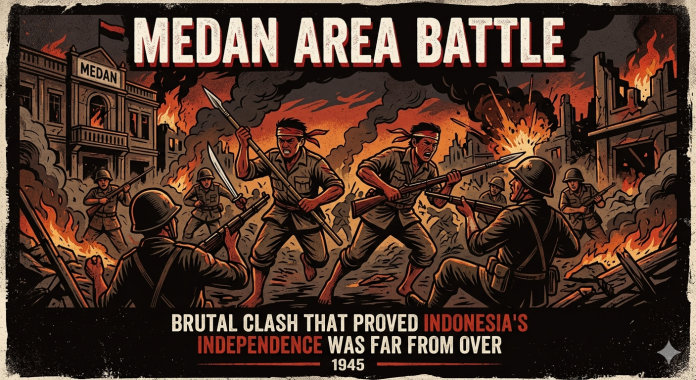

RADAR TULUNGAGUNG – Medan Area Battle 1945 stands as one of the most brutal and decisive conflicts in Indonesia’s early struggle to defend its independence. Although the nation declared freedom on August 17, 1945, reality quickly proved that independence was far from secure. Foreign powers, particularly the Dutch supported by Allied forces, refused to recognize Indonesia’s sovereignty.
In the weeks following independence, tension escalated rapidly. The Medan Area Battle 1945 became a powerful symbol of resistance, showing that independence was not simply declared, it had to be defended through continuous struggle and sacrifice.
Rising Tension After Independence
After Japan surrendered on August 15, 1945, Indonesia seized the opportunity to proclaim independence. However, Allied forces, including Britain, arrived in Indonesia with official missions such as disarming Japanese troops and maintaining order. Behind these missions, however, there was a hidden agenda.
The Dutch, through the Netherlands Indies Civil Administration (NICA), returned alongside the Allies. Their goal was clear: to reclaim Indonesia as a colony. This move triggered suspicion and anger among Indonesians, especially in North Sumatra.
In Medan, the situation quickly became volatile. Local communities began organizing resistance groups, including the Barisan Pemuda Indonesia and the People’s Security Army (TKR). These groups prepared for what they believed was an inevitable conflict.
The Spark That Ignited Conflict
The Medan Area Battle 1945 officially erupted on October 13, 1945. A Dutch soldier provoked Indonesian youth by tearing a red-and-white badge from a local’s chest and trampling on it. This act insulted national pride and sparked immediate clashes.
Violence escalated quickly. Street fights broke out, resulting in casualties on both sides. News of the incident spread rapidly, intensifying resistance across the region. Indonesian fighters began attacking Allied and Dutch positions, while the occupiers responded with increasing military force.
Soon, the conflict spread beyond Medan to surrounding areas such as Pematang Siantar and Berastagi. One notable clash, known as the Siantar Hotel Incident, saw Indonesian forces successfully attack Allied positions and capture several enemy troops.
“Fixed Boundaries Medan Area” and Open War
On December 1, 1945, the Allies and Dutch escalated tensions further by declaring “Fixed Boundaries Medan Area.” These were unilateral territorial claims marking zones under their control. Anyone crossing these boundaries risked being shot on sight.
This declaration turned Medan into a war zone. The term “Medan Area” itself originated from these boundary markers. The policy angered local fighters and civilians, leading to widespread armed resistance.
Indonesian forces, though poorly equipped, relied on guerrilla tactics. They used their knowledge of the terrain and launched night attacks. These strategies proved effective in slowing down Allied advances.
Months of Relentless Fighting
The Medan Area Battle 1945 continued for months with no clear resolution. Allied forces launched large-scale operations to crush Indonesian resistance. Meanwhile, Indonesian fighters mobilized civilians and strengthened defensive lines.
Despite superior weaponry, Allied troops struggled to fully control the region. By early 1946, they managed to take control of Medan city, forcing Indonesian officials to relocate to Pematang Siantar.
However, resistance did not end. Fighting persisted in rural areas, with Indonesian forces continuously launching counterattacks. The conflict caused heavy casualties and widespread destruction, including the burning of villages.
Failed Ceasefire and Final Outcome
Efforts to establish a ceasefire repeatedly failed. On November 3, 1946, planned negotiations collapsed when Allied forces violated the agreement by opening fire. This incident confirmed Indonesian suspicions that diplomacy could not be trusted.
The fighting finally subsided on February 15, 1947, following orders from the central government. A formal boundary agreement was later established on March 14, 1947, marking the end of the Medan Area conflict.
However, the struggle for independence continued. The Dutch launched further military aggressions, prolonging the war until international pressure forced them to recognize Indonesia’s sovereignty in 1949.
Legacy of the Medan Area Battle
Today, the Medan Area Battle 1945 is remembered as a powerful symbol of courage and unity. Monuments such as the Medan Area Memorial stand as reminders of the sacrifices made by fighters and civilians.
The battle highlights a crucial truth: Indonesia’s independence was not achieved overnight. It was the result of years of struggle, resilience, and unwavering determination.