
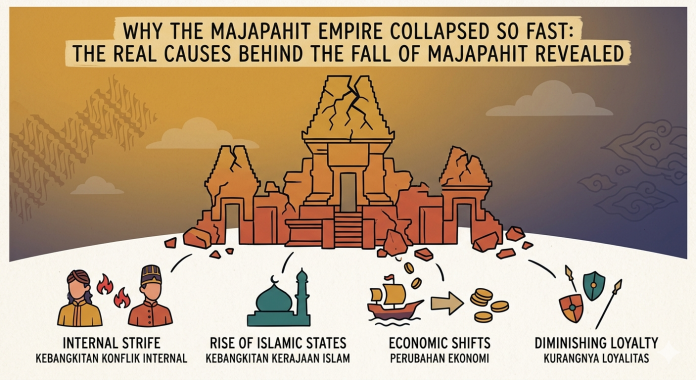

RADAR TULUNGAGUNG – The question of the fall of Majapahit continues to spark debate among historians and history enthusiasts. Despite its reputation as one of the greatest empires in Southeast Asian history, Majapahit only lasted around three centuries. This relatively short lifespan often raises comparisons with longer-lasting civilizations. However, experts argue that longevity alone does not define greatness.
The fall of Majapahit was not a simple event triggered by a single cause. Instead, it resulted from a complex combination of internal and external factors. Contrary to popular belief, historical evidence suggests that Majapahit did not collapse primarily due to an attack from Demak, as often portrayed in later Javanese chronicles.
External Factors: Misinterpreted Historical Narratives
Many traditional accounts, particularly from secondary sources like Babad Tanah Jawi, claim that Demak played a decisive role in destroying Majapahit. However, historians who rely on primary sources such as inscriptions argue otherwise. Evidence indicates that Majapahit had already weakened before Demak rose to prominence.
The real turning point came when the Girindrawarddhana dynasty, based in Daha (modern Kediri), challenged Majapahit’s authority. By the time Demak attacked in the 16th century, it was Daha, not Majapahit, that became the main target. This distinction is crucial in understanding the actual sequence of events behind the fall of Majapahit.
Internal Collapse: The Real Root of the Problem
While external pressures played a role, historians emphasize that internal issues were far more decisive in causing the fall of Majapahit. One of the most critical factors was the erosion of public trust in the government.
Historical records, including notes from Portuguese traveler Tome Pires in Suma Oriental, describe how people in Java during Majapahit’s final years no longer trusted their rulers. This loss of trust marked a stark contrast with the empire’s golden age under King Hayam Wuruk.
During its peak, Majapahit maintained a strong connection between the ruler and the people. The king frequently traveled across regions, interacting directly with citizens. These visits were not marked by fear but by enthusiasm, as people gathered, even climbing trees, just to see their ruler. This reflects a deep sense of loyalty and emotional connection.
Leadership Shift: From Accessibility to Fear
The situation changed dramatically in the later period. Under rulers like Batara Vojaya, the relationship between the state and its people deteriorated. Instead of openness, fear began to dominate. Accounts suggest that any man found on the road during royal travel could face execution, indicating a government increasingly detached from its citizens.
This shift highlights a broader pattern: when leaders isolate themselves and rule through fear rather than trust, instability becomes inevitable. The fall of Majapahit illustrates how quickly a strong civilization can weaken when its internal cohesion breaks down.
Decline of Law Enforcement and Governance
Another key factor in the fall of Majapahit was the decline in law enforcement. During its golden age, Majapahit enforced strict laws that applied to everyone, including the elite. Legal systems such as Kutara Manawa ensured justice and order across the empire.
However, in its final phase, these systems weakened. Corruption, selective law enforcement, and administrative decline contributed to widespread dissatisfaction. When laws are no longer upheld consistently, public confidence erodes, further accelerating collapse.
Economic and Social Disruptions
Internal conflicts, such as the Paregreg civil war, also played a significant role. This conflict created dual centers of power, confusing citizens about loyalty and taxation. As a result, economic stability declined, leading to food shortages and social unrest.
Previously, Majapahit had been known for agricultural productivity and surplus rice exports. The disruption of this system further signaled the empire’s weakening foundation.
A Lesson from History
Ultimately, the fall of Majapahit serves as a powerful reminder that the strength of a nation lies in the relationship between its government and its people. External threats may act as triggers, but internal decay is often the real cause of collapse.
Historians suggest that when trust disappears, law enforcement weakens, and leaders become disconnected, even the greatest empires can fall. The story of Majapahit is not just about the past, it offers valuable lessons for modern societies about governance, unity, and resilience.