
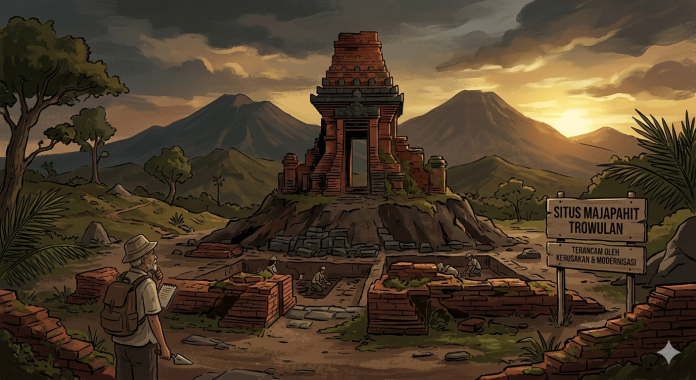

RADAR TULUNGAGUNG – The story of the Majapahit Kingdom capital Trowulan continues to fascinate historians and archaeologists, as new interpretations of ancient texts and archaeological discoveries shed light on one of Southeast Asia’s most powerful empires. Believed to have flourished between the 13th and 16th centuries, the Majapahit Kingdom remains a defining chapter in the historical narrative of the Indonesian archipelago.
The Majapahit Kingdom capital Trowulan is widely accepted by experts as the political and cultural center of this Hindu-Buddhist empire. Located in Trowulan, the site contains thousands of archaeological remains that illustrate the grandeur of the kingdom. From temple ruins to ancient artifacts, the area serves as a living archive of Majapahit’s golden age.
The existence of Majapahit is not only supported by physical evidence but also by historical texts such as the Nagarakretagama, written by Mpu Prapanca in 1365. This manuscript provides detailed descriptions of the kingdom’s administration, territories, and royal life, especially during the reign of King Hayam Wuruk.
Ancient Records and Historical Validation
The earliest confirmed evidence of Majapahit comes from the Kudadu Inscription, which mentions the first king, Kertarajasa Jayawardhana. Complementary sources like the Pararaton further enrich the historical narrative, although some were written centuries after the kingdom’s decline.
Scholarly interest in Majapahit intensified during the colonial period, particularly under Thomas Stamford Raffles, who documented ancient ruins in Java in the early 19th century. Later, Dutch archaeologist J.L.A. Brandes played a crucial role in preserving the Nagarakretagama manuscript after rescuing it from a destroyed palace in Lombok.
The Missing Palace Mystery
Despite extensive research, the exact location of the Majapahit royal palace remains unknown. Experts believe that the palace may have shifted locations over time due to political changes and internal conflicts. This uncertainty adds to the enduring mystery surrounding the Majapahit Kingdom capital Trowulan.
Historians also point to continuous conflicts, including internal power struggles and external invasions, as factors contributing to the destruction of royal structures. Over the centuries, natural decay and human activity have further erased physical traces of the palace.
Archaeological Riches of Trowulan
Even without a confirmed palace site, Trowulan Archaeological Site offers compelling evidence of a sophisticated urban civilization. Excavations have uncovered a wide range of artifacts, including ceramics from China and Thailand, terracotta objects, metal coins, and jewelry.
Prominent structures such as Candi Brahu highlight the architectural achievements of the Majapahit era. Estimated to date back to the 15th century, this temple may have even older origins linked to earlier Javanese kingdoms.
Other significant sites include Segaran Pond, believed to have ceremonial functions, and monumental gateways like Wringin Lawang Gate and Bajang Ratu Gate. These structures reflect the complexity and grandeur of Majapahit urban planning.
Preservation Challenges and Cultural Importance
Despite its historical significance, the Majapahit Kingdom capital Trowulan faces serious preservation challenges. Many archaeological sites are located within residential areas, making conservation efforts difficult. Economic pressures have led some locals to excavate land for materials, inadvertently damaging valuable historical layers.
Artifacts have been lost, sold, or destroyed over time, raising concerns among historians and cultural activists. While the government has initiated preservation programs since the 1980s, many believe these efforts are insufficient to protect the remaining heritage.
Experts emphasize that preserving Trowulan is not just about saving physical structures but also about maintaining cultural identity. The legacy of Majapahit represents a crucial foundation of Indonesian history, offering lessons about governance, culture, and unity.
A Legacy Worth Protecting
Today, many artifacts from Trowulan are preserved in the Trowulan Museum, providing valuable insights into the past. However, the broader landscape still holds untapped historical treasures waiting to be explored.
The Majapahit Kingdom capital Trowulan stands as a testament to Indonesia’s rich heritage. Its preservation is essential, not only for academic study but also for future generations to understand the greatness of one of the archipelago’s most influential empires.