
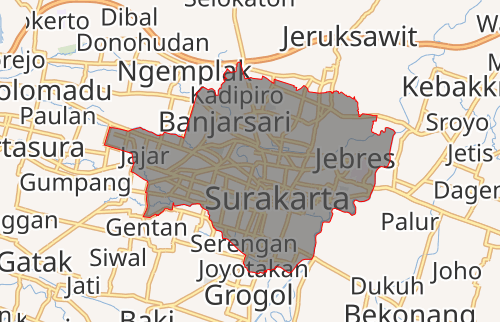

RADAR TULUNGAGUNG – The Surakarta Special Region was the first special autonomous territory formally recognized by the newly established Republic of Indonesia after independence in 1945. Yet within a few years, political turmoil, competing power centers, security crises, and shifting national policies led to the suspension of its authority, making it one of the most debated constitutional episodes in Indonesian history.
Following Indonesia’s declaration of independence on August 17, 1945, Susuhunan Pakubuwono XII of the Surakarta Sunanate and Mangkunegoro VIII of the Mangkunegaran principality pledged their support to the new republic. Their declarations were welcomed by President Soekarno, who recognized Surakarta as a special region directly linked to the central government.
The arrangement initially placed Surakarta alongside Yogyakarta as one of Indonesia’s privileged monarchic territories. However, unlike Yogyakarta, Surakarta soon became the center of intense political conflict that would ultimately reshape its status.
The Birth of the Surakarta Special Region
Surakarta entered the independence era with a unique political structure. The territory consisted of two historic Javanese monarchies: the Surakarta Sunanate and the Mangkunegaran principality. Both had enjoyed special administrative standing during the Dutch colonial era and later under Japanese occupation.
On September 1, 1945, Pakubuwono XII and Mangkunegoro VIII formally declared their territories part of the Republic of Indonesia while retaining their status as special regions. President Soekarno reaffirmed their positions as regional leaders through official presidential decrees.
Yet the new arrangement quickly faced challenges. Revolutionary groups, local political activists, and armed militias questioned whether hereditary monarchies were compatible with the republican ideals emerging across Indonesia. At the same time, supporters of the royal institutions argued that the monarchies had voluntarily joined the republic and deserved constitutional protection.
Political Conflict and the Erosion of Authority
Throughout 1945 and 1946, Surakarta experienced growing instability. Multiple institutions exercised authority simultaneously, including the royal governments, local nationalist committees, and revolutionary organizations.
Political polarization intensified between groups supporting the continuation of the special region and factions seeking its abolition. Kidnappings, attacks on officials, and violent confrontations became increasingly common.
Among the most dramatic incidents was the temporary abduction of Pakubuwono XII in early 1946. Several regional administrations also broke away from the authority of the royal governments, further weakening Surakarta’s political position.
Faced with deteriorating security conditions, the central government gradually assumed greater control over the territory. In June 1946, Surakarta’s administration was effectively placed under direct central oversight while authorities sought a long-term constitutional solution.
National Revolution and the Debate Over Special Status
Despite losing much of its governing authority, Pakubuwono XII remained publicly committed to the Indonesian republic during the struggle against Dutch attempts to regain control.
Historical records indicate that the Surakarta palace contributed funds, vehicles, weapons, logistical support, and facilities to the republican cause. During the Dutch military offensives of 1947 and 1948, palace officials maintained contacts with Indonesian authorities and military leaders.
Meanwhile, the legal status of Surakarta remained unresolved. The enactment of Law No. 22 of 1948 on regional government created new uncertainties regarding special regions and their constitutional standing.
Royal authorities repeatedly petitioned Jakarta to clarify Surakarta’s future position. Proposals ranged from restoring the special region under a more democratic structure to integrating its institutions within Indonesia’s evolving regional government system.
How Surakarta Ultimately Lost Its Special Status
The dispute continued into the early 1950s as Indonesia transitioned from revolution to state-building. While supporters of the Surakarta monarchy organized demonstrations demanding restoration of special-region status, opponents continued to advocate full integration into the national administrative system.
A decisive turning point came with the formation of Central Java Province in 1950, which incorporated Surakarta into the provincial structure. Subsequent legislation established autonomous local governments that further reduced the political role of the royal institutions.
Although Pakubuwono XII continued lobbying for constitutional recognition throughout the 1950s, the central government never restored Surakarta’s special status. The issue was effectively settled when later national regulations standardized regional administration across most former self-governing territories.
Today, the Surakarta Sunanate and Mangkunegaran remain influential cultural institutions rather than political authorities. Nevertheless, debates over the historical status of the Surakarta Special Region continue to attract interest among historians, legal scholars, and regional political groups, making it one of the most enduring constitutional questions in modern Indonesian history.