
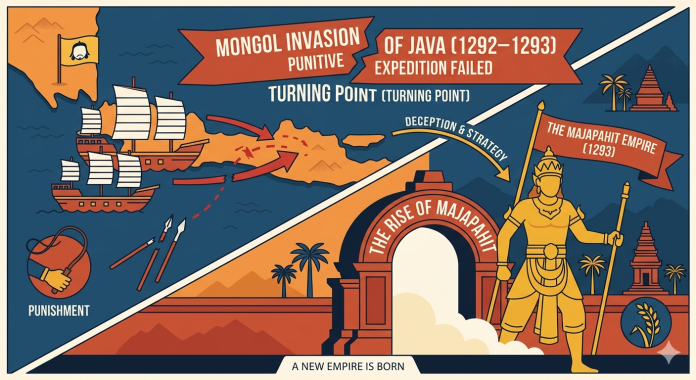

RADAR TULUNGAGUNG – The Mongol invasion of Java stands as one of history’s most ironic turning points, where a failed military campaign unexpectedly gave birth to a powerful new empire. What began as a punitive expedition ordered by Kublai Khan ultimately reshaped the political landscape of Southeast Asia.
The Mongol invasion of Java in 1292–1293 was meant to punish the Kingdom of Singhasari for insulting the Mongol emperor. Instead, it ended in chaos, deception, and the rise of Majapahit, one of the most influential empires in Indonesian history.
At the center of this story lies a chain of miscalculations, rebellion, and strategic brilliance that turned the Mongols’ ambition into one of their most embarrassing defeats.
The Spark of Conflict
The conflict traces back to 1279 when Kublai Khan, ruler of the Yuan Dynasty, demanded submission from neighboring kingdoms. Singhasari, a relatively small but strategically powerful kingdom in Java, refused.
Its ruler, Kertanegara, went further by humiliating Mongol envoys, cutting their ears and branding their faces before sending them back. This act was seen as a grave insult, prompting Kublai Khan to plan a large-scale retaliation.
However, by the time the Mongol forces were ready to strike, internal turmoil had already destabilized Java.
Political Chaos in Java
Before the Mongols arrived, Singhasari collapsed due to a rebellion led by Jayakatwang of Kediri. Kertanegara was killed, and power shifted dramatically.
Amid the chaos, Raden Wijaya, Kertanegara’s son-in-law, emerged as a key figure. Though initially weak, he cleverly navigated the political situation. With the help of Arya Wiraraja, a skilled political strategist, Raden Wijaya secured a temporary alliance with Jayakatwang.
He then established a new settlement in a forest area called Majapahit, named after the bitter maja fruit found there.
Arrival of the Mongol Forces
In 1293, the Mongol army finally reached Java with around 20,000 troops. They expected to confront Kertanegara but instead found a completely different political reality.
Seizing the opportunity, Raden Wijaya approached the Mongols and convinced them he was the rightful ruler of Singhasari. He promised loyalty and tribute if they helped him defeat Jayakatwang.
The Mongols agreed.
A Strategic Betrayal
The joint forces successfully defeated Jayakatwang in Kediri. However, victory quickly turned into complacency. Mongol troops began celebrating and looting, unaware of the trap being set.
Raden Wijaya used this moment to execute a carefully planned betrayal. After returning to Majapahit under the pretense of preparing tribute, he launched a surprise attack on the Mongol forces.
Caught off guard, the Mongol army suffered heavy losses. Exhausted, disorganized, and unfamiliar with the terrain, they were forced into a chaotic retreat.
The Mongols’ Embarrassing Defeat
The Mongol invasion of Java ended in humiliation. The once-feared army returned to China with minimal gains and significant losses, eearning the wrath of Kublai Khan.
This defeat added to a series of failed expeditions by the Mongols, particularly in maritime regions like Japan and Vietnam, where unfamiliar conditions often worked against them.
Birth of a Maritime Power
For Raden Wijaya, the victory marked the beginning of something far greater. He officially established the Majapahit Kingdom, which would later grow into a dominant maritime empire controlling much of the Indonesian archipelago.
Interestingly, the Mongol presence also introduced gunpowder technology to the region, giving Majapahit an additional advantage in warfare.
The death of Kublai Khan in 1294 further eased external pressures. His successor adopted a more diplomatic approach, allowing Majapahit to expand without fear of renewed Mongol attacks.
A Turning Point in World History
The Mongol invasion of Java illustrates how interconnected global history can be. A mission intended to enforce dominance instead facilitated the rise of a new power.
What seemed like a routine act of imperial punishment ended up reshaping Southeast Asia, proving that even the mightiest empires can inadvertently create their own challengers.