
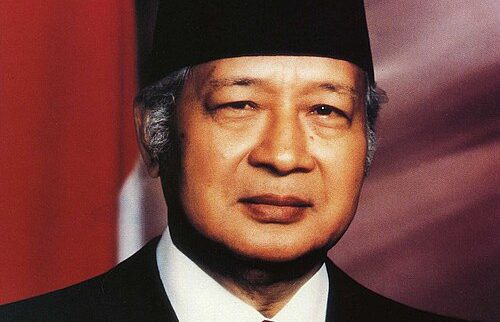

RADAR TULUNGAGUNG – The Soeharto legacy remains one of the most debated chapters in modern Indonesian history. After ruling Indonesia for more than three decades, the country’s second president is remembered both for driving rapid economic development and for presiding over an authoritarian regime marked by political repression and alleged human rights abuses.
Even decades after his resignation in 1998, public opinion remains divided. Some Indonesians credit Soeharto with transforming a struggling nation into one of Southeast Asia’s fastest-growing economies, while critics argue that his rule weakened democratic institutions and enabled widespread corruption.
The debate over the Soeharto legacy continues to shape discussions about governance, development, and democracy in Indonesia, making his presidency one of the most consequential periods in the country’s post-independence history.
From Humble Origins to National Power
Soeharto was born on June 8, 1921, in Kemusuk, Yogyakarta, and grew up in modest circumstances during the Dutch colonial era. His childhood was marked by family instability, economic hardship, and frequent relocations.
Financial limitations prevented him from pursuing higher education, so he entered military service through the Dutch colonial army, KNIL, in 1940. Following the Japanese occupation of Indonesia during World War II, he joined Japanese-sponsored security forces and later became a member of PETA, the militia that Japan established during the occupation.
After Indonesia proclaimed independence in 1945, Soeharto joined the newly formed Indonesian military and rapidly advanced through its ranks. He became known for his role in military operations during the Indonesian National Revolution, including participation in the March 1, 1949 General Offensive in Yogyakarta, an event that demonstrated the survival of the Republic.
Political turmoil surrounding the September 30 Movement in 1965 accelerated his rise to power. As military leaders moved against the Indonesian Communist Party (PKI), Soeharto emerged as the dominant figure within the armed forces and gradually consolidated power from President Soekarno.
Supporting Data and Historical Background
In March 1967, Indonesia’s provisional parliament appointed Soeharto acting president, and lawmakers formally inaugurated him as president in 1968.
Soeharto inherited a country facing severe economic instability, soaring inflation, and political uncertainty. To stabilize the economy, his administration implemented market-oriented reforms and relied on a team of Western-educated economists often referred to as the “Berkeley Mafia.”
His government used those policies to reduce inflation, attract foreign investment, and stimulate economic growth. Indonesia achieved rice self-sufficiency in 1984, a milestone often cited as one of the New Order government’s major achievements.
During much of the 1970s and 1980s, Indonesia recorded strong economic expansion, supported by oil revenues, foreign investment, and large-scale infrastructure projects. The government’s family planning programs also received international recognition.
However, economic growth came with significant criticism. Political elites concentrated wealth, relied heavily on foreign capital, and fueled recurring allegations of corruption, collusion, and nepotism. The government heavily centralized political power, restricted opposition groups, and subjected media organizations to censorship.
Human rights organizations and historians have also highlighted the anti-communist purge that followed the events of 1965. Estimates vary, but the violence killed hundreds of thousands of people, making it one of the deadliest episodes in modern Indonesian history.
Reactions, Impact, and the End of the New Order
The Asian Financial Crisis of 1997 proved to be the greatest challenge to Soeharto’s rule. Indonesia’s economy collapsed as the rupiah plunged in value, inflation surged, and unemployment increased dramatically.
Although Indonesia secured a rescue package worth approximately US$43 billion from the International Monetary Fund (IMF), public dissatisfaction intensified. Student-led demonstrations spread nationwide, demanding political reform and an end to the New Order regime.
The movement reached a turning point after the fatal shooting of four students from Trisakti University in May 1998. The incident triggered widespread unrest and intensified calls for Soeharto’s resignation.
On May 21, 1998, after 32 years in power, Soeharto officially stepped down as president and transferred authority to Vice President BJ Habibie. His resignation marked the beginning of the Reformasi era and a transition toward democratic governance.
Following his departure from office, Soeharto faced allegations of corruption involving charitable foundations and state resources. Several investigations were launched, but legal proceedings were ultimately halted because of his declining health. International organizations later cited estimates suggesting billions of dollars may have been misappropriated during his presidency, allegations that remained politically contentious.
Soeharto died on January 27, 2008, in Jakarta at the age of 86. His legacy continues to divide opinion, reflecting the complex balance between economic modernization and authoritarian rule that defined Indonesia’s New Order era.