

RADAR TULUNGAGUNG – The story of Indonesian independence on August 17, 1945, is widely known. It marks a defining moment when the nation declared freedom after centuries of colonial rule. However, behind this monumental event lie many untold stories that rarely make it into textbooks.
These Indonesian independence facts reveal a deeper, more complex narrative filled with tension, urgency, and unexpected twists. From health struggles of key figures to hidden roles played by unlikely allies, each detail adds a new layer to the historic proclamation.
Understanding these lesser-known Indonesian independence facts is crucial, especially for younger generations. By revisiting these stories, the public can gain a richer appreciation of the sacrifices and extraordinary circumstances that shaped Indonesia’s path to sovereignty.
Sukarno’s Illness on Proclamation Day
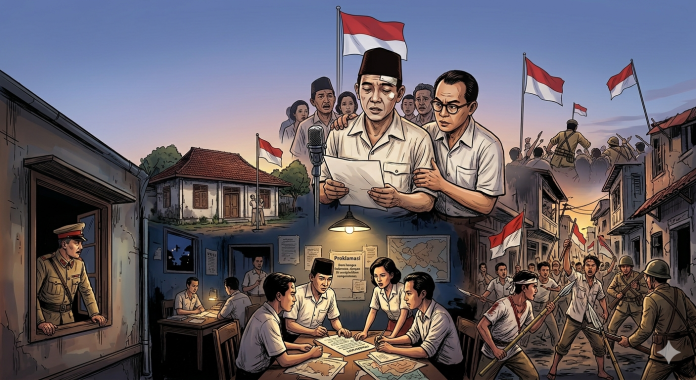
One of the most surprising Indonesian independence facts is that President Sukarno was seriously ill on the day he proclaimed independence. On August 17, 1945, Sukarno was suffering from tertian malaria and had a high fever. Despite his condition, he insisted on proceeding with the proclamation.
After staying up late the previous night to finalize the proclamation text at the residence of a Japanese naval officer, Sukarno was awakened by his doctor in the morning. He received medical treatment before finally appearing at 10 a.m., dressed in white, alongside Mohammad Hatta. Shortly after delivering the proclamation, Sukarno returned to his bedroom to rest, showing how critical the moment was despite his fragile health.
The Story Behind the First Red-and-White Flag
Another fascinating Indonesian independence fact involves the iconic red-and-white flag. The original flag was sewn by Fatmawati, Sukarno’s wife, using fabric obtained during the Japanese occupation.
The materials were reportedly acquired with the help of a Japanese officer sympathetic to Indonesia’s independence movement. To avoid suspicion, the fabric was initially separated into two pieces and later reassembled before the proclamation ceremony. The original flag was used annually until 1968, when it became too fragile and was preserved as a historical artifact. Today, replicas are used for official ceremonies.
A Japanese Officer Who Helped Indonesia
One of the most unexpected Indonesian independence facts is the role of Admiral Tadashi Maeda. The proclamation text was drafted at his residence, raising questions about why a Japanese officer would support Indonesian independence.
Maeda reportedly sympathized with the Indonesian struggle and ensured the safety of national leaders while they prepared the proclamation. However, his actions came at a cost. After Japan’s defeat, he was arrested and imprisoned for assisting Indonesia, highlighting the risks he took in supporting the independence movement.
The Lost Draft Found in a Trash Bin
The original handwritten draft of the proclamation holds its own intriguing story. Unlike the typed version read publicly, the draft was nearly lost forever.
It was discovered by journalist B.M. Diah in a trash bin at Maeda’s house shortly after being typed. Recognizing its historical value, Diah kept the document for decades before handing it over to the government in 1992. This Indonesian independence fact underscores how easily crucial historical evidence could have disappeared.
Why the Date Reads “Year 05”
A detail that often confuses people is the date written on the proclamation text: “17-8-05.” This refers not to 1905 or 2005, but to the Japanese imperial calendar.
At the time, Indonesia followed Japan’s calendar system, where 1945 corresponded to the year 2605. The “05” was taken from this system, making it another unique Indonesian independence fact tied to the era of occupation.
Rare Photos That Almost Never Surfaced
Photographic documentation of the proclamation was extremely limited. Capturing such moments was risky under Japanese control.
Two photographers, Alex and Frans Mendur, managed to take several historic photos. Frans cleverly hid the film negatives to prevent Japanese forces from confiscating them. Months later, the photos were finally published, becoming invaluable records of Indonesia’s birth as a nation.
The Proclamation Recording Is Not Original
Interestingly, the voice recording of Sukarno reading the proclamation that Indonesians hear today is not from 1945. It is a re-recording made years later.
At the time of independence, there was no proper recording equipment available. The widely circulated audio was recreated to preserve the moment for future generations.
The Title “Proclamator” Came Much Later
Although Sukarno and Hatta are universally recognized as the Proclamators of Indonesia, the official title was granted decades later. For many years, it was simply a public acknowledgment rather than a formal designation.
This Indonesian independence fact reflects the evolving political dynamics in Indonesia, especially during the New Order era, when historical narratives were reshaped.
These hidden stories remind us that independence was not just a single event but a series of complex moments filled with sacrifice, courage, and unexpected alliances. Understanding these Indonesian independence facts allows a deeper appreciation of the nation’s journey toward freedom.