
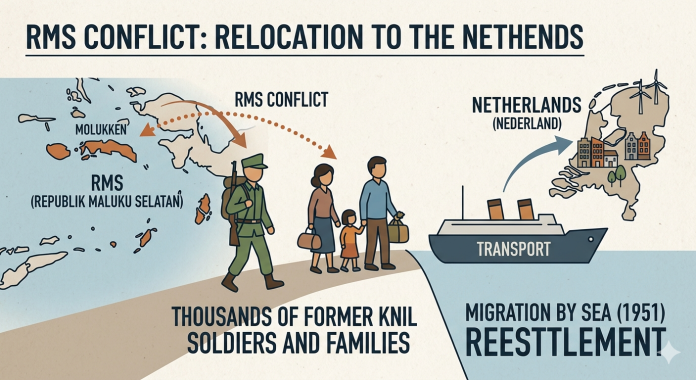

RADAR TULUNGAGUNG – The South Maluku Republic (RMS) remains one of the most controversial legacies of Indonesia’s post-independence era. Declared in April 1950 amid political tensions surrounding the future of the newly independent nation, the South Maluku Republic triggered a military conflict that ultimately led thousands of former KNIL soldiers and their families to relocate to the Netherlands.
The movement emerged during a turbulent period following the transfer of sovereignty from the Netherlands to Indonesia in December 1949. At the time, Indonesia briefly operated as the federal Republic of the United States of Indonesia (RIS). As political momentum shifted toward a unitary state, some political leaders and former colonial military personnel in South Maluku opposed the transition and advocated a separate political future.
On April 25, 1950, RMS leaders proclaimed the Republic of South Maluku in Ambon. The declaration gained support from segments of the local population and many former members of the KNIL, the Royal Netherlands East Indies Army. However, the Indonesian government rejected the proclamation and viewed it as a challenge to national sovereignty.
How the South Maluku Republic Was Established
The RMS declaration occurred against the backdrop of the dissolution of colonial institutions and uncertainty over the future of former KNIL personnel. For decades, the Dutch colonial administration had recruited large numbers of soldiers from Maluku, particularly from Ambon. Following Indonesian independence, the disbandment of KNIL created difficult choices for these troops regarding their military status and political allegiance.
Indonesia responded by launching military operations to regain control of Ambon and surrounding areas. By late 1950, Indonesian forces had captured key RMS strongholds in Ambon, although resistance continued in parts of Seram for several years. The conflict became one of the earliest internal security challenges faced by the young Indonesian republic.
Why Former KNIL Soldiers Were Sent to the Netherlands
One of the most significant consequences of the conflict involved former KNIL soldiers of Malukan origin. Historical records indicate that approximately 12,500 former KNIL personnel and family members were transported to the Netherlands in 1951 after political negotiations over their future reached a deadlock. Many expected the relocation to be temporary and hoped to return once conditions improved.
Researchers studying the migration note that many of these families maintained strong emotional ties to Maluku despite establishing new lives in Europe. Over time, a sizable Malukan community emerged in the Netherlands, preserving cultural traditions while continuing debates over the RMS legacy.
The issue also reflected broader tensions surrounding the dissolution of KNIL. While some former soldiers supported RMS, others accepted integration into Indonesian institutions or supported the Republic of Indonesia. Historians caution against portraying the entire Ambonese community as uniformly pro-RMS, as political views varied considerably across Maluku.
The Lasting Legacy of RMS in Indonesia and the Netherlands
More than seven decades later, the South Maluku Republic remains a sensitive historical subject in both Indonesia and the Netherlands. The Indonesian government continues to regard RMS as a separatist movement whose military challenge ended decades ago. Meanwhile, RMS organizations in the Netherlands maintain a government-in-exile and continue to advocate their historical interpretation of events.
For historians, the RMS episode illustrates the complex human consequences of decolonization. The conflict not only shaped political developments in eastern Indonesia but also created a diaspora community whose identity was forged by war, migration, and competing visions of nationhood.
The story of the South Maluku Republic continues to resonate because it links Indonesia’s struggle to consolidate independence with the experiences of thousands of former KNIL soldiers who found themselves caught between two nations during one of Southeast Asia’s most dramatic political transitions.