
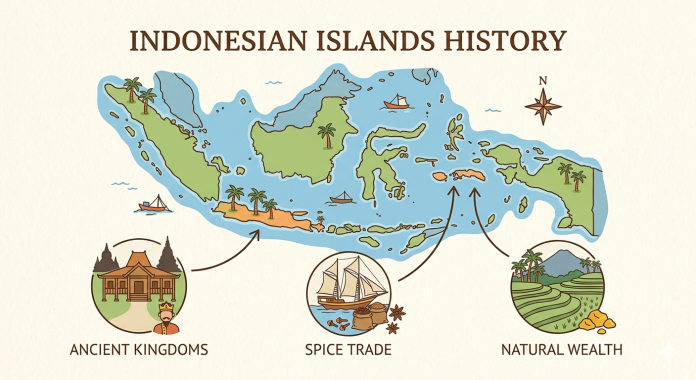

RADAR TULUNGAGUNG – Indonesian Islands History reflects centuries of trade, exploration, and cultural exchange that transformed the archipelago into one of the world’s most influential maritime regions. Spread across thousands of islands, Indonesia’s major island groups developed distinct civilizations, economies, and traditions that continue to shape the nation today.
From the ancient trading ports of Sumatra and the powerful kingdoms of Java to the globally renowned Spice Islands of Maluku, Indonesian Islands History reveals how natural resources and strategic sea routes attracted merchants from India, China, the Middle East, and later Europe. These interactions helped establish the archipelago as a vital center of commerce long before the modern era.
The story of Indonesian Islands History is also a story of diversity. Kalimantan’s early Hindu kingdoms, Sulawesi’s maritime heritage, Papua’s extraordinary biodiversity, and the cultural landscapes of the Lesser Sunda Islands each contributed unique chapters to the development of Indonesia. Together, they formed a network of societies whose influence extended far beyond Southeast Asia.
Ancient Trade Networks Built Sumatra’s Reputation
Sumatra was known in ancient Sanskrit sources as Swarnadwipa or “Island of Gold,” reflecting its reputation for precious metals and commercial importance. Historical records indicate that the west coast settlement of Barus became a major trading center renowned for camphor, a valuable commodity exported across Asia and the Middle East.
The island later became the heartland of the powerful Srivijaya Empire, one of Southeast Asia’s most influential maritime kingdoms between the seventh and thirteenth centuries. Based in Sumatra, Srivijaya controlled key trade routes through the Malacca Strait and maintained diplomatic and commercial links with China, India, and neighboring kingdoms.
Today, Sumatra remains rich in natural resources, including minerals, energy reserves, and agricultural commodities, continuing a legacy that dates back centuries.
Natural Resources and Early Kingdoms Across the Archipelago
Kalimantan, the Indonesian portion of Borneo, played an important role in early Indonesian history. The region was home to Kutai Martadipura, widely recognized as Indonesia’s earliest known Hindu kingdom based on inscriptions dating to the fourth century CE. The island’s rivers facilitated trade in forest products, gold, and other natural resources.
Sulawesi developed a reputation for iron production and maritime expertise. The Kingdom of Luwu became known for its iron industry, while later kingdoms such as Gowa and Bone emerged as major political and trading powers. The Bugis people gained international recognition for their advanced shipbuilding traditions, particularly the construction of the famous Pinisi sailing vessels that navigated long-distance maritime routes.
Java, meanwhile, evolved into the political and agricultural center of the archipelago. Ancient texts referred to the island as Yavadvipa, often interpreted as the “Island of Rice.” Fertile volcanic soils supported intensive agriculture, helping sustain large populations and powerful states. The Majapahit Empire, which reached its peak during the fourteenth century, became one of the most influential kingdoms in Southeast Asian history.
Spice Trade, Biodiversity, and Tourism Drive Regional Importance
Maluku earned global fame as the original Spice Islands, producing cloves and nutmeg that became among the world’s most valuable commodities. European exploration during the fifteenth and sixteenth centuries was heavily motivated by efforts to gain direct access to these lucrative spice-producing islands. Historical records confirm that Maluku occupied a central position in global trade networks for centuries.
Papua, Indonesia’s easternmost region, is renowned for extraordinary biodiversity and abundant natural resources. The island hosts some of the world’s richest ecosystems and remains home to numerous endemic species, including birds-of-paradise. Scientific expeditions in the Foja Mountains during the twenty-first century documented previously unknown species, reinforcing Papua’s reputation as one of Earth’s most biologically diverse regions.
The Lesser Sunda Islands, which include Bali, Lombok, Sumbawa, Flores, Sumba, and Timor, developed distinct cultural and economic traditions. Bali became internationally recognized for its cultural heritage and natural beauty, while parts of Nusa Tenggara gained prominence through livestock production and valuable commodities such as sandalwood.
Today, Indonesian Islands History demonstrates how geography, trade, natural resources, and cultural exchange combined to create one of the world’s most diverse nations. Although some legendary accounts mentioned in traditional narratives remain unverified, the documented achievements of kingdoms, traders, sailors, and local communities continue to shape Indonesia’s national identity and historical legacy.