
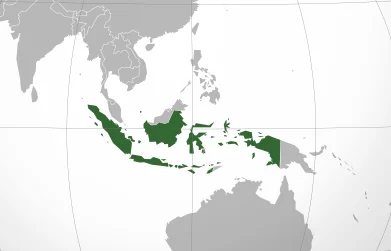

RADAR TULUNGAGUNG – The history of Indonesia stretches from ancient trading kingdoms and powerful maritime empires to centuries of colonial rule and a hard-fought independence struggle. Today, the world’s largest archipelagic nation stands as a unified state despite its vast geographic and cultural diversity.
For many people around the world, Indonesia is often associated primarily with Bali, a globally renowned tourist destination. Yet the country’s history extends far beyond a single island, encompassing thousands of islands that gradually became part of one nation through centuries of political, economic, and cultural transformation.
The history of Indonesia reveals how early trade networks, influential kingdoms, foreign colonial powers, and nationalist movements collectively shaped the modern Republic of Indonesia, which today is home to more than 270 million people.
Ancient Kingdoms Laid the Foundations of Indonesian Civilization
Archaeological evidence suggests that human ancestors lived in parts of present-day Indonesia as early as 1.8 million years ago, including the discovery of Homo erectus remains in Java. Meanwhile, modern human populations have inhabited the archipelago for tens of thousands of years.
The earliest documented historical developments emerged through trade connections with India and China. By the early centuries CE, merchants exchanged goods across maritime routes linking Sumatra, Java, and other islands with major Asian civilizations. These interactions introduced Hinduism and Buddhism, which profoundly influenced local societies.
One of the most significant early powers was the Srivijaya Empire, a maritime kingdom centered in Sumatra that dominated regional trade between the 7th and 13th centuries. Srivijaya controlled important shipping routes and became a major center of Buddhist learning.
Following Srivijaya’s decline, the Majapahit Empire, founded in 1293 in East Java, emerged as one of the most influential states in Southeast Asian history. Under leaders such as Hayam Wuruk and statesman Gajah Mada, Majapahit expanded its influence across large parts of the archipelago and strengthened regional commerce.
Colonial Competition Reshaped the Archipelago
Beginning in the 16th century, European powers arrived in Southeast Asia seeking access to the lucrative spice trade. Portugal captured Malacca in 1511 and expanded its presence into the Maluku Islands, known globally as the Spice Islands.
The Dutch later became the dominant colonial force. The first Dutch expedition led by Cornelis de Houtman reached Java in 1596. Soon afterward, the VOC (Dutch East India Company) was established in 1602 and gained extensive authority to conduct trade, wage war, and administer territories.
Over time, the VOC transformed from a trading enterprise into a colonial power. After the company’s bankruptcy in 1799, the Dutch government assumed direct control, creating the Dutch East Indies.
Dutch colonial policies significantly affected local populations. During the 19th century, the controversial Cultivation System required many farmers to devote part of their land and labor to export crops such as coffee, sugar, tea, and spices. While these policies generated substantial profits for the Netherlands, they imposed heavy burdens on many Indonesians.
Resistance movements emerged throughout the archipelago. One of the most notable was the Java War (1825-1830), led by Prince Diponegoro, which became one of the largest anti-colonial uprisings against Dutch rule.
Independence Movement Transformed Indonesia’s Future
In the early 20th century, expanded educational opportunities contributed to the rise of Indonesian nationalism. Intellectuals, students, and political activists increasingly advocated self-determination and independence.
The situation changed dramatically during World War II when Japan occupied Indonesia from 1942 to 1945 after defeating Dutch colonial forces. Although the occupation brought hardship and exploitation, it also accelerated nationalist mobilization.
Following Japan’s surrender, Soekarno and Mohammad Hatta proclaimed Indonesia’s independence on August 17, 1945. However, independence was not immediately recognized. Armed conflict and diplomatic negotiations followed as Dutch authorities attempted to re-establish colonial control.
International pressure, including criticism from the United States and the United Nations, eventually pushed the Netherlands toward a settlement. On December 27, 1949, the Dutch formally transferred sovereignty, marking international recognition of Indonesian independence.
Indonesia subsequently experienced periods of parliamentary democracy, Guided Democracy under President Soekarno, the New Order era under President Soeharto beginning in 1966, and democratic reforms following the Reformasi movement in 1998.
Today, Indonesia remains one of the world’s most influential emerging economies and the largest nation in Southeast Asia. The history of Indonesia demonstrates how centuries of trade, cultural exchange, colonial resistance, and national unity helped transform a diverse archipelago into a modern sovereign state.