
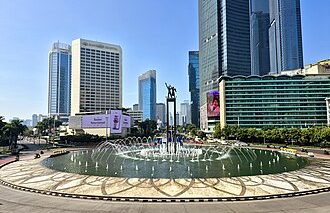

RADAR TULUNGAGUNG – The history of Jakarta reflects centuries of political change, colonial expansion, urban planning, and nation-building that transformed a small port known as Sunda Kelapa into Indonesia’s modern capital. From the rise of Jayakarta and Batavia to post-independence modernization, the city’s development mirrors the broader history of the Indonesian archipelago.
Today’s Jakarta is one of Southeast Asia’s largest metropolitan areas, but its origins date back to a thriving maritime trading hub that connected merchants from across Asia, the Middle East, and Europe. Strategic geography turned the city into a key gateway for commerce long before colonial powers arrived.
The history of Jakarta also reveals how successive rulers, from the Sunda Kingdom and Islamic sultanates to the Dutch colonial administration and independent Indonesia, reshaped the city according to their political ambitions, leaving visible traces that remain part of Jakarta’s urban landscape.
From Sunda Kelapa to Batavia
The earliest chapter in the history of Jakarta began with Sunda Kelapa, a major port under the control of the Hindu Sunda Kingdom. By the 15th century, the harbor had grown into an important trading center that attracted merchants from China, Arabia, and various parts of the archipelago.
Seeking support against the growing influence of Islamic kingdoms in Java, the Sunda Kingdom forged ties with Portugal in the early 16th century. However, the alliance did not last long.
On June 22, 1527, forces led by Fatahillah, a military commander associated with the Sultanate of Demak and later Cirebon, captured Sunda Kelapa and expelled the Portuguese. He then renamed the settlement Jayakarta, meaning “complete victory” or “glorious victory.” Jakarta still celebrates that date as the city’s official anniversary.
A dramatic transformation followed in 1619 when the Dutch East India Company (VOC), under the leadership of Jan Pieterszoon Coen, destroyed Jayakarta and established Batavia. Dutch planners designed the new colonial city according to urban models from the Netherlands, incorporating canals, fortifications, public squares, churches, and administrative buildings.
Supporting Data and Historical Background
During the 17th century, Batavia emerged as the VOC’s most important Asian headquarters and one of the busiest ports in the region. Dutch authorities constructed an extensive canal network inspired by Amsterdam, while commercial activity connected the city to trade routes stretching from Europe to East Asia.
Many remnants of this era survive in what is now Kota Tua Jakarta. Historic structures such as the former city hall, now the Jakarta History Museum, continue to illustrate Batavia’s colonial legacy.
By the late 18th century, deteriorating health conditions within the walled city encouraged residents to move southward. This shift accelerated under Governor-General Herman Willem Daendels, who promoted the development of Weltevreden, an area near present-day Central Jakarta.
The expansion produced many neighborhoods whose names remain familiar today, including Kebon Sirih, Kebon Kacang, and Kebon Jeruk. During the early 20th century, modern residential districts such as Menteng and Gondangdia emerged as part of broader colonial urban planning initiatives.
Reactions, Impact, and the Road to Modern Jakarta
Following Indonesian independence in 1945, Jakarta entered a new phase of development. Large-scale urban projects accelerated during the administration of Indonesia’s first president, Sukarno, who sought to transform the former colonial capital into a symbol of national pride.
Landmarks including National Monument, the Semanggi interchange, and the sports complex now known as Gelora Bung Karno Stadium were developed as part of preparations for the 1962 Asian Games and broader nation-building efforts. Sukarno also promoted the renaming of streets to honor Indonesian national heroes, replacing many colonial-era designations.
Further urban modernization occurred under Governor Ali Sadikin, who introduced major infrastructure projects and pioneered kampung improvement programs aimed at improving living conditions in densely populated neighborhoods.
However, urban historians and planners have also noted that rapid growth since the late 20th century has generated significant challenges. The conversion of green spaces and water-catchment areas into residential and commercial developments has contributed to environmental pressures, while uneven development has widened disparities between affluent districts and lower-income communities.
The history of Jakarta ultimately demonstrates that the city has continuously reinvented itself across centuries. From Sunda Kelapa and Jayakarta to Batavia and modern Jakarta, each era has left its mark on a metropolis whose identity remains shaped by trade, migration, political power, and cultural diversity.