
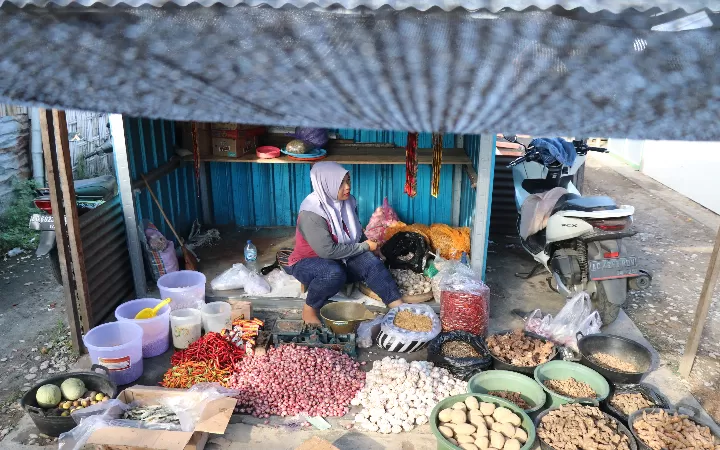

TULUNGAGUNG – Campurdarat Market revitalization in Tulungagung, East Java, remains delayed as local lawmakers warn that the government has not yet met infrastructure spending targets, limiting funds for major reconstruction.
The traditional market has struggled to recover since a major fire five years ago. Damaged sections still stand today, and traders continue operating amid temporary repairs.
Dio Jordy Alvian, a member of Commission C of the Tulungagung Regional House of Representatives (DPRD), said incomplete mandatory infrastructure spending likely caused the postponement.
“The delay may be linked to Tulungagung’s infrastructure mandatory spending not yet being fulfilled,” he said.
Indonesian regulations require local governments to allocate a fixed portion of regional budgets (APBD) to infrastructure. However, Tulungagung’s limited fiscal capacity has narrowed fiscal space and pushed several strategic projects into a queue.
Dio said the situation should not continue. He urged the local government to seek funding beyond the core regional budget, including Special Allocation Funds (DAK), central government support, or provincial assistance.
“In my view, funding could come from DAK, the national budget through ministries, or provincial support,” he said.
In 2026, the Tulungagung Industry and Trade Office (Disperindag) allocated about 2 billion rupiah (around $125,000) from the regional budget for market improvements. Officials must divide the funds across 11 work packages covering 20 markets, leaving only a small share for Campurdarat.
As a result, spending now focuses on basic maintenance to keep trading active and prevent further deterioration. Full reconstruction remains financially out of reach without major external funding.
Commission C said it will continue oversight with technical agencies to keep priority programs moving. Dio stressed that infrastructure spending is not merely a budget compliance issue.
“Infrastructure is strategic for regional economic growth. Meeting mandatory spending is not just about regulations but about real community needs,” he said.