
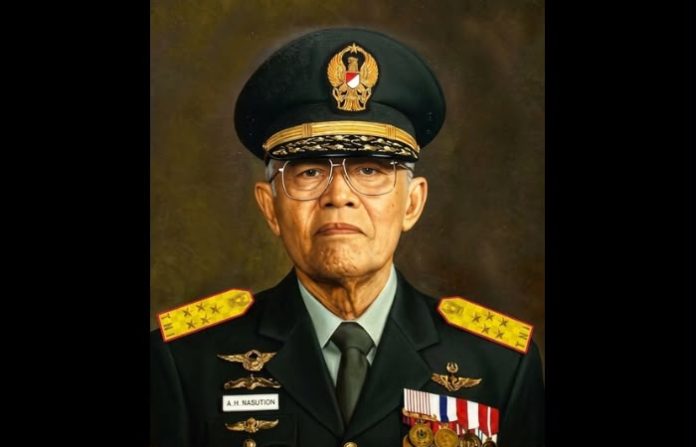

RADAR TULUNGAGUNG – Abdul Haris Nasution remains one of the most influential figures in modern Indonesian history, remembered not only as a military commander but also as the architect of the guerrilla warfare doctrine that helped shape the Indonesian National Armed Forces (TNI). His military ideas, leadership, and political role left a lasting impact on Indonesia’s struggle for independence and the nation’s subsequent development.
As one of only a handful of Indonesian officers to combine battlefield experience with strategic military thinking, Abdul Haris Nasution played a key role in building the foundations of Indonesia’s defense system. His concepts of territorial warfare and guerrilla resistance became central elements of TNI doctrine and continue to influence national defense planning today.
Born on December 3, 1918, in Huta Pungkut near Kotanopan, present-day Mandailing Natal Regency, North Sumatra, Nasution initially trained as a teacher before pursuing a military career. His interest in nationalism grew during his studies in Bandung, where he became familiar with the ideas of Indonesia’s independence movement.
The Military Strategist Behind Indonesia’s Defense Doctrine
Following Indonesia’s declaration of independence in 1945, Nasution joined the newly established armed forces and quickly emerged as a prominent military leader. In May 1946, he was appointed commander of the Siliwangi Division in West Java, where he developed the concept of territorial warfare to counter Dutch military offensives.
Recognizing that Indonesian forces could not defeat the better-equipped Dutch army in conventional battles, Nasution advocated a strategy that combined mobile military operations with support from local populations. This approach evolved into the guerrilla warfare doctrine that later became a cornerstone of Indonesia’s military strategy.
After the signing of the Renville Agreement in January 1948, Nasution led the famous “Long March” of the Siliwangi Division from West Java to Central Java. The same year, he became Deputy Commander of the TNI under General Sudirman and played a major role in reorganizing military forces during the Indonesian National Revolution.
A Thinker Whose Ideas Reached Beyond Indonesia
Following Indonesia’s sovereignty recognition and the death of General Sudirman in 1950, Nasution was appointed Army Chief of Staff. Although political tensions led to his temporary removal after the October 17, 1952 affair, he used that period to write extensively on military strategy.
One of his most influential works was Pokok-Pokok Gerilya (Fundamentals of Guerrilla Warfare), a book that analyzed Indonesia’s independence struggle and outlined principles of irregular warfare. The publication was translated into several languages and became a reference for military academies and resistance movements around the world.
Historians frequently describe Nasution as one of Indonesia’s foremost military intellectuals. Beyond battlefield tactics, he developed broader concepts concerning military organization, territorial defense, and the relationship between the armed forces and the state.
Political Turmoil, G30S, and Legacy
Nasution’s career also intersected with some of Indonesia’s most dramatic political events. In 1958, he introduced the “Middle Way” concept, arguing that the military should neither dominate government nor remain entirely detached from national affairs. The idea later influenced the New Order-era doctrine known as Dwifungsi ABRI.
During the attempted coup of September 30, 1965, Nasution became one of the primary targets. He escaped by scaling a wall near his residence, but the attack claimed the life of his five-year-old daughter, Ade Irma Suryani Nasution. The failed operation marked a turning point in Indonesian politics and paved the way for the rise of Suharto.
Despite initially supporting the political transition, Nasution later became a critic of Suharto’s government. He joined other prominent figures in advocating constitutional reforms and political accountability, leading to restrictions on his public activities during the New Order era.
Abdul Haris Nasution died in Jakarta on September 6, 2000, at the age of 81. His legacy endures through Indonesia’s military doctrine, his writings on guerrilla warfare, and his role in shaping the nation’s modern history. For many Indonesians, he remains both a soldier and a strategist whose ideas transcended the battlefield.