
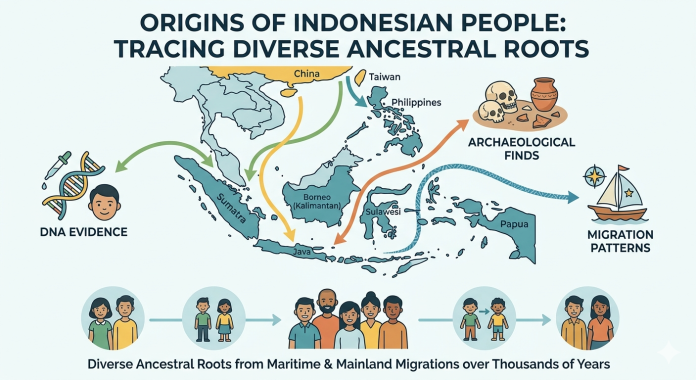

RADAR TULUNGAGUNG – The origins of Indonesian people are far more complex than political labels such as “native” or “indigenous” often suggest. Genetic, archaeological, and linguistic research indicates that modern Indonesians descend from multiple waves of migration spanning tens of thousands of years, making the archipelago one of the world’s most diverse population crossroads.
Rather than tracing their roots to a single ancestral group, Indonesians today carry genetic and cultural influences from ancient hunter-gatherers, Austronesian-speaking migrants, and later arrivals from across Asia, the Middle East, and Europe.
The findings challenge common assumptions about who can legitimately claim to be the “original” inhabitants of Indonesia and highlight a history shaped by migration, interaction, and cultural exchange.
The Scientific Search for the Origins of Indonesian People
Modern research suggests that there is no single ethnic group that can be considered the sole ancestor of all Indonesians. According to genetic studies led by Indonesian molecular biologist Herawati Sudoyo, populations across the archipelago display extensive genetic mixing resulting from thousands of years of migration and intermarriage.
The broader scientific consensus supports the Out of Africa theory, which holds that modern humans, or Homo sapiens, originated in Africa before gradually spreading across the globe. Archaeological and genetic evidence indicates that some of these early human populations reached Southeast Asia and the landmass known as Sundaland, a prehistoric extension of the Asian continent that once connected many of today’s Indonesian islands during periods of lower sea levels.
Evidence from ancient human remains and prehistoric cave art suggests that humans had already inhabited parts of what is now Indonesia at least 40,000 to 50,000 years ago. Notable examples include early human remains discovered in Kalimantan and prehistoric cave paintings in Maros-Pangkep, South Sulawesi, some of the oldest known figurative artworks in the world.
Three Major Migration Waves Shaped Indonesia
Researchers generally identify three major population movements that contributed significantly to the ancestry of modern Indonesians.
The first wave involved early Homo sapiens populations that migrated from Africa through South Asia and eventually entered Sundaland around 50,000 years ago. Their descendants later spread eastward toward Papua and Australia. These populations are commonly associated with the ancestors of many present-day Melanesian groups.
The second migration wave likely originated from mainland Southeast Asia thousands of years later. Archaeologists associate this movement with the Hoabinhian cultural tradition, characterized by distinctive stone tools found across parts of mainland Southeast Asia and western Indonesia.
The third and perhaps most influential migration involved Austronesian-speaking peoples. Current linguistic and archaeological evidence indicates that Austronesian expansion began from Taiwan approximately 4,000 to 5,000 years ago, spreading through the Philippines and into the Indonesian archipelago. These migrants introduced languages that eventually evolved into many of the regional languages spoken across Indonesia today.
Genetics Reveal a Complex National Identity
Genetic studies involving thousands of DNA samples from dozens of Indonesian ethnic groups have provided further insight into this complex history.
Populations in western Indonesia, including parts of Sumatra, Java, and Kalimantan, generally show stronger genetic links to Austronesian-speaking populations. Communities such as the Nias and Mentawai peoples retain some of the closest genetic relationships to ancestral populations connected with the Austronesian migration.
Meanwhile, many communities in eastern Indonesia, particularly in Papua, possess stronger genetic connections to ancient populations related to Melanesian and Indigenous Australian groups. However, researchers emphasize that the distinction is not absolute.
Many Indonesian populations exhibit varying degrees of genetic admixture, reflecting centuries of interaction between different groups. Eastern Indonesia, in particular, served as a major zone of cultural and genetic exchange where Austronesian and earlier populations interacted extensively.
The diversity visible across Indonesia today therefore reflects a long process of migration, adaptation, and integration rather than the dominance of a single ancestral lineage.
Later historical developments added even more layers to Indonesia’s genetic landscape. Trade networks connected the archipelago with South Asia, China, the Middle East, and eventually Europe. These interactions encouraged cultural exchange, migration, and intermarriage, further contributing to the genetic diversity present among Indonesians today.
As a result, scientists generally reject the notion that any modern population can claim completely “pure” ancestry. Instead, Indonesia’s population history illustrates how migration and cultural interaction have shaped one of the most diverse societies on Earth.
The story of the origins of Indonesian people ultimately suggests that Indonesian identity is rooted not in racial purity or exclusive ancestry, but in a shared history forged through thousands of years of movement, adaptation, and coexistence across the archipelago.