
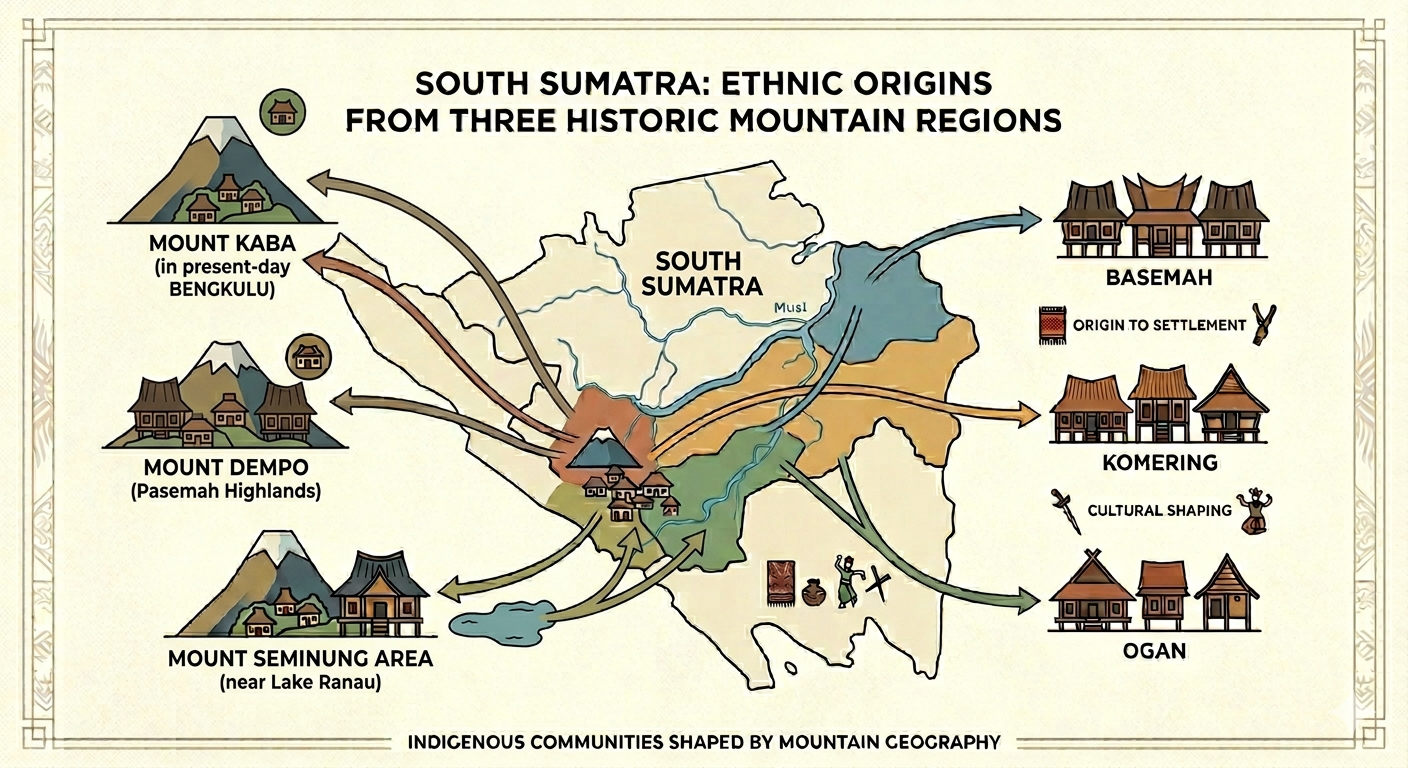

RADAR TULUNGAGUNG – The story of South Sumatra ethnic origins begins not in Palembang but in the province’s highlands, where rivers, mountains, and early settlements helped shape the identities of communities that still exist today. Historians and regional studies trace many indigenous groups in South Sumatra to three major upland regions that became the source of migration and cultural development long before Palembang emerged as a political center.
South Sumatra remains one of Indonesia’s most ethnically diverse provinces. The region is home to communities such as the Palembang, Pasemah, Ogan, Komering, Musi, Rawas, Semendo, and several other indigenous groups. Their languages, traditions, and social structures often differ significantly, even between neighboring areas.
The province’s remarkable diversity has prompted historians to investigate how these communities formed and spread across the region. One of the most influential studies came from Dutch scholar J.W. van Royen, who compiled historical records from inland South Sumatra and published them in De Palembangsche Marga in 1927.
The Three Highland Centers Behind South Sumatra Ethnic Origins
Van Royen identified three major highland regions that played a central role in the development of South Sumatra’s indigenous communities: the area around Mount Seminung near Lake Ranau, Mount Dempo in the Pasemah Highlands, and Mount Kaba in present-day Bengkulu.
These mountainous regions supplied water to major river systems that later became migration routes, trade corridors, and centers of settlement. Communities followed these river networks for centuries, allowing populations to expand into different parts of South Sumatra.
The Pasemah Highlands around Mount Dempo contributed to the growth of several communities, including the Pasemah, Lematang, Gumay, and Semendo peoples. Archaeologists have also discovered numerous megalithic sites in the area, indicating a long history of human settlement.
Further east, the Mount Seminung region influenced the development of the Ogan and Komering communities. The Ogan and Komering rivers provided natural pathways that connected inland settlements with downstream regions. Linguists classify the Komering language within the Lampungic language group, highlighting historical connections that extend beyond modern provincial borders.
Meanwhile, communities around Mount Kaba and the upper Musi watershed helped shape the cultural landscape of northern South Sumatra. Over time, migration and interaction among neighboring groups produced additional local identities throughout the region.
Historical Governance and the Emergence of Marga Systems
Beyond ethnic identity, the highland regions also shaped South Sumatra’s traditional governance structures. Before Dutch colonial administration standardized local institutions, communities often organized themselves through systems known as petulai, sumbai, or buay, depending on the region.
These social units governed customary law, land rights, and kinship relations. During the era of the Palembang Sultanate and later under Dutch colonial rule, many of these local structures were reorganized into the broader marga system, which became the dominant administrative framework across much of inland South Sumatra.
Historians note that the marga system did not necessarily create ethnic groups but instead formalized existing communities into recognized territorial units. The process helped integrate diverse populations while preserving local identities and customary traditions.
Why the Theory Still Matters Today
Modern scholars caution that ethnic origins cannot be explained solely through a single migration theory. Centuries of interaction, trade, intermarriage, and political change have shaped South Sumatra’s population. The people of Palembang itself, for example, developed through a mixture of indigenous Malay-speaking communities and influences from other regions of the Indonesian archipelago.
Nevertheless, the three-mountain theory remains one of the most influential frameworks for understanding how South Sumatra’s indigenous communities emerged and spread across the province. It also helps explain why river basins such as the Musi, Ogan, Komering, and Lematang became important cultural corridors linking highland settlements with downstream trading centers.
As interest in local history continues to grow, researchers and cultural observers view these historical narratives as an important way to understand the rich diversity that defines South Sumatra today. While some aspects of the theory remain debated, the broader conclusion is widely accepted: the province’s ethnic landscape evolved through centuries of settlement centered around its strategic highland regions and river networks.