
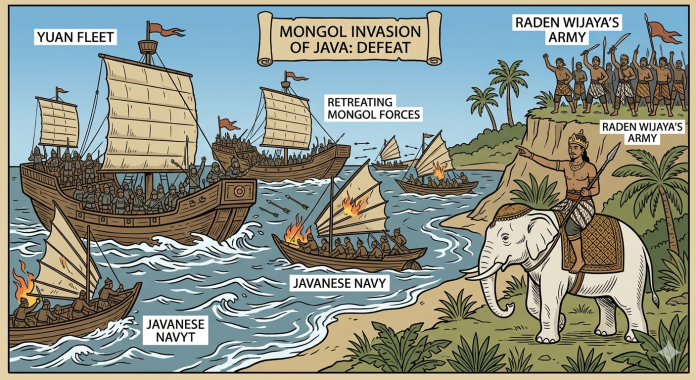

RADAR TULUNGAGUNG – The Mongol invasion of Java in 1293, ordered by Mongol ruler Kublai Khan, ended in one of the empire’s most humiliating military failures after Javanese forces manipulated and defeated the vastly larger expedition. The failed campaign later paved the way for the rise of the powerful Majapahit kingdom under Raden Wijaya.
At the height of its power, the Mongol Empire controlled vast territories stretching across Asia and Europe. Under the leadership of Kublai Khan and the Yuan dynasty, the empire sought to expand further into Southeast Asia by targeting wealthy maritime trade centers, including Java.
The campaign became one of the rare moments when Mongol military dominance failed dramatically. Historians continue to view the Java expedition as a strategic disaster fueled by misinformation, unfamiliar terrain, and political manipulation by local rulers.
Java Became a Strategic Target for the Mongol Empire
Following the Mongol conquest of China in 1279, Kublai Khan gained control over major Asian trade routes. Java quickly attracted Mongol attention because of its role in regional commerce and its exports of rice, spices, and valuable natural goods.
At the time, eastern Java was ruled by the Singhasari kingdom under King Kertanegara. The kingdom held influence across parts of Sumatra and Kalimantan and actively participated in international trade networks linked to China and India.
According to historical records, Kublai Khan sent several diplomatic envoys to Java between 1280 and 1289 demanding that Singhasari recognize Mongol authority and pay tribute. Kertanegara repeatedly rejected those demands.
The conflict escalated in 1289 when the Javanese ruler allegedly humiliated a Mongol envoy by mutilating his face and cutting his ears before sending him back to China. The incident enraged Kublai Khan, who then ordered a massive punitive expedition against Java.
Historical accounts estimate the Mongol force included around 20,000 soldiers and roughly 1,000 ships led by commanders Shi Bi, Ike Mese, and Gao Xing.
Political Chaos in Java Changed the Course of the Invasion
While the Mongols prepared their invasion fleet, political turmoil erupted inside Java. Around the early 1290s, Kertanegara faced a rebellion led by Jayakatwang, a regional ruler from Kediri who held longstanding grievances against Singhasari.
The rebellion succeeded in overthrowing Singhasari, and Kertanegara was killed before the Mongol fleet even arrived in Java.
Meanwhile, Raden Wijaya, Kertanegara’s son-in-law and heir, escaped to Madura and received support from local ruler Wiraraja. Together, they devised a strategy that would later trap the Mongol forces.
When the Mongol army landed near Tuban in March 1293, they still believed they were avenging the insult committed by Kertanegara. However, local political figures reportedly convinced the Mongols that Jayakatwang was responsible for the humiliation of the Yuan envoy.
Raden Wijaya then offered to cooperate with the Mongols, promising loyalty to the Yuan dynasty if they helped him defeat Jayakatwang first.
The alliance benefited both sides temporarily. Mongol troops and Wijaya’s forces launched joint attacks against Kediri, eventually defeating Jayakatwang and capturing the kingdom.
Raden Wijaya Turned Against the Mongols
After securing victory, Raden Wijaya requested permission to return to his base in Majapahit to prepare tribute for the Mongol commanders. The Yuan forces agreed and even allowed thousands of Mongol soldiers to escort him.
Instead of surrendering, Wijaya launched a surprise attack against the escorting troops and simultaneously targeted scattered Mongol camps across Java.
The Mongol army struggled to respond effectively. Unlike the open grasslands of Central Asia where Mongol cavalry excelled, Java’s tropical climate, dense forests, and difficult terrain severely weakened their mobility and coordination.
Without strong local support and facing unexpected guerrilla-style attacks, the Mongol expedition quickly collapsed. Historical sources estimate the invasion force lost around 3,000 troops before retreating from Java after only a few months.
Although the Mongols returned to China with tribute items such as spices, gold, silver, and maps, the campaign was widely viewed as a major embarrassment for the Yuan dynasty. Kublai Khan reportedly punished several commanders after the failed expedition.
The defeat also marked a turning point in Javanese history. Soon after the Mongol withdrawal, Raden Wijaya established the Majapahit kingdom, which later emerged as one of the most influential empires in Southeast Asian history.
The failed Mongol invasion of Java remains one of history’s clearest examples of how political strategy, local knowledge, and deception overcame one of the world’s most feared military powers.