
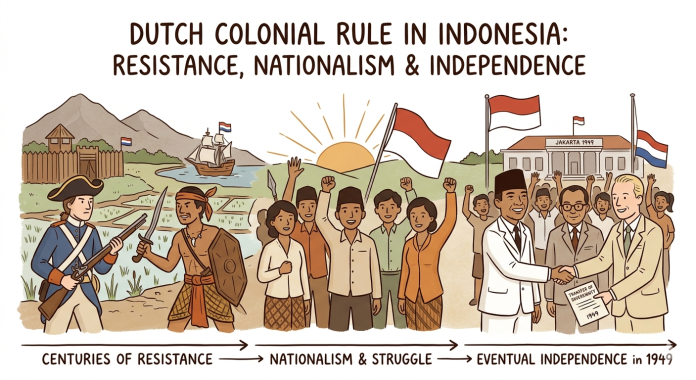

RADAR TULUNGAGUNG – Dutch colonial rule in Indonesia transformed the archipelago from a major center of global trade into a territory increasingly controlled by foreign powers, shaping centuries of political conflict, economic exploitation, and resistance that eventually culminated in Indonesian independence.
The history of Dutch colonial rule in Indonesia stretches across several centuries, although historians note that Dutch authority expanded gradually and did not encompass the entire archipelago continuously from the beginning. What started as a quest for valuable spices evolved into one of the most influential colonial projects in Southeast Asian history.
European interest intensified after the Portuguese captured Malacca in 1511, a move that reshaped regional trade networks. By the late 16th century, Dutch expeditions began arriving in the Indonesian archipelago seeking direct access to lucrative spice markets. In 1602, Dutch merchants consolidated their operations under the Verenigde Oostindische Compagnie (VOC), commonly known as the Dutch East India Company.
From Spice Trade to Colonial Dominance
The VOC became more than a trading enterprise. Granted extensive powers by the Dutch government, it could wage war, negotiate treaties, establish military forces, and administer territories. These powers enabled the company to expand its influence throughout key trading centers in the archipelago.
A major turning point came in 1619 when the VOC captured Jayakarta and established Batavia, now Jakarta, as its administrative center. The company subsequently tightened control over the spice trade, particularly in the Banda Islands, where efforts to enforce monopoly policies resulted in devastating consequences for the local population.
Throughout the 17th and 18th centuries, the VOC expanded its influence by combining military force, commercial monopolies, and alliances with local rulers. Historians widely acknowledge that colonial authorities frequently exploited political divisions among indigenous kingdoms, allowing Dutch influence to grow without direct control over all territories.
The VOC eventually collapsed under the weight of corruption, debt, and administrative problems. In 1799, its assets and territories were transferred to the Dutch state, marking the beginning of the Dutch East Indies as a formal colonial administration.
Economic Exploitation and Expanding Dutch Control
During the 19th century, Dutch colonial policies increasingly focused on generating revenue from the colony. One of the most significant measures was the Cultivation System, introduced in 1830 by Governor-General Johannes van den Bosch.
Under this system, many farmers were required to devote part of their land and labor to export crops such as coffee, sugar, and indigo. While the policy generated substantial income for the Netherlands and contributed to economic development in Europe, historians have documented widespread hardship among local populations. In several regions of Java, food shortages and social disruption accompanied the expansion of export agriculture.
Criticism of colonial practices gained international attention after the publication of Max Havelaar in 1860 by Eduard Douwes Dekker, writing under the pen name Multatuli. The novel exposed abuses within the colonial system and influenced debates about Dutch policies in the East Indies.
The late 19th century also witnessed prolonged military campaigns, including the Aceh War, which began in 1873 and became one of the longest and most costly conflicts in Dutch colonial history. Resistance leaders such as Teuku Umar, Cut Nyak Dhien, and Cut Nyak Meutia became enduring symbols of anti-colonial struggle.
Rise of Nationalism and the Independence Movement
The early 20th century marked a significant shift in resistance strategies. Instead of relying solely on armed struggle, educated Indonesians increasingly organized through political, social, and religious movements.
Organizations such as Budi Utomo, Sarekat Islam, Muhammadiyah, and Nahdlatul Ulama helped foster a growing sense of national identity.
Nationalist leaders including Sukarno, Mohammad Hatta, Sutan Sjahrir, and Ki Hajar Dewantara advocated self-determination and political reform.
The collapse of Dutch authority during the Japanese occupation in World War II created new opportunities for Indonesian leaders. Following Japan’s surrender, Sukarno and Hatta proclaimed Indonesia’s independence on August 17, 1945.
However, the struggle did not end there. Dutch efforts to re-establish colonial control triggered a four-year conflict involving military campaigns, diplomatic negotiations, and international pressure. Global attention increasingly favored Indonesian independence, particularly after reports of civilian casualties and continued warfare reached the international community.
The Netherlands formally transferred sovereignty to Indonesia on December 27, 1949, ending centuries of colonial rule. While historians continue to debate aspects of the colonial era, the legacy of Dutch colonial rule in Indonesia remains central to understanding the nation’s modern identity, political development, and long struggle for independence.