
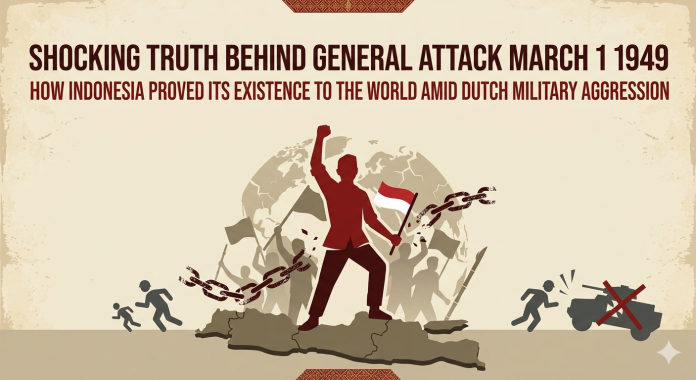

RADAR TULUNGAGUNG – The General Attack March 1 1949 marks one of the most decisive moments in Indonesia’s fight to defend its independence. This bold operation not only showcased military strength but also sent a clear message to the world that the Republic of Indonesia still stood firm despite Dutch claims.
The background of the General Attack March 1 1949 began with the Dutch Military Aggression II on December 19, 1948. Dutch forces led by General Simon Hendrik Spoor launched a massive assault on Yogyakarta, which at the time served as the capital of Indonesia. Airstrikes targeted strategic locations, including Maguwo Air Base, followed by the rapid deployment of ground troops.
Within a short time, Yogyakarta fell into Dutch hands. Indonesian leaders, including President Soekarno and Vice President Mohammad Hatta, were captured and exiled. The Dutch believed this operation had effectively ended the existence of the Republic. However, resistance continued across the country.
Guerrilla Warfare Led by Sudirman
Instead of surrendering, General Sudirman took decisive action. Although he suffered from a severe illness, he chose to lead resistance efforts directly in the field. Therefore, he ordered Indonesian troops to adopt guerrilla warfare tactics.
These fighters launched ambushes, disrupted supply routes, and attacked Dutch outposts across various regions. Moreover, Sudirman continued to command operations while being carried on a stretcher due to his condition. His determination inspired troops to keep fighting under extreme circumstances.
At the same time, Lieutenant General Abdul Haris Nasution implemented a territorial defense strategy. This system divided Indonesian forces into several regional units, ensuring that resistance could continue even after major cities were occupied.
Strategic Planning Behind the Attack
Meanwhile, Sultan Hamengkubuwono IX initiated a bold plan to strike back. He coordinated closely with Lieutenant Colonel Soeharto and other commanders to organize a large-scale attack on Yogyakarta.
To ensure success, they prepared the operation in secrecy. They used covert communication methods, including coded exchanges in public places, to avoid detection. Furthermore, they focused on a clear objective: demonstrate Indonesia’s strength rather than permanently hold the city.
Eventually, they agreed to launch the attack on March 1, 1949.
Execution of the General Attack
In the early morning of March 1, 1949, approximately 2,000 Indonesian troops launched the General Attack March 1 1949. They entered Yogyakarta from multiple directions, taking advantage of the element of surprise.
Dutch forces were caught off guard. Indonesian fighters successfully seized control of key parts of the city. For about six hours, they managed to dominate Yogyakarta, proving their strength and coordination.
The operation was not intended to hold the city indefinitely. As Dutch reinforcements approached, Indonesian troops withdrew in an organized and strategic manner around midday.
International Impact and Diplomatic Outcome
The impact of the General Attack March 1 1949 extended beyond the battlefield. Reports of the attack spread quickly through international media, contradicting Dutch statements that Indonesia had been defeated.
This development drew global attention and increased pressure on the Netherlands. The United Nations became involved, urging both sides to pursue a peaceful resolution.
On April 14, 1949, Indonesia and the Netherlands entered negotiations known as the Roem–Royen Agreement. The agreement included key points such as the return of Yogyakarta to Indonesia, the release of political prisoners, and the cessation of military operations.
A Lasting Symbol of Resistance
Following the agreement, Yogyakarta was officially returned to Indonesian control on July 1, 1949. National leaders gradually came back, restoring the government’s function.
The General Attack March 1 1949 remains a powerful symbol of Indonesia’s determination to defend its independence. It demonstrated that even under extreme pressure, the nation could unite and fight back effectively.
Today, the event is commemorated through a monument in Yogyakarta, reminding future generations of the sacrifices made by those who fought for freedom. The operation stands as proof that independence is not only achieved through declaration, but also through persistence and courage.