
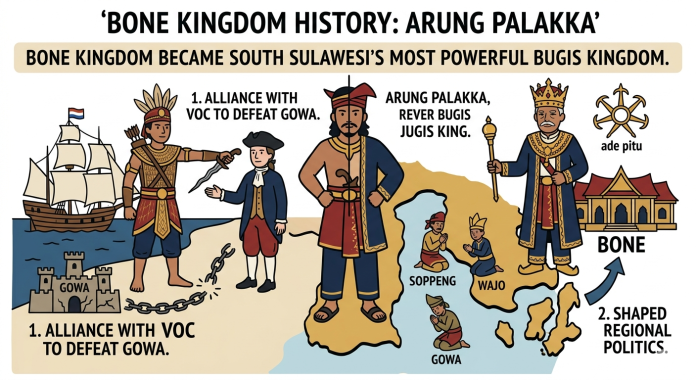

RADAR TULUNGAGUNG – The history of the Bone Kingdom reflects the rise of one of the most influential Bugis states in eastern Indonesia. Founded in the 14th century, the kingdom expanded its political influence across South Sulawesi and played a decisive role in regional power struggles, particularly during the era of Arung Palakka, its most famous ruler.
For centuries, the Bone Kingdom shaped political, cultural, and military developments throughout South Sulawesi. Its rulers forged alliances, fought regional wars, embraced Islam, and later confronted Dutch colonial expansion. These events transformed Bone into one of the most significant kingdoms in the history of eastern Nusantara.
Historical records preserved in Bugis lontara manuscripts trace the kingdom’s origins to the early 14th century. The kingdom later emerged as a major center of Bugis civilization and maintained considerable influence until the beginning of the 20th century.
The Founding of the Bone Kingdom and the Rise of Bugis Power
According to historical accounts, the territory that later became Bone was initially divided into several autonomous communities known as wanua. These settlements eventually united under a centralized authority following the emergence of Manurungnge ri Matajang, a figure associated with the Bugis founding tradition known as Tomanurung. He was installed as the first ruler around 1330 and established the foundations of government and customary law.
A key institution in the kingdom’s administration was the Ade’ Pitue, a council of seven advisers who assisted the ruler in governance and legal affairs. This system contributed to political stability and helped Bone develop into a significant regional power during the following centuries.
The kingdom’s strategic location and strong political organization enabled it to expand its influence across South Sulawesi. By the early modern period, Bone had become one of the most important Bugis kingdoms, frequently competing and cooperating with neighboring powers such as Gowa and Soppeng.
Islamization and Political Transformation in Bone
One of the most significant turning points in the history of the Bone Kingdom was the arrival of Islam in South Sulawesi during the early 17th century. Historical sources indicate that Bone’s conversion to Islam occurred after military and political conflicts with the Gowa Sultanate. The kingdom formally embraced Islam in 1611 under the reign of La Tenriruwa, who became known as Sultan Adam.
Islam subsequently became an integral part of Bone’s political and social structure. Later rulers promoted Islamic law and religious institutions, contributing to the kingdom’s transformation into an Islamic sultanate.
Bone’s greatest period of influence arrived in the second half of the 17th century under Arung Palakka (1634–1696). After years of conflict with the Gowa Sultanate, Arung Palakka allied with the VOC during the Makassar War. The defeat of Gowa and the subsequent implementation of the Treaty of Bongaya dramatically altered the balance of power in South Sulawesi, allowing Bone to emerge as the dominant regional kingdom.
Arung Palakka’s Legacy and the Fall of the Bone Kingdom
The legacy of Arung Palakka remains the subject of debate among historians and the public. Some narratives have labeled him a collaborator because of his alliance with the VOC. However, scholars note that the conflict reflected the political realities of the 17th century, when independent kingdoms pursued their own strategic interests rather than acting within a modern national framework.
Bone maintained considerable influence throughout the 18th and 19th centuries, but growing Dutch colonial expansion gradually weakened its independence. A series of military confrontations between Bone and the Dutch culminated in 1905, when Dutch forces defeated the kingdom and effectively ended its sovereignty. The last ruler, La Pawawoi Karaeng Sigeri, was subsequently exiled to Bandung, where he later died in 1911.
The history of the Bone Kingdom continues to hold cultural and political significance in South Sulawesi today. Its legacy survives through Bugis traditions, historical sites, and the enduring memory of a kingdom that once stood among the most powerful states in eastern Indonesia.