
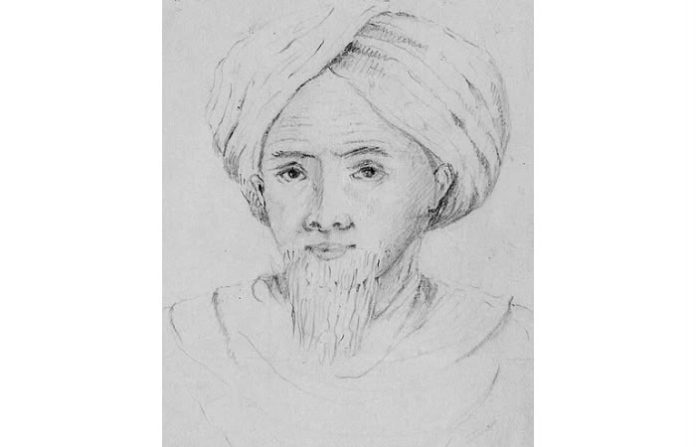

RADAR TULUNGAGUNG – Tuanku Imam Bonjol remains one of Indonesia’s most influential historical figures, remembered for leading resistance against Dutch colonial forces during the Padri War while also leaving behind a rare autobiographical account that reflected on the conflict’s human cost. His role in the struggle helped secure his recognition as an Indonesian National Hero in 1973.
Born as Muhammad Shahab in Bonjol, present-day West Sumatra, on January 1, 1772, Tuanku Imam Bonjol emerged as an Islamic scholar and community leader during a turbulent period in Minangkabau history. He later became a central figure in the Padri movement, which sought religious reform and greater adherence to Islamic teachings in the region.
His name remains deeply embedded in Indonesia’s collective memory through monuments, public institutions, roads, and historical studies that continue to examine both his military leadership and his personal reflections on the war.
The Rise of Tuanku Imam Bonjol and the Padri Movement
Tuanku Imam Bonjol was born into a respected religious family. His father, known as Khatib Bayanuddin, was a prominent Islamic scholar. As he matured, Muhammad Shahab gained recognition as a religious teacher and local leader before eventually receiving the title by which he became famous.
Contrary to some popular accounts, Tuanku Imam Bonjol was not among the earliest leaders of the Padri movement. Historical records indicate that he became actively involved after being appointed as an imam and leader of the Padri community in Bonjol by influential reformist figures within the movement.
The Padri War began in the early 19th century as an internal conflict among Minangkabau groups. Reformist Islamic leaders, known as the Padri, sought to eliminate practices they considered inconsistent with Islamic teachings. Their efforts brought them into conflict with traditional Minangkabau leaders, known as the adat community.
By 1815, fighting intensified across parts of West Sumatra, including areas surrounding the former Pagaruyung Kingdom. The conflict gradually evolved from a local civil struggle into a wider war that would eventually draw in Dutch colonial forces.
Dutch Intervention Changed the Course of the War
A major turning point came in 1821 when several adat leaders signed an agreement with the Dutch colonial administration in Padang. In exchange for military assistance against the Padri forces, the Dutch gained access and influence over parts of the Minangkabau interior.
Dutch intervention transformed the conflict. What began as a struggle between local factions increasingly became a broader confrontation with colonial authorities.
Facing resistance from Padri forces, the Dutch signed the Masang Agreement in 1824. However, hostilities later resumed. By the early 1830s, many former rivals within Minangkabau society recognized the consequences of colonial involvement and began cooperating against Dutch expansion.
This reconciliation culminated in the well-known Plakat Puncak Pato, which symbolized a compromise between Islamic and customary traditions. The agreement became a foundation for the enduring Minangkabau principle: “Adat Basandi Syarak, Syarak Basandi Kitabullah” (custom founded upon Islamic law, and Islamic law founded upon the Quran).
The Fall of Bonjol and Tuanku Imam Bonjol’s Enduring Legacy
The final phase of the Padri War centered on Bonjol, Tuanku Imam Bonjol’s stronghold. Dutch forces launched a massive military campaign against the fortified settlement in 1837. Historical records show that the colonial army included European officers and thousands of indigenous soldiers recruited from various regions of the archipelago.
After months of siege warfare, Dutch troops captured Bonjol in August 1837. Tuanku Imam Bonjol was subsequently detained and exiled. He was first sent to Cianjur in West Java, then to Ambon, and finally to Lotta in Minahasa, North Sulawesi.
He died in exile on November 6, 1864, and was buried in Lotta, where his grave remains a historical site today.
One of the most remarkable aspects of his legacy is his autobiographical manuscript, often referred to as the Naskah Tuanku Imam Bonjol. Historians regard it as one of the earliest autobiographical works written in Malay. In the manuscript, he reflected on the violence of the conflict and expressed regret over suffering experienced by fellow Minangkabau communities during the war.
Indonesia officially recognized Tuanku Imam Bonjol as a National Hero through Presidential Decree No. 087/TK/1973 on November 6, 1973. More than a century after his death, he remains a symbol of resistance against colonialism and a figure whose life illustrates the complexities of religious reform, local politics, and anti-colonial struggle in Indonesian history.