
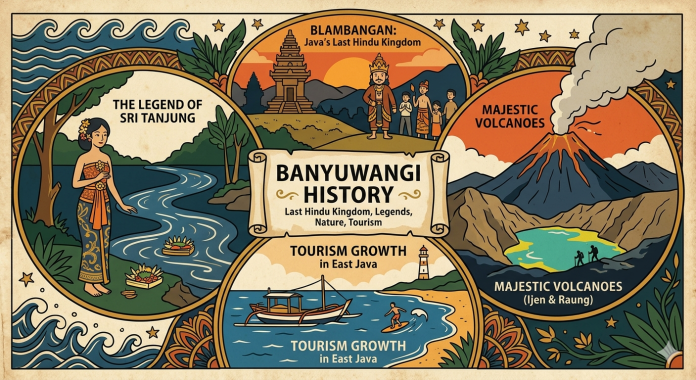

RADAR TULUNGAGUNG – Banyuwangi has long been known as the eastern gateway of Java Island. However, behind its modern tourism image and vibrant festivals, the region stores a dramatic historical legacy tied to ancient kingdoms, volcanic landscapes, and a legendary royal tragedy that shaped its identity.
Located at the eastern tip of Java, Banyuwangi once served as the center of the powerful Blambangan Kingdom, the last Hindu kingdom on the island during the 16th century. Historians often describe the kingdom as the final stronghold resisting the rapid expansion of Islamic influence from the Mataram Sultanate in Central Java.
The history of Banyuwangi continues to attract attention because it combines political struggle, folklore, and natural beauty into one unique narrative. Today, the regency is also famous as the “City of Festivals” because cultural events take place almost throughout the year, drawing both domestic and international tourists.
The Last Hindu Kingdom in Java
The Blambangan Kingdom played a crucial role in East Java’s historical development. While many regions on Java gradually fell under Islamic rule during the 16th and 17th centuries, Blambangan managed to survive for decades as a Hindu kingdom.
Mataram forces repeatedly attempted to conquer the region during the early 17th century. Despite intense pressure, Blambangan maintained its influence and independence longer than many neighboring territories. The Dutch colonial government initially paid little attention to the area before eventually taking control in the 18th century.
Banyuwangi later gained strategic importance during the colonial era because it became a communication link between Indonesia and Australia. In November 1871, an undersea telegraph cable connecting Darwin, Australia, met the Australian Overland Telegraph line in Banyuwangi. The project strengthened international communication networks during that period.
The Legendary Story Behind Banyuwangi’s Name
One of the most famous stories associated with Banyuwangi is the legend of Princess Sri Tanjung. Local folklore says the princess was falsely accused of infidelity by her husband after he returned from war.
Before her death, Sri Tanjung reportedly told her husband that the truth would reveal itself through the river. She said if the river smelled foul, she had truly betrayed him. However, if the water released a fragrant aroma, it meant she was innocent.
After she was killed, the river reportedly produced a fragrant scent instead of a foul odor. Realizing his mistake, her husband deeply regretted his actions. According to local belief, the phrase “Banyu Wangi,” which means “fragrant water,” eventually became the origin of the region’s name.
The legend remains one of the strongest cultural identities in Banyuwangi and continues to inspire local art performances, festivals, and tourism branding.
Volcanoes, National Parks, and Marine Wealth
Beyond its history, Banyuwangi is also known for its extraordinary geography. The region features mountains, plantations, beaches, and conservation forests spread across its territory.
On the border with Bondowoso Regency lies the Ijen Plateau, home to several volcanic peaks including Mount Raung and Mount Ijen. Mount Ijen is internationally famous for its crater and rare blue fire phenomenon, attracting tourists and researchers from around the world.
The southern area of Banyuwangi contains plantations established during the Dutch East Indies era. The region also hosts protected conservation zones such as Meru Betiri National Park, which serves as a turtle breeding habitat, especially around Sukamade Beach.
Meanwhile, Alas Purwo National Park on the Blambangan Peninsula is widely recognized for its dense forest ecosystem and mystical reputation among local communities.
The eastern coastline facing the Bali Strait also supports one of East Java’s largest fishing industries. Muncar Fishing Port has become an important center for fish production and economic activity in the region.
Transportation and Tourism Growth
Banyuwangi’s accessibility continues to improve as tourism expands rapidly. The regency connects Java and Bali through Ketapang Harbor, one of Indonesia’s busiest ferry routes.
Travelers from Surabaya can reach Banyuwangi through northern and southern land routes. Railway services across East Java also terminate in the region, with Banyuwangi Kota Station serving as one of the main transportation hubs.
In addition, Banyuwangi International Airport in Blimbingsari Subdistrict officially opened commercial flights in 2010. The airport now connects the regency with major cities such as Jakarta and Surabaya.
The local government continues to promote infrastructure development and tourism investment to attract more international visitors. Combined with its rich history, cultural legends, and natural attractions, Banyuwangi remains one of Indonesia’s most fascinating destinations.