
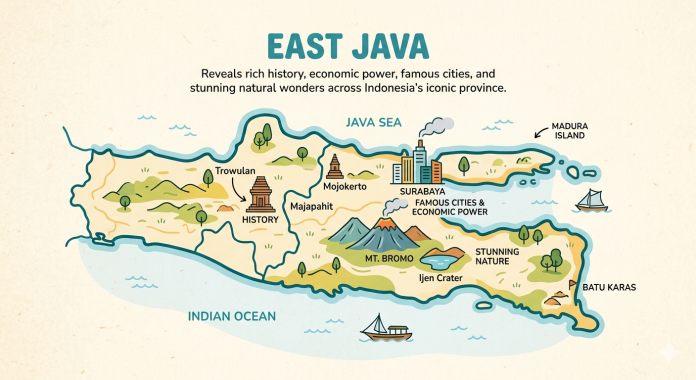

RADAR TULUNGAGUNG – East Java is widely known as one of Indonesia’s most influential provinces, but many people still do not realize how massive its contribution is to the country’s economy, culture, and history. From industrial cities and historic kingdoms to volcanic mountains and famous tourist destinations, East Java continues to shape the identity of modern Indonesia.
Located in the eastern part of Java Island, East Java covers an area of around 48,000 square kilometers. The province also includes Madura Island, Bawean Island, Kangean Islands, and several smaller surrounding islands. With a population of more than 41.7 million people, East Java ranks as the second most populated province in Indonesia after West Java.
East Java shares borders with the Java Sea in the north, Bali Strait in the east, the Indian Ocean in the south, and Central Java in the west. Its strategic position has helped the province grow into one of Indonesia’s strongest economic centers.
East Java’s Massive Economic Power
East Java plays a critical role in Indonesia’s economy. The province contributes around 15 percent of the national Gross Domestic Product, making it the second-largest regional economy after Jakarta.
The capital city, Surabaya, stands at the center of this economic activity. Known as the City of Heroes, Surabaya became famous for the historic Battle of November 10, 1945, which strengthened Indonesia’s independence movement.
Today, Surabaya remains one of the busiest cities in Indonesia. The city has the second-largest population in the country and records the highest regional GDP in East Java. Nearby Sidoarjo also ranks among the province’s strongest economic regions thanks to its industrial growth.
The Historical Formation of East Java
East Java officially became one of Indonesia’s first provinces on October 12, 1945. During its early formation, the province consisted of seven residencies: Surabaya, Madura, Besuki, Malang, Kediri, Madiun, and Bojonegoro.
Over time, the Indonesian government reorganized those regions into regencies and cities. Currently, East Java consists of 29 regencies and nine cities. Interestingly, only one major regional expansion has occurred since 1950, leading to the formation of Batu City in 2001.
The province’s long administrative history reflects how important East Java has been throughout Indonesia’s development.
Regions with Unique Identities
Every region in East Java has its own identity and cultural significance. Gresik, for example, is known as an industrial hub and one of the earliest centers of Islam in Java.
Madura Island consists of four regencies, including Bangkalan, which serves as the gateway to Madura through the famous Suramadu Bridge connecting the island with Surabaya.
Meanwhile, Banyuwangi has become internationally recognized as the “Sunrise of Java.” The regency is home to Mount Ijen, famous for its rare blue fire phenomenon. Banyuwangi is also the largest regency in East Java by area.
Jember attracts attention through the internationally known Jember Fashion Carnaval, while Bondowoso and Situbondo continue to promote natural tourism and agriculture.
Malang and Batu Continue to Shine
The Malang residency area remains one of East Java’s biggest tourism magnets. Malang City is popularly called the Apple City because of its agricultural heritage and cool climate.
Batu City, formed from the expansion of Malang Regency in 2001, is often referred to as the “Switzerland of East Java.” Beautiful mountain scenery, fresh air, and tourist attractions have transformed Batu into one of Indonesia’s favorite holiday destinations.
Pasuruan and Probolinggo also contribute significantly to East Java’s economy and tourism sectors.
Tulungagung and Other Cultural Centers
The Kediri residency includes several historically important regions such as Kediri, Tulungagung, Trenggalek, Blitar, and Nganjuk.
Tulungagung itself continues to grow as one of the cultural centers in southern East Java. Trenggalek was originally part of Tulungagung before becoming its own regency. Blitar, meanwhile, remains famous as the burial place of Indonesia’s first president, Sukarno.
Kediri is nationally recognized as the center of Indonesia’s cigarette industry, strengthening East Java’s industrial reputation.
Natural Wonders of East Java
Beyond history and industry, East Java also offers extraordinary natural beauty. Mount Bromo remains one of Indonesia’s most iconic tourist destinations. The volcano stretches across four regencies: Probolinggo, Pasuruan, Lumajang, and Malang.
Another legendary mountain is Mount Semeru, the highest peak on Java Island. Located between Malang and Lumajang, Semeru attracts climbers and adventure seekers from across Indonesia.
Pacitan also deserves attention because of its nickname, the City of a Thousand Caves. Goa Gong, located in Pacitan, is widely considered one of Southeast Asia’s most beautiful caves.
With its strong economy, diverse culture, long history, and breathtaking landscapes, East Java continues to stand as one of Indonesia’s most important provinces. Each regency and city contributes unique strengths that make East Java not only economically powerful, but also culturally rich and globally attractive.