
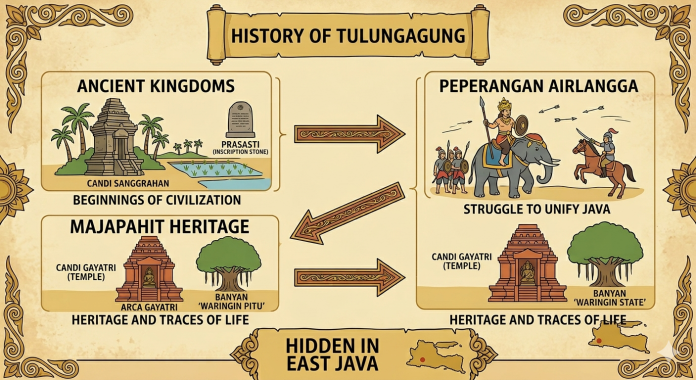

RADAR TULUNGAGUNG – For centuries, Tulungagung has stood beneath the shadow of Mount Wilis and the flow of the Brantas River. Behind its peaceful landscape lies one of East Java’s richest historical stories. Ancient inscriptions, royal conflicts, and archaeological discoveries show that Tulungagung once played a major role in the political struggles of old Java.
The history of Tulungagung stretches from the Medang Kingdom to the reign of Airlangga, the rivalry between Panjalu and Jenggala, and the golden era of Majapahit. Historians and old manuscripts describe the region as a strategic territory that repeatedly shaped the course of Javanese civilization.
The Meaning Behind the Name Tulungagung
The name Tulungagung comes from Old Javanese. “Tulung” means help or water source, while “Agung” means great. Together, the words can mean “great help” or “great water source.”
Both meanings reflect the region’s history. Long before people called the area Tulungagung, locals knew it as Ngerawa, a swampy land that stretched across southern East Java. Historical accounts also mention Bonorowo, a forest that later turned into marshland.
Authorities officially replaced the name Nerawa with Tulungagung on April 1, 1901. Later, historians discovered the Lawadan Inscription dated November 18, 1205. The finding encouraged the government to move Tulungagung’s official anniversary to November 18.
Tulungagung During the Medang Era
The earliest traces of organized government in Tulungagung appear in the Penampihan I Inscription from 898 AD during the reign of King Balitung of the Medang Kingdom. The inscription, located near Candi Penampihan in Sendang District, recorded the granting of tax-free land, proving that local governance already existed more than a thousand years ago.
According to historical interpretation, Tulungagung played an important role during Balitung’s military campaign in East Java. After his troops suffered setbacks against the Kanjuruhan Kingdom, local communities around Mount Wilis reportedly helped the king regroup and eventually secure victory.
That support later became associated with the idea of “great help,” strengthening the symbolic meaning of Tulungagung itself.
Airlangga, Floods, and the Rise of Lodoyong
The region became increasingly important during the reign of King Airlangga in the 11th century. At that time, Tulungagung was known as Lodoyong, a powerful territory in southern Brantas ruled by the legendary Queen Diah Tulodong.
Historical inscriptions describe fierce battles between Airlangga and the queen of Lodoyong. In 1032 AD, Diah Tulodong’s forces successfully attacked Airlangga’s palace, forcing the king to flee. However, several years later, Airlangga returned with renewed strength and defeated Lodoyong.
Despite the victory, Airlangga reportedly allowed Diah Tulodong to continue ruling as a subordinate ally. This alliance later became crucial when massive flooding threatened the southern Brantas region.
To save agriculture and prevent economic collapse, Airlangga ordered the construction of a giant dam and water control system in Lodoyong. The project included canals, embankments, and wooden floodgates believed to be among the greatest hydrological engineering achievements in ancient Java.
The Division of Java and the Rise of Tumapel
Following Airlangga’s reign, Java was divided into two kingdoms: Panjalu and Jenggala. Yet historical narratives suggest that parts of southern Brantas, including Tulungagung, maintained semi-independent status.
Centuries later, the region again became involved in political turmoil during the rise of Ken Arok and the Tumapel Kingdom. In 1205 AD, King Kertajaya of Kediri fled to Lawadan in Tulungagung after being attacked by Ken Arok’s forces.
The Lawadan Inscription recorded how local residents protected the king and were rewarded with special autonomous rights and tax exemptions. That inscription later became the foundation for determining Tulungagung’s official birth date.
Tulungagung and the Majapahit Legacy
During the Majapahit era, Tulungagung gained even greater importance. Several royal figures were believed to be buried or memorialized in the region, including figures linked to Raden Wijaya, Gayatri Rajapatni, and Wikramawardhana.
Sites such as Candi Dadi, Candi Sanggrahan, Boyolangu Temple, and Goa Pasir became important spiritual centers connected to the royal family of Majapahit. Ancient texts including Negarakertagama also mention areas in Tulungagung as tax-free religious territories and royal memorial sites.
Historians believe the concentration of royal monuments in Tulungagung suggests the region was considered ancestral land for parts of the Majapahit dynasty.
Today, traces of that forgotten civilization still survive in village names, inscriptions, rivers, temples, and sacred hills scattered across Tulungagung. Far beyond a modern regency, the land remains a living monument to the long journey of Javanese history.