
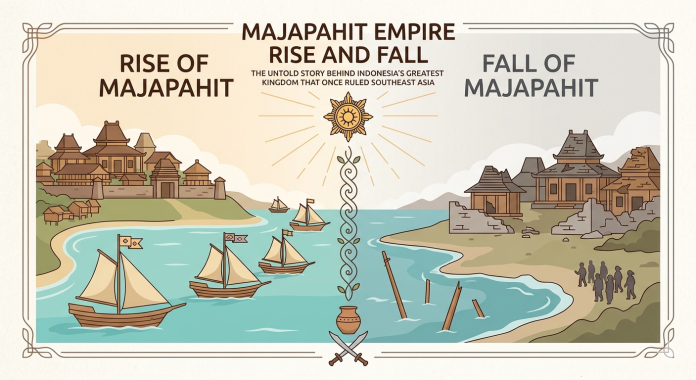

RADAR TULUNGAGUNG – Majapahit Empire remains one of the most powerful and influential kingdoms in Indonesian history. Founded in the late 13th century, the Majapahit Empire successfully unified vast regions of the archipelago, turning it into a major center of civilization in Southeast Asia. Its legacy continues to shape Indonesia’s cultural and historical identity today.
The rise of the Majapahit Empire began with a dramatic turning point following the collapse of the Singhasari Kingdom. Raden Wijaya, a nobleman with strategic brilliance, played a key role in establishing this new power. After defeating the Mongol forces sent by Kublai Khan in 1293, he officially founded the Majapahit Empire, marking the beginning of a new era in regional dominance.
From its early days, the Majapahit Empire was built not only on military strength but also on smart political strategies and diplomacy. Raden Wijaya secured alliances, stabilized internal conditions, and laid a strong foundation for the kingdom’s expansion and prosperity.
The Strategic Rise of Majapahit
Raden Wijaya’s journey was far from easy. After the fall of Singhasari due to internal conflict and Mongol invasion, he cleverly formed a temporary alliance with Mongol forces to defeat his enemies. However, once his position was secure, he turned against the Mongols and successfully expelled them from Java.
This victory marked the birth of an independent and sovereign Majapahit Empire. The name “Majapahit,” believed to be derived from the bitter maja fruit, symbolized the hardships faced during its founding.
As the first king, Raden Wijaya focused on building political stability and strengthening economic foundations. He established diplomatic ties with neighboring regions such as Bali and Sumatra, ensuring both security and trade expansion. Agriculture and trade became the backbone of the Majapahit economy, supported by strategic locations along major international trade routes.
Golden Age Under Hayam Wuruk
The Majapahit Empire reached its peak during the reign of Hayam Wuruk in the 14th century. Under his leadership, the kingdom expanded its territory across much of the Indonesian archipelago and beyond. This period is often considered the golden age of Majapahit.
A key figure during this time was Gajah Mada, the powerful prime minister known for his famous Sumpah Palapa oath. He vowed to unite the entire archipelago under Majapahit rule, refusing worldly pleasures until his mission was complete. His efforts led to the expansion of Majapahit’s influence across Sumatra, Kalimantan, Sulawesi, and Maluku.
Majapahit also became a major hub for international trade. Merchants from China, India, and other Southeast Asian regions flocked to its ports, bringing goods such as spices, textiles, and crafts. This global interaction enriched the kingdom’s culture and boosted its economic power.
Cultural and Administrative Excellence
Beyond military and economic success, the Majapahit Empire excelled in culture and governance. It developed a centralized administrative system, with the king holding ultimate authority supported by high-ranking officials.
Cultural achievements flourished, including advancements in literature, architecture, and art. Monumental temples like Candi Panataran and Singosari stand as evidence of its architectural brilliance. Literary works such as Nagarakretagama documented the glory of the kingdom and remain valuable historical sources today.
The blending of local traditions with foreign influences created a unique cultural identity that still resonates in modern Indonesian society.
Decline and Legacy
Despite its greatness, the Majapahit Empire eventually declined after the death of Hayam Wuruk in 1389. Internal conflicts, succession disputes, and rebellions weakened the kingdom. At the same time, external pressures from rising Islamic kingdoms and European expansion further destabilized the region.
By the 15th century, Majapahit had lost much of its power. Many regions broke away, and new political forces emerged, marking the end of its dominance.
However, the legacy of the Majapahit Empire did not disappear. Its cultural, political, and social influences continue to shape Indonesia. From traditional arts to governance concepts, Majapahit remains a symbol of unity and national pride.
Even today, stories of its greatness, including the legendary Sumpah Palapa, inspire generations and keep the spirit of the Majapahit Empire alive in the nation’s collective memory.