
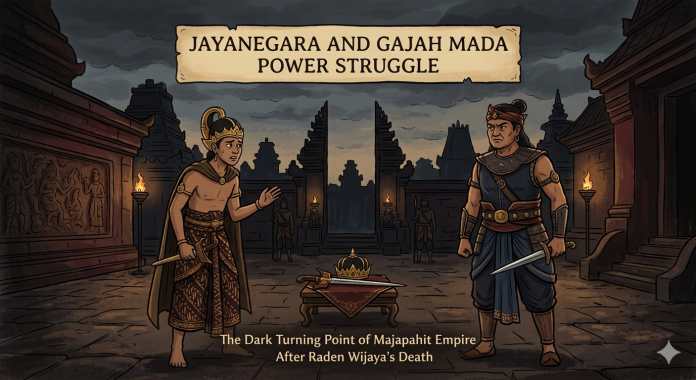

RADAR TULUNGAGUNG – The death of Raden Wijaya in 1309 marked a critical turning point for the Majapahit Empire. After ruling for 17 years, the founder left behind not only a vast kingdom but also a fragile political structure built on complex alliances. His successor, Jayanegara, inherited a throne already surrounded by tension and rebellion.
From the beginning, Jayanegara’s reign faced instability. Unlike his father, who relied heavily on diplomatic marriages to maintain alliances, Jayanegara struggled to command authority. His legitimacy was questioned due to his maternal lineage, which was not fully Javanese, triggering resentment among regional elites. These tensions quickly escalated into open rebellions across the archipelago.
A Weak King Amid Rising Rebellions
Early in his reign, Jayanegara attempted to assert dominance by emphasizing Majapahit’s spiritual and cultural ties to India. He commissioned grand temples and maintained royal ceremonies to project power. Despite these efforts, his leadership remained questionable. Historical accounts suggest that while he managed to suppress an early rebellion, his involvement in governance, diplomacy, and military affairs was minimal.
A decade into his rule, a major uprising forced him to flee from the capital with only a small group of loyal guards. At this critical moment, loyalty within his ranks began to crumble. The situation could have ended the Majapahit dynasty, if not for the intervention of a powerful figure: Gajah Mada.
Gajah Mada: The Power Behind the Throne
Known as the “Elephant General,” Gajah Mada quickly emerged as the savior of the kingdom. Demonstrating strategic brilliance, he secured Jayanegara’s safety and returned to the capital to dismantle the rebellion from within. Through calculated deception, he spread rumors of the king’s death, identified traitors, and executed them once control was regained.
With limited resources, Gajah Mada successfully restored Jayanegara to the throne. Recognizing his importance, the king elevated him to a high-ranking position in court. From that point on, Gajah Mada effectively became the driving force behind Majapahit’s governance, handling rebellions and strengthening foreign relations, including trade agreements with China.
A King Consumed by Power and Scandal
While Gajah Mada managed state affairs, Jayanegara increasingly indulged in personal pleasures. His reputation deteriorated due to controversial actions, particularly within his own family. Historical records describe how he confined his half-sisters to prevent political threats and engaged in morally questionable relationships, including pursuing women within his court circle.
These actions not only damaged his image but also fueled internal resentment. His misuse of royal authority extended beyond accepted norms, even in the context of traditional Javanese kingship. What was once considered customary began to cross into excess, alienating both elites and commoners.
The Mysterious Assassination
Jayanegara’s reign came to a sudden and violent end. During a medical procedure, he was assassinated by his own surgeon. Although Gajah Mada immediately killed the attacker, suspicion lingered. Some historical interpretations suggest that the assassination may have been orchestrated, possibly involving Gajah Mada himself, as retaliation for personal grievances.
The lack of clear records has left historians divided. Certain sources, written during Gajah Mada’s rise to power, portray Jayanegara negatively, raising questions about whether these accounts served to justify a political coup.
Transition to a New Era
With no legitimate heir, the throne passed to the daughter of the last Singhasari ruler. However, due to her religious status, her daughter, Princess Gitarja, ascended as queen. Under her rule, Gajah Mada was appointed prime minister, solidifying his position as the most influential figure in Majapahit.
Gajah Mada would later make his famous vow to unify Nusantara, setting the stage for Majapahit’s golden age. His leadership transformed the kingdom into a dominant regional power, expanding influence across Southeast Asia through diplomacy, tribute systems, and selective military campaigns.
The fall of Jayanegara thus became more than a royal tragedy, it was the beginning of a new chapter. Under Gajah Mada’s calculated leadership, Majapahit moved from internal chaos toward imperial ambition, paving the way for the legendary reign of Hayam Wuruk.